

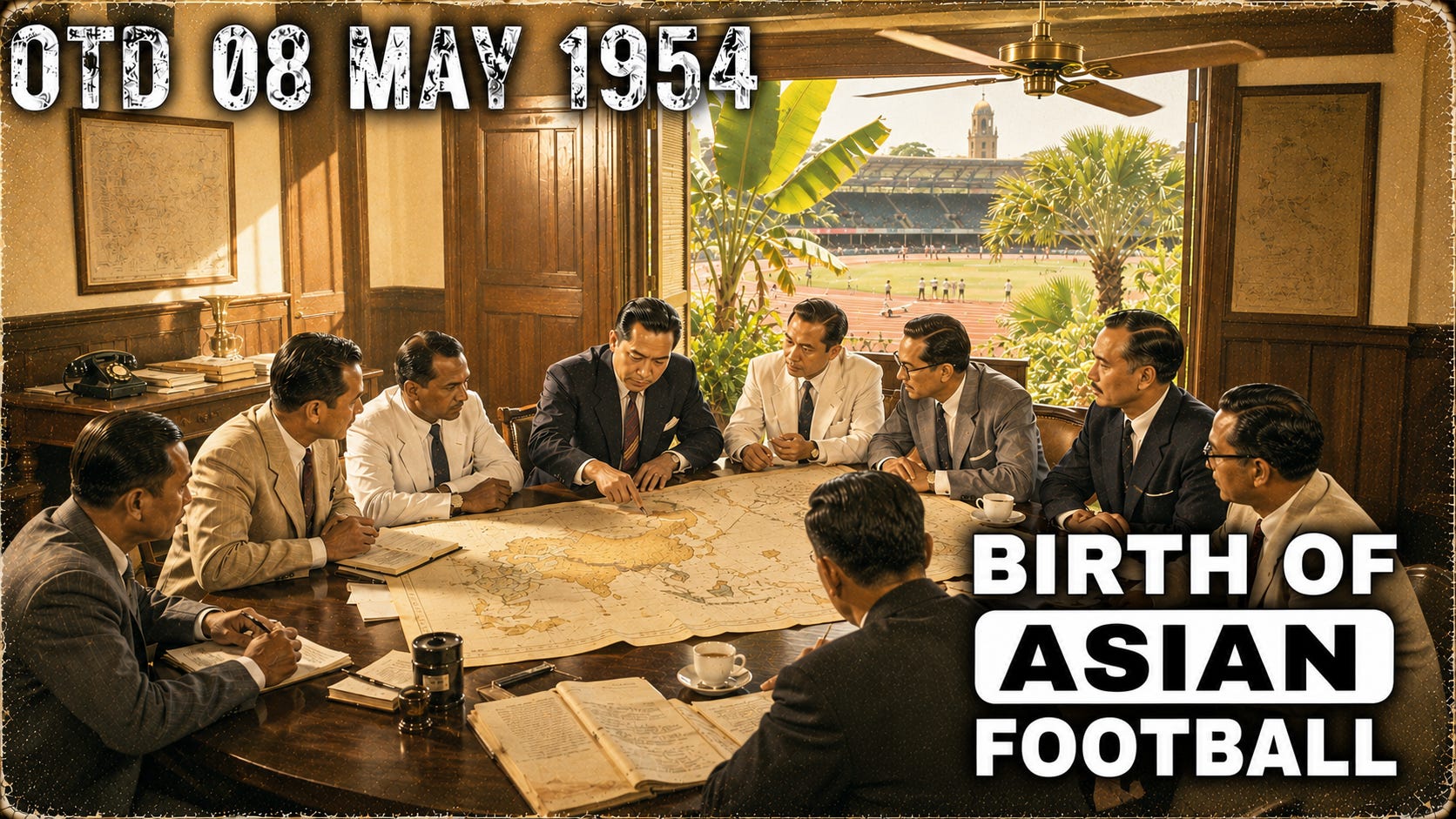
It is 8 May 1954. Manila. The second Asian Games are reaching their final days, football delegates from across the continent are gathered on the sidelines, and Asian football decides it needs a home of its own.
Not an Olympic committee. Not a colonial-era sporting circuit. Not just the football tournament inside the Asian Games. A confederation.
On this day in 1954, the Asian Football Confederation is born — thirteen founding members, a first president from Hong Kong, a first general secretary who had once been called Asia’s “King of Football,” and a mission that sounds simple only until you look at the map.
Because Asia is not one football culture. It is East Asia, South Asia, Southeast Asia, West Asia, Central Asia. It is postwar reconstruction, decolonization, Cold War politics, religious and regional fault lines, new states, old empires, Olympic ambition, and football trying to organize a continent before the continent itself has agreed what “Asia” really means.
1954 is one of those years when football governance is being rebuilt at continental level. South America had long had CONMEBOL. Europe is about to create UEFA in June 1954. Africa will create CAF a few years later. Asia moves first in this postwar wave.
The impulse had begun two years earlier, at the 1952 Helsinki Olympics. Football representatives from different Asian countries met and discussed the need for a continental body. That matters because Helsinki was the first Olympics after the war in which Japan returned to the Olympic fold. Asia is re-entering. Asia is organizing.
The first Asian Games had been staged in New Delhi in 1951. By 1954, Manila hosts the second edition. In an age before easy travel and instant communication, you build institutions when everyone is already in the same city.
So the football delegates meet. John M. Cleland, a Scottish national representing the Philippines, provides leadership. The new confederation’s first president is Sir Man Kam Lo of Hong Kong. The first general secretary is Lee Wai Tong, one of the greatest Asian football figures of the prewar era — a Chinese and Hong Kong football legend, Olympic coach, administrator, and later a FIFA vice-president.
The founding members tell the story of Asia’s complexity. Afghanistan. Burma, now Myanmar. Chinese Taipei. Hong Kong. India. Israel. Indonesia. Japan. Korea Republic. Pakistan. The Philippines. Singapore. South Vietnam.
That is not a neat bloc. It stretches from the Mediterranean edge to East Asia. It includes countries that will later become politically impossible to keep in the same football room. It includes Israel, which will eventually leave Asian football. And it doesn’t include Australia, which will spend decades looking toward Asia before joining in 2006.
But in 1954, the point is not that Asia is easy. The point is that Asia needs a football mechanism precisely because it is difficult.
The AFC moved quickly. The first AFC Asian Cup was staged in Hong Kong in 1956 — the second-oldest continental national-team championship in world football, behind only Copa America (1916). South Korea won the first two. India had started strongly, won Asian Games gold in 1951 and 1962, finished fourth at the 1956 Olympics, finished runners-up in the 1964 Asian Cup. They were not a sleeping giant. They were awake. Then they faded.
Israel won the Asian Cup in 1964, but politics made their position impossible. By 1974 they were out. Iran then dominated: 1968, 1972, 1976. Then Kuwait. Then Saudi Arabia. In the 1990s and 2000s, Japan rose dramatically, helped by professionalism and the J.League, and became the Asian Cup’s most successful nation. Qatar, in our own era, has won back-to-back.
The competitive map keeps moving. South Asia starts brightly and recedes. East Asia rises. West Asia asserts itself. Southeast Asia remains passionate but still chasing the continental summit.
And the AFC’s World Cup story became a long fight for respect. North Korea changed the imagination in 1966 by beating Italy and reaching the quarterfinals. Saudi Arabia did it in 1994 through Al-Owairan’s solo run against Belgium. Then 2002: South Korea reached the semi-finals — the best World Cup finish by an Asian team. Australia’s arrival in 2006 changed the confederation again, and in 2015 Australia won the Asian Cup on home soil.
That, too, is part of the AFC’s identity. Asia is not static. It absorbs. It argues. It redraws. It grows.
And that is why 8 May 1954 matters. Not because one meeting solved Asian football. Because one meeting gave Asian football the tool with which to keep solving itself.
---
🎧 Also available on Apple Podcasts, Amazon Music, Overcast, iHeart, and YouTube.
📩 Got an episode idea? otd@17lawsguy.com
Yesterday: 7 May 1986 — Steaua Stole It.
Tomorrow: 9 May 1951 — England and Argentina meet for the very first time. At Wembley.
Looking forward to reading this.