

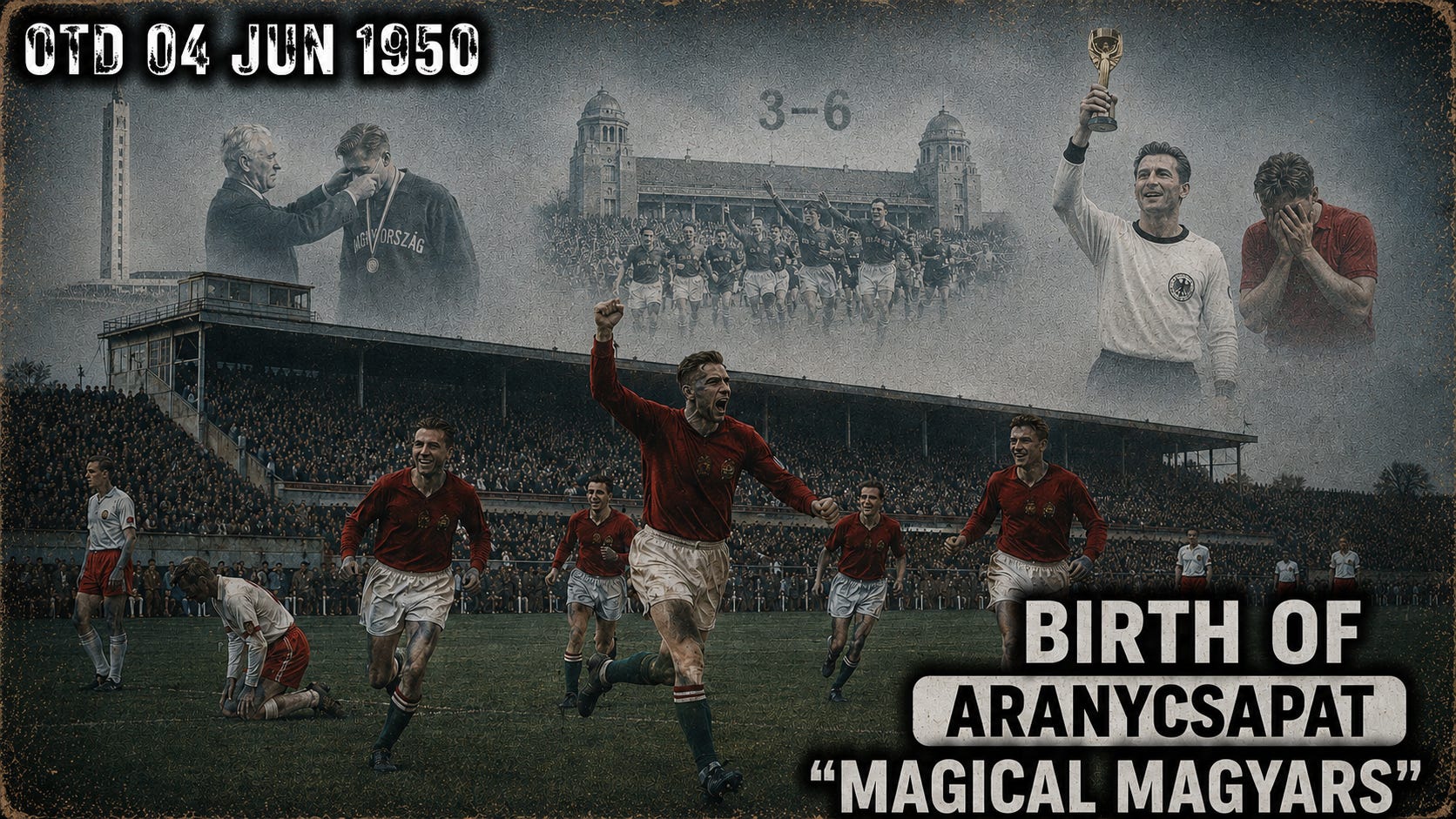
It is 4 June 1950, in Warsaw. Poland against Hungary, officially a friendly. After ninety minutes: Poland 2, Hungary 5. Gyula Szilágyi scores a hat-trick; Ferenc Puskás scores twice.
At the time, a strong away win. In hindsight, the first step in one of the greatest unbeaten runs football has ever seen. Olympic gold. The Match of the Century at Wembley. Seven against England in Budapest. Twenty-seven goals at one World Cup. And, finally, the Miracle of Bern.
This is the story of the Aranycsapat — the Golden Team. The Magical Magyars.
How did we get here? Not on a training ground, but in cafés. Before the Second World War, Central Europe — Vienna, Budapest, Prague — was a football laboratory where the game was discussed like music, like chess. In Vienna, Hugo Meisl built the Austrian Wunderteam. And an Englishman misunderstood at home, Jimmy Hogan, carried the Scottish passing gospel to MTK in Budapest: short passing, movement, the ball doing the work. From that came the Danubian school — technique and intelligence over brute force.
Then history turned dark. The Anschluss broke Austria’s football world; Matthias Sindelar died mysteriously in 1939. War, occupation, and the Soviet sphere followed — and post-war Hungary became a different kind of laboratory: centralized, ideological, state-backed. That is where Gusztáv Sebes becomes decisive. A communist sports official, he thought football politically — “socialist football,” he called it, meaning the team must move as a collective. Everyone attacks. Everyone defends. Positions are starting points, not prisons.
And he had a structural advantage. Kispest became Budapest Honvéd, the army club, which could concentrate talent — Puskás, Kocsis, Czibor, Bozsik all became club-mates. MTK supplied the other tactical centre, especially Nándor Hidegkuti and the deep-lying centre-forward idea. Hungary weren’t just picking eleven gifted players; they were building a national team out of club laboratories.
A 5-2 defeat in Czechoslovakia in 1949 became a purge point — older names out, flexible young thinkers in. A 5-0 win over Czechoslovakia in April 1950 showed the new shape. A 5-3 loss to Austria in May was the last official defeat before the run. Three weeks later came Warsaw, and the spell began — though nobody in the stadium knew it.
The run became extraordinary fast. At the 1952 Helsinki Olympics the world saw them properly: Italy beaten 3-0, Turkey 7-1, Sweden 6-0, then Yugoslavia 2-0 in the final. Olympic gold. In 1953 they won the Central European International Cup. And then, on 25 November 1953, Wembley. England had never lost at home to a side from outside the British Isles. Hidegkuti dropped deep, Puskás and Kocsis moved around him, Bozsik ran midfield, Grosics swept behind the defense — and England couldn’t solve the geometry. Hungary won 6-3, the Match of the Century. In case anyone thought it a fluke, Hungary won the Budapest rematch in May 1954 by 7-1. Thirteen-four over two games; the birthplace of football, given a tutorial.
So expectation at the 1954 World Cup was almost unbearable. They opened 9-0 over South Korea, then beat West Germany 8-3 — but that game cost them Puskás, injured by a Werner Liebrich tackle. Without him, they beat Brazil 4-2 in the violent Battle of Berne, then the defending champions Uruguay 4-2 after extra time. Twenty-seven goals — still the record for one World Cup edition.
Then the final, at Bern, against West Germany again. Hungary led 2-0 after eight minutes — Puskás, then Czibor. The coronation seemed underway. Then Morlock pulled one back, Rahn equalized, and in the 84th minute Rahn scored again. West Germany 3, Hungary 2. The Miracle of Bern. National rebirth for Germany; for Hungary, the wound that never quite closes.
And yet — this is part of the myth — they didn’t collapse. They beat Scotland 4-2 at Hampden. In May 1955 they toured the north and won by absurd margins: Norway 5-0, Sweden 7-3, Denmark 6-0, Finland 9-1 — 27 goals in four games over eleven days. But the end was coming: defeats in 1956 to Turkey, Czechoslovakia and Belgium; Sebes sacked. Then October 1956 and the Hungarian uprising. Soviet tanks returned. Honvéd were abroad for a European Cup tie, and the team fractured for good. Puskás, Kocsis and Czibor never returned — Puskás to Real Madrid, the others to Barcelona. The Aranycsapat as a Hungarian collective was over.
That’s why 4 June 1950 matters — not because Poland 2, Hungary 5 was their greatest match (it wasn’t), but because it was the moment before the world knew. Before Wembley. Before Bern. Before all the ghosts. They changed football and never won the World Cup, and the myth survives because the football was brilliant and the ending was cruel.
🎙️ THE PODCAST GOES DEEPER. The full episode has what this post compresses: the Hogan-Meisl-MTK roots in more detail; the 1949 purge and squad rebuild; the goal-by-goal of Wembley and the 1954 World Cup run; the Battle of Berne; and the 1956 rupture that scattered the team. That’s the 10-minute version.
---
🎧 Listen on Spotify, Apple Podcasts, Amazon Music, Overcast, iHeart, and YouTube.
📩 Got an episode idea? otd@17lawsguy.com
Yesterday: 3 June 1981 — The Spark That Lit Danish Dynamite.