

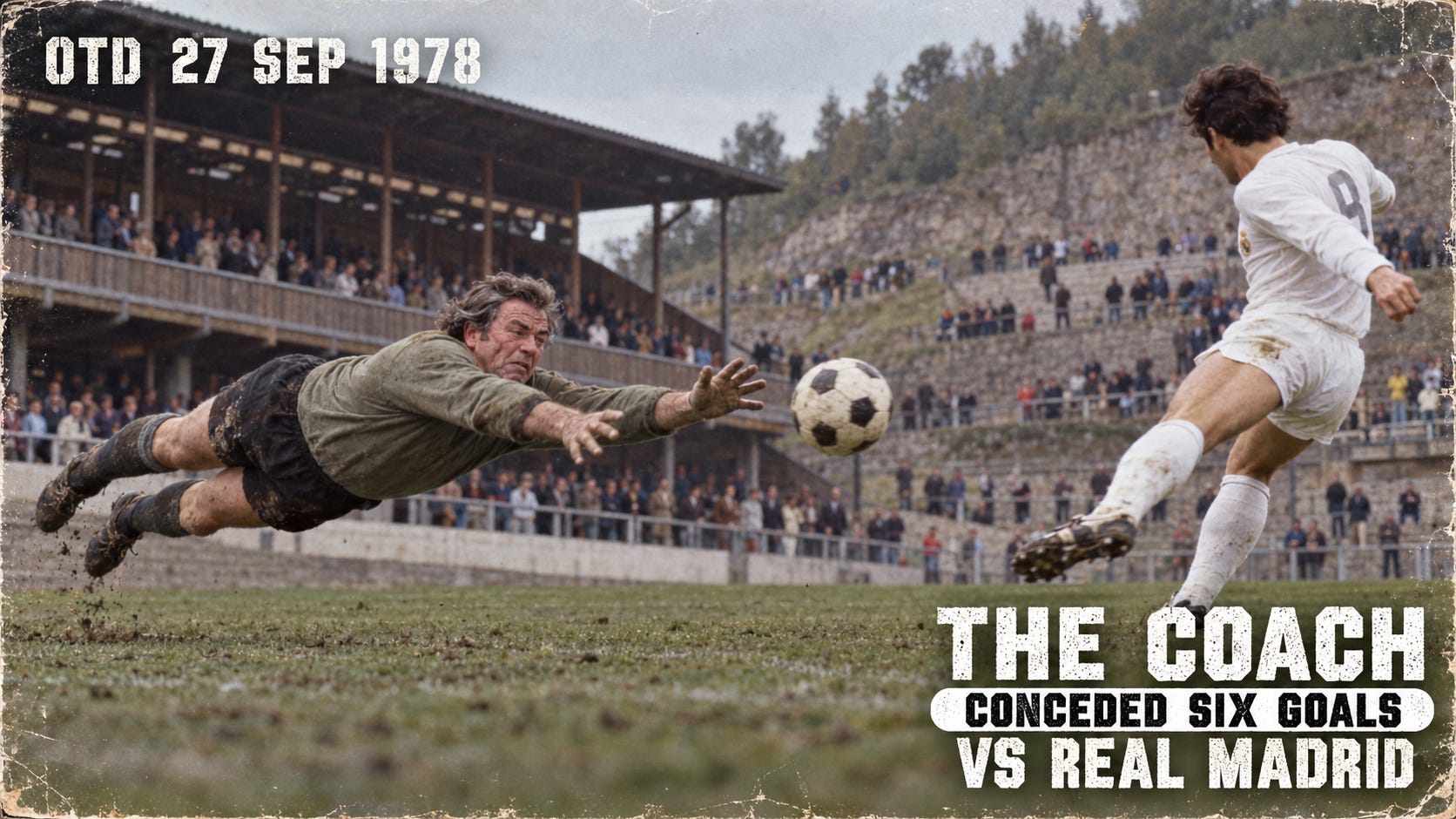
It is September 27, 1978, and Real Madrid are leading 1-0. That is hardly surprising. They are Real Madrid, visiting the champions of Luxembourg, Progrès Niederkorn, and they have already won the first leg 5-0. Then, after barely twelve minutes, the Progrès goalkeeper, Victor Schaefer, goes down injured. Progrès had named a second goalkeeper among their substitutes that night, but when the moment came he would not take the field, and walked instead toward the dressing room. No explanation for that has ever come to light. So Progrès turn to a 39-year-old former goalkeeper who also happens to be their coach. Romain Schoder takes off his tracksuit, goes into goal against Santillana, Juanito, Pirri, Vicente del Bosque and the rest of Real Madrid, and concedes six. This is the story of how a manager came to spend almost a whole European Cup match in his own net, and why he was even allowed to.
How did we get here?
To understand it you have to return to a European Cup that belonged to another football world. The competition was still reserved almost entirely for national champions. There was no league phase, no seeding system built to protect every major television market, and no safety net for famous clubs that finished second or third at home. Win your national league and you entered, whether you were Liverpool, Real Madrid or Progrès Niederkorn. That created mismatches, certainly, but it also placed the champions of small football nations directly opposite the continent’s aristocracy. The European Cup was not merely a competition between Europe’s richest clubs; it was, however unevenly, a meeting of Europe’s football cultures.
Progrès came from Niederkorn, in Luxembourg’s industrial south, close to Differdange and the borders with Belgium and France. Founded in 1919, the club won its first Luxembourg title in 1953, and then waited a long time for more. In 1976-77 they finished second in the league but won the Luxembourg Cup, and the following season they went further still, retaining the cup and winning the Division Nationale to complete the domestic double. That championship put them in the 1978-79 European Cup. Luxembourg football was organized, established and deeply rooted; its federation had been founded in 1908 and joined FIFA in 1910. But internationally the country faced an almost unavoidable problem of scale. Its population in the late 1970s was comfortably below 400,000, its domestic game was largely amateur or semi-professional, and the strongest Luxembourgers tended to cross the borders into France, Belgium or West Germany. Louis Pilot had built a real career with Standard Liège and Antwerp before becoming Luxembourg’s national coach in 1978; Nico Braun had scored heavily for Metz and played for Schalke; Paul Philipp, a future national coach and federation president, was in Belgium with Union Saint-Gilloise. Luxembourg could produce good footballers. What it could not produce was Real Madrid’s depth, full-time preparation or resources. Several of the Progrès side facing Madrid were themselves Luxembourg internationals, but that did not make the club professional in the sense that Madrid were professional.
On the other side stood a club that had defined the European Cup, the winners of its first five editions. By 1978, though, Madrid’s most recent European title was twelve years old, and their president Santiago Bernabéu, the man whose reign had become inseparable from the club’s European identity, had died that June. Real were entering a new era under Luis de Carlos, yet the team remained recognizably formidable. Luis Molowny had just guided them to the Spanish championship, and the side still contained Pirri, Santillana, Juanito, Vicente del Bosque and the goalkeeper Mariano García Remón, with foreign players in West Germany’s Uli Stielike, Denmark’s Henning Jensen and Argentina’s Quique Wolff. This was not the Di Stéfano and Puskás Madrid of the five consecutive cups, nor the Madrid that would dominate Europe in the twenty-first century. But against Progrès, it might as well have been. The first leg at the Santiago Bernabéu on September 13 finished 5-0, so the return was no longer about advancing. For Progrès it was about hosting one of the great names in European football and giving Luxembourg’s supporters a night to remember. Even “hosting” needs qualification, because the match was staged not at their own ground but at the larger Stade du Thillenberg in neighboring Differdange, where around 6,000 spectators arrived on September 27.
There is a teamsheet detail behind all of this that makes the whole story possible. Romain Schoder, the Progrès coach, was formally named among the substitutes that night. He did not earn the right to play because an emergency happened; the laws of the game did not let a manager walk out of the technical area and become a player simply because his goalkeeper was hurt. A team could name only two substitutes, chosen in advance, with no modern concussion replacement and no special emergency slot reserved for a goalkeeper. Schoder could play only because Progrès had already anticipated the possibility. A former goalkeeper himself, he was registered and listed among their available replacements, functioning at nearly 40 as a player-coach, even though nobody seriously expected him to take the field against Real Madrid. He entered not because Progrès had forgotten to bring a reserve, but because the reserve they had brought would not go on.
The match followed the shape of the tie so far. After ten minutes Pirri scored, putting Real 1-0 up on the night and 6-0 up on aggregate, and it was shortly afterward, around the twelfth minute, that Schaefer went down and could not continue. Off came the goalkeeper, on came the coach, at nearly 40, with no competitive preparation for facing Real Madrid, old enough to be the father of some of the players around him, and a forward line ahead of him that held three genuine international stars. Within minutes Jensen made it two, and Stielike added a third, so it was 3-0 in Differdange and 8-0 on aggregate at halftime. Yet Schoder did not simply collapse. He surprised the players around him with his agility, and made saves that a part-time defense in front of him had little right to expect. Six goals conceded sounds disastrous only until you ask how many Real Madrid might have scored against an unprepared coach with almost no cover behind him. Santillana struck again just after the interval, a Madrid substitute added a fifth past the hour, Santillana completed his second soon after, and Jean-Louis Margue turned the seventh into his own net in the final minute. Progrès nil, Real Madrid seven, and 12-0 on aggregate. A Spanish newspaper called it a match without a story. From Madrid it probably looked that way. From inside the Progrès goal it was anything but.
So what?
Progrès did not progress. Real Madrid did, but not for long: they beat Grasshopper Club Zürich 3-1 at home in the next round, then lost 2-0 in Switzerland and went out on away goals. The team that actually inherited Europe that year was Nottingham Forest, who in the very same first round knocked out the holders, Liverpool, before beating Malmö in the final to win the first of two consecutive European Cups. That is the useful perspective. The 12-0 did not prove that Real Madrid were once again the best team in Europe; it proved the enormous distance between the champions of Spain and the champions of Luxembourg. And for Progrès the defeat did not erase what had taken them there. They had won a league and cup double, Schoder had led them into the European Cup, and they would be league runners-up that season and champions again in 1980-81. Europe stayed punishing for them, a 10-0 aggregate loss to Vejle in one competition, a 6-0 to Grasshoppers in another, the familiar experience of a small nation’s champions drawing full professionals from far larger leagues and finding the contest unequal before kickoff. But that is not the end of the arc. Between the Real Madrid tie and the summer of 2017, Progrès played thirteen European ties without winning a single one, and scored just once in all of them, a lone equalizer against Glentoran of Northern Ireland in 1981. Then, in July 2017, they drew Rangers in Europa League qualifying, lost 1-0 at Ibrox and won the return 2-0 in Luxembourg. It was their first European win in the club’s hundred-year history, and British newspapers called it one of the worst results Rangers had ever suffered. A year later Progrès beat Gabala and Budapest Honvéd on the way to a third qualifying round. Other Luxembourg clubs moved the same line, F91 Dudelange becoming the first from the country to reach a major UEFA group stage. The gap did not disappear, but thirty-nine years after Schoder went in goal against Real Madrid, the country’s champions finally had a European night to set beside it.
The substitution itself is rarer than it sounds. Outfield players have pulled on the gloves after an injury or a red card often enough, Pelé did it for Santos, John Terry for Chelsea, Kyle Walker finished a Champions League match in goal for Manchester City in 2019, but each of those was already a player on the pitch, or an outfield substitute, being asked to do something unfamiliar. A coach coming on from the bench is a different and much rarer thing, because in the laws of the game a coach is simply not a player, whatever his history. That is why most apparent parallels turn out to be ordinary player-managers, men like Kenny Dalglish or Gianluca Vialli, who could select themselves only because they had never stopped being registered players. Schoder’s case sits apart from both: a coach who was no longer part of the regular squad, kept on the teamsheet as cover purely because his old position made him useful. The nearest true parallel came almost forty years later, in January 2016, when Wycombe Wanderers registered their 46-year-old goalkeeping coach, Barry Richardson, as emergency cover after a run of injuries. He had not played competitively in over a decade. Fifteen minutes into a match against Plymouth Argyle, Wycombe’s goalkeeper was hurt, Richardson came on, and he kept a clean sheet in a 1-0 win. Schoder conceded six and Richardson conceded none, but the underlying arrangement was identical in both cases: a member of staff, registered in advance as a contingency, turned back into a player only when the contingency arrived. Modern squads make the whole scenario far less likely now, with longer substitute lists, a specialist reserve goalkeeper as standard practice and as many as five changes available in a game. In 1978, two substitutes had to cover every possibility a match could throw up, and Progrès spent one of theirs on a former goalkeeper who happened to be coaching them. It looked like an eccentric use of a precious resource, right up until the twelfth minute.
Three things to take away
First, the old European Cup threw the champions of every football country together with almost no protection against inequality. Real Madrid against Progrès Niederkorn was a mismatch, but it was also a literal meeting of the Spanish and Luxembourg champions, which is what the competition was for.
Second, Schoder did not simply promote himself from the dugout. He was a former goalkeeper, registered and named as a substitute before kickoff, and the remarkable part is that he had to go in at all, after Schaefer’s injury and after the reserve keeper would not.
Third, seven goals do not mean Schoder was hopeless. They tell you what happens when a nearly 40-year-old coach, behind a largely part-time team, spends almost a whole European Cup match facing Real Madrid, and by every account of the night he made rather more saves than the score alone suggests.
On this day in 1978, at the Stade du Thillenberg in Differdange, Real Madrid beat Progrès Niederkorn 7-0 for a 12-0 aggregate win. A Spanish newspaper called it a match without a story. Nearly half a century later, the man inside the other goal is the story.
---
📩 Got an idea to an OTD story? otd@17lawsguy.com
Great story. Someting similar happened in the Netherlands in the season 1991/1992 in de First Division (second tier) in the game Telstar-RBC. 47-year old goalkeeping coach Paul van der Meeren of Telstar had to return in goal because four keepers were injured or ill. Arnold Nijkamp was the fourth keeper in line, but he couldn't play because of sinusitus. He did the warming up, but was too ill to play. Paul van der Meeren had not played competitively for just over ten years. He conceded four goals on the day in a 4-4 draw.