

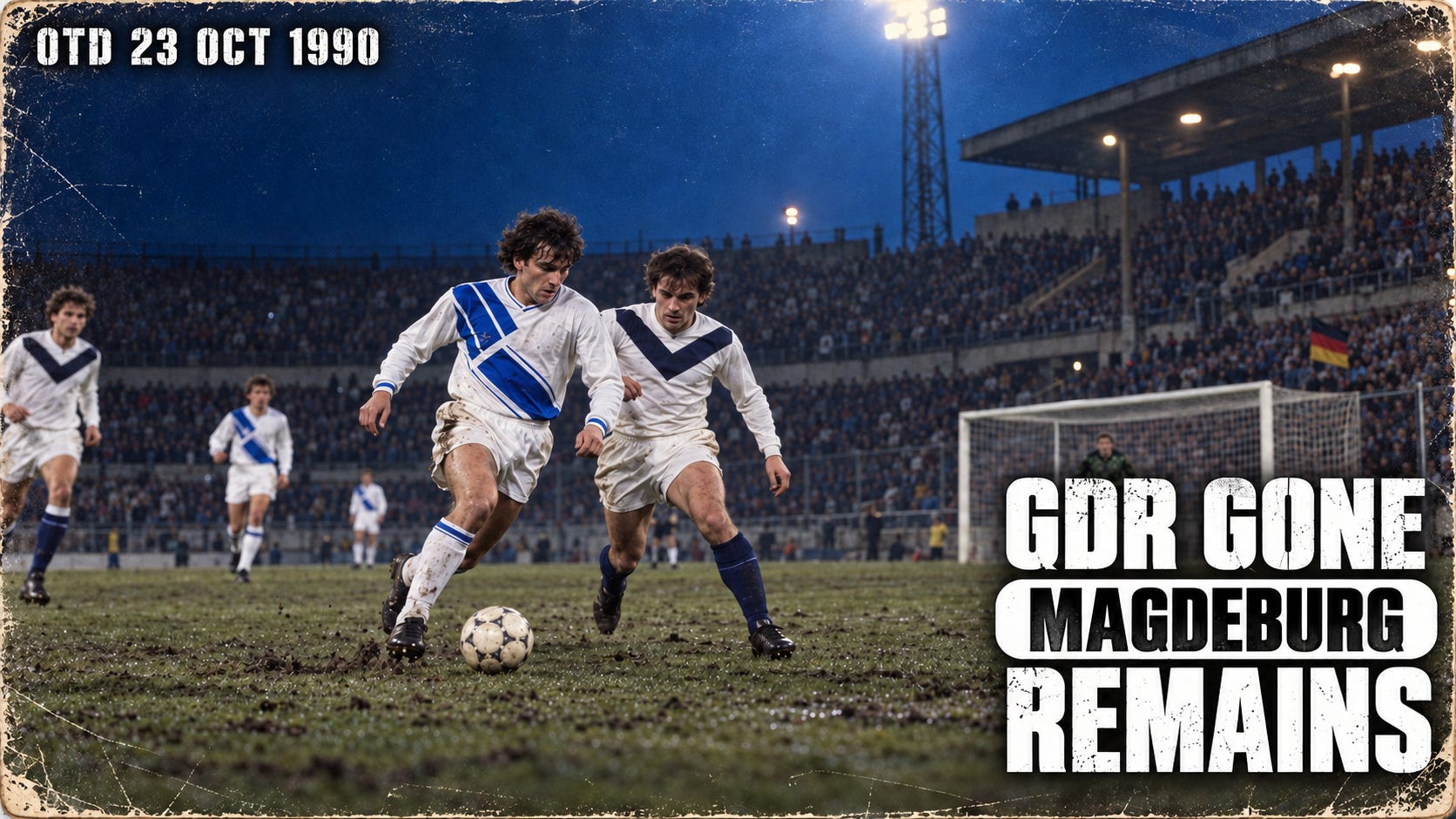
On a Tuesday night in Magdeburg, 1. FC Magdeburg walked out for a UEFA Cup match carrying an identity no map could any longer show. They had qualified as a club from the German Democratic Republic. By the time Bordeaux arrived at the Ernst-Grube-Stadion, the German Democratic Republic had ceased to exist.
The ticket preserved the oddity in ink. “UEFA-Cup 1990/91 – 2. Runde.” “1. FC Magdeburg – Girondins Bordeaux.” Beneath that, its place of issue still belonged to a city that had spent four decades on the eastern side of a divided Germany. The tie was no exhibition arranged to mark reunification. It was a competitive European match, with a French club, an Austrian referee, a meaningful aggregate scoreline and a home side that had entered the tournament through the final completed East German league season.
This was football’s version of history moving faster than the paperwork. Magdeburg’s passport had changed between rounds. Its European place did not.
How Did We Get Here?
To understand why that was so remarkable, begin with what East German football had been. The GDR did not merely have a separate league and national team because two German states happened to coexist. Football was part of the state’s self-portrait. Clubs could be attached to industry, the army, the police or, most notoriously, the Ministry for State Security. The game produced wonderful players and intense local loyalties, but it also operated in a system where power could move clubs, players and opportunity. Its elite footballers were “amateurs” on paper, usually workers, soldiers or policemen, but trained and lived as full-time athletes within a national sports system.
Magdeburg was never one of the institutions most associated with that machinery. Its name carried city and club rather than Dynamo or Vorwärts. Yet it became one of the GDR’s genuine football powers. In the 1970s it won three East German championships, collected seven East German cups and, in 1974, did something no other East German club managed: it won a European trophy. Magdeburg beat AC Milan 2-0 in Rotterdam to lift the Cup Winners’ Cup.
That achievement made the club more than a provincial success story. Its players fed the East Germany team which beat West Germany 1-0 at the 1974 World Cup, Jürgen Sparwasser scoring the goal that became an indelible GDR image. Magdeburg supplied Sparwasser, Martin Hoffmann, Jürgen Pommerenke and Wolfgang Seguin to the World Cup squad. East German football had one World Cup appearance, one victory over its western neighbor and one European club trophy. Magdeburg sat inside all three memories. That autumn, its Cup Winners’ Cup title should have brought a UEFA Super Cup against European champions Bayern Munich, but the match never happened. A few weeks later the teams did meet in the European Cup: Bayern survived 5-3 on aggregate, after Magdeburg had led 2-0 in Munich. Those were not ordinary German fixtures; every border crossing, hotel and visiting supporter was part of the Cold War choreography.
It was also a city with its own postwar symbolism. The Second World War had devastated Magdeburg. The Soviet-zone state rebuilt it within the GDR, and the Ernst-Grube-Stadion became a place where the city could watch itself represented. European nights mattered differently there. They were not simply commercial occasions; they were encounters with a world most East Germans could not freely enter.
By 1989, the state that had organized so much of this was losing control of the story. The fall of the Berlin Wall was not announced as a carefully staged state decision. At Günter Schabowski’s infamous November 9 press conference, asked when new travel rules would begin, he said, after shuffling his papers, that they took effect “immediately, without delay.” East Berliners went to the checkpoints; the guards had no clear instructions; the wall opened because the old system could no longer command the moment.
Football’s seasons, of course, had their own timetable. The 1989-90 DDR-Oberliga was played to a finish amid the Wende. Dynamo Dresden won it. FC Karl-Marx-Stadt finished second. Magdeburg finished third, only two points behind second place, and claimed a UEFA Cup berth. That qualification was uncontroversial at the moment it was earned: UEFA’s access list still recognized the East German football association, the Deutscher Fußball-Verband der DDR, as a member association with allotted European places.
The following autumn turned that administrative fact into a historical paradox. Magdeburg’s first-round opponent was Rovaniemen Palloseura of Finland. On September 19, 1990, Magdeburg drew 0-0 at home. It was still, officially, a GDR club playing a Finnish club in the UEFA Cup. On October 3, in Rovaniemi, Heiko Laeßig scored after four minutes and Magdeburg won 1-0. Between those legs came October 3 itself: German reunification. The GDR had entered the tie; Germany completed it.
The distinction mattered at every level. The DFV was still a UEFA member when the 1989-90 league table allocated its places. By the time Magdeburg returned from Finland, the association was heading toward its own absorption into the West German DFB. The club did not become “West German” in the old sense; it became German, joining a football order that was supposed to become one system but had not yet decided where all of its former eastern clubs would fit. The UEFA Cup tie was therefore a narrow bridge between two legal orders: qualification under one association, participation under its successor.
That outcome was neither a loophole nor a miracle. UEFA had admitted a club, not a political slogan. The place had been earned by the club through the previous season, the tie had already begun and the successor football structure could vouch for Magdeburg. To remove it would have punished players and supporters for a constitutional change beyond their control. Football had no appetite to make the club disappear just because the country printed on the original access list had done so.
The second round offered a much grander visitor. Bordeaux were six-time French champions and had the experienced Gérard Gili in charge. Their squad brought together Jean-Marc Ferreri, the Dutch center forward Wim Kieft, Patrick Battiston, the young Bixente Lizarazu and Didier Deschamps, and the emerging Christophe Dugarry. The European Cup was already becoming more economically unequal, yet an old East German giant had reason to believe it belonged on the same pitch. Magdeburg had played 72 European matches by 1990. It had beaten AC Milan in a final; it had knocked out Schalke in the UEFA Cup. This was not an accidental qualifier.
Still, the home match came in a city, a country and a league system being remade in real time. The ticket says Tuesday, October 23. It costs six Deutsche Mark. The sponsor logos are Jägermeister, Puma and Derby Star. That little rectangle tells the whole transition: a UEFA match staged at the old Ernst-Grube, with the hard currency of the new Germany and the commercial language that East German football was learning almost overnight.
Magdeburg wore their 1990-91 Puma white shirts with sweeping royal-blue diagonal panels and fine blue striping. Bordeaux wore their white Uhlsport away shirts, their navy chevron framing the Opel sponsor. It was a meeting of two early-1990s football worlds, but one club’s shirt and badge now outlived the state system that had developed it.
There were 13,500 in the Ernst-Grube-Stadion, enough to make the old bowl feel alive. Siegmund Mewes selected Dirk Heyne in goal; Dirk Stahmann, René Schneider, Frank Cebulla and Frank Siersleben behind; Jens Gerlach and Stefan Minkwitz in midfield; and Laeßig alongside Uwe Rösler up front. Bordeaux had Joseph-Antoine Bell in goal and Ferreri behind Kieft, with Lizarazu, Battiston and the rest of their polished French side around them.
For almost a half, the score stayed level. Then, on the stroke of halftime, Bordeaux won a penalty. Ferreri converted it. One moment, one goal, 0-1. Magdeburg sent on Peter Köhler for Schneider and Lutz Schwerinski for Jens Landrath, while Bordeaux introduced Dugarry for Jean-Philippe Durand. But the home side could not find an equalizer.
It was not a catastrophe, merely a narrow first-leg defeat. Yet the scoreline had a grim symmetry. In Bordeaux two weeks later, Ferreri scored again, this time in the 59th minute. Another 1-0. Bordeaux progressed 2-0 on aggregate. Magdeburg’s European story, which had begun in the GDR and ended in unified Germany, was over.
So What?
The obvious answer is that Magdeburg had become a historical curiosity: the club that represented a country that had vanished. But the more important answer is that the match marked the beginning of a much harder inheritance.
The DDR-Oberliga was not absorbed as an equal into the Bundesliga. The 1990-91 season continued as the NOFV-Oberliga, a final sorting mechanism for German reunification. Only the top two, Hansa Rostock and Dynamo Dresden, went directly into the Bundesliga. Six more clubs obtained places in the 2. Bundesliga. Magdeburg finished tenth, then bottom of a four-club play-off for the remaining second-tier places. In 1991-92, the European Cup Winners’ Cup holders of 1974 began again in the third tier.
That was the broad pattern. East German clubs lost the protected structures, institutional backing and player retention on which they had relied, then entered a market in which western clubs possessed deeper money, sponsorship, media reach and established professional systems. The gap was not simply sporting. Factories that had supported works teams were closing or being privatized; stadiums and youth systems required investment; leading players could move west. Hansa and Dresden reached the Bundesliga, but neither turned reunification into sustained parity. For decades, the top flight contained no club from the former GDR.
Magdeburg’s descent was particularly cruel because it came immediately after those last two European nights. The club later faced insolvency and a forced fall to the fourth tier. Yet supporters kept the institution alive, and the modern 1. FC Magdeburg’s eventual return to the 2. Bundesliga gave the story a long-delayed second act. The old European honor never became less extraordinary: Magdeburg remain the only club from the former East Germany to win a major UEFA trophy.
The national-team ending was just as abrupt. East Germany had been drawn with West Germany, Belgium, Wales and Luxembourg in qualifying for Euro 1992. The potential East Germany-West Germany fixture in Leipzig was one of football’s great might-have-beens: a competitive return to the only meeting of the two countries’ senior men’s teams, Sparwasser’s 1-0 World Cup win in Hamburg in 1974. There had been meetings between Olympic selections, but only one full A international.
For the people around Magdeburg, that gap between club and country was not abstract. The club had supplied players to the East German national side at its moments of greatest visibility, then watched the national shirt disappear while its own blue-and-white colors endured. A fixture list can look clinical on paper. In 1990, it recorded the loss of an anthem, a flag and the possibility of a second Germany-versus-Germany match that supporters had waited sixteen years to see.
Reunification removed the qualifier from the calendar. East Germany withdrew; West Germany’s entry became Germany’s; the group was reduced. A November 1990 “unification match” in Leipzig was contemplated but canceled amid security concerns. The final East Germany international had already taken place on September 12 in Brussels, a 2-0 win over Belgium that had begun life as a Euro qualifier and was reclassified as a friendly. A national team did not lose a decisive match. It simply stopped having future fixtures.
That is why Magdeburg’s Bordeaux tie has such unusual emotional force. It carried the last fragments of an international identity into a new national framework. The UEFA Cup allowed the club’s sporting qualification to survive the disappearance of its association. The national team did not receive the same grace, because a national team is its association’s public embodiment. Once the DFV was folded into the DFB, there could not be two German teams pursuing the same European Championship.
This was one part of a wider UEFA adjustment after the Warsaw Pact dissolved. German reunification was exceptional because one state was absorbed by another. Elsewhere, associations emerged or re-emerged from the Soviet Union, Yugoslavia and Czechoslovakia, while UEFA’s calendar and access list kept expanding. The old European Cup landscape—roughly one champion, one cup winner and a handful of UEFA Cup qualifiers per established state—was becoming a much larger, more crowded and commercially consequential system.
Could Magdeburg’s case happen now? The precise version is unlikely, but not because modern regulations contain a simple “Magdeburg clause.” Today’s UEFA competitions are built around licensed clubs nominated by their member associations, with entry lists, deadlines, financial and ownership tests, registration rules and detailed access lists. A club cannot simply arrive because it says it once belonged to a vanished political order. But if a recognized association ceased or merged after qualification had been earned, UEFA would still have to make a succession decision. It would balance sporting merit, the continuing legal identity of the club, the successor association’s authority and the integrity of the competition.
In other words, modern bureaucracy makes the process clearer; it cannot make political change ordinary. The lasting principle from 1990 is the humane one. Players and supporters should not lose a season’s earned European opportunity because history rearranged the borders after the final whistle.
Magdeburg did not win that night. Bordeaux were better at the decisive instant, and Ferreri twice provided the only goals of the tie. But the ticket has survived because the score is not the whole result. The match proved that a football club can carry a community’s continuity through the disappearance of the state around it.
Three Things to Take Away
1. Magdeburg qualified for the 1990-91 UEFA Cup by finishing third in the final completed DDR-Oberliga season. It started Europe as a GDR club and completed its first tie as a German one.
2. The Bordeaux match was not a ceremonial farewell. It was a real second-round UEFA Cup first leg, decided by Jean-Marc Ferreri’s penalty just before halftime and followed by another Ferreri goal in France.
3. Reunification preserved Magdeburg’s club place but ended East Germany’s national team. The contrast explains why this obscure-looking European tie is a remarkable political football story.
On This Day
On October 23, 1990, 1. FC Magdeburg played Bordeaux in the UEFA Cup, carrying into a unified Germany a European place earned in East Germany. Bordeaux won 1-0, but the match remains a rare record of a club surviving the country through which it had qualified.
• • •
Have a football memory, a correction or a story that belongs here? Write to otd@17lawsguy.com.
Yesterday: *The Day Copenhagen Tore Bayern Apart* — B 1903 6-2 Bayern Munich, 22 October 1991.