

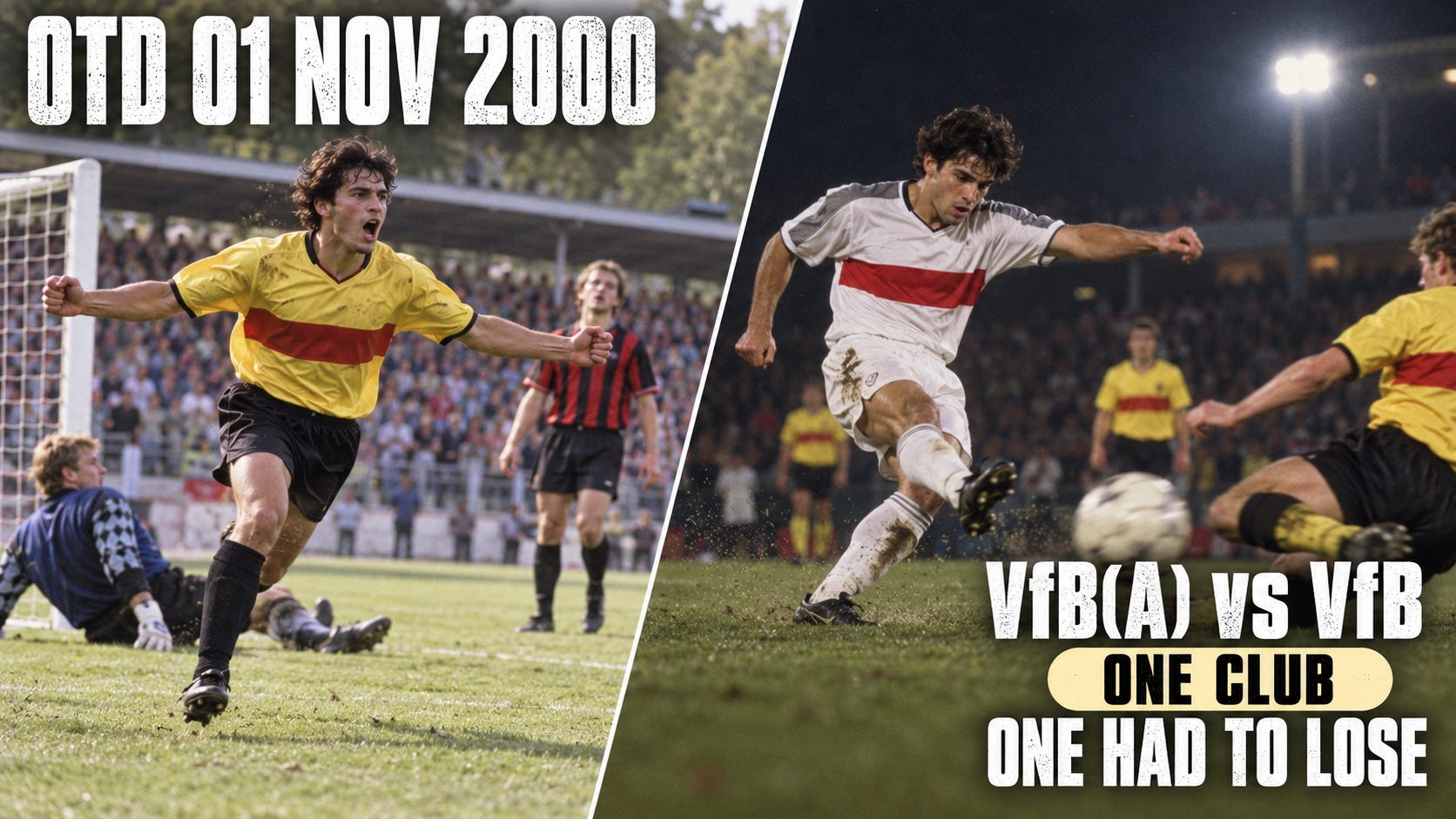
On 26 August 2000, Ioannis Amanatidis scored twice for VfB Stuttgart Amateure in a 6-1 DFB-Pokal demolition of Bundesliga Eintracht Frankfurt. His goals came in the 78th and 90th minutes, the fifth and sixth of an afternoon that made a third-tier reserve side famous. The young forward had helped write the kind of giant-killing story the cup exists to produce.
Five weeks later, on 1 November, he started for VfB Stuttgart’s professional side against those same Amateure. In the 83rd minute he scored again, this time to make it 3-0 to the Bundesliga team. The opposing shirts, changing rooms and team sheets said Stuttgart against Stuttgart. Amanatidis’s two appearances made the contradiction impossible to miss: a player who had fired the underdog past Frankfurt had been selected to finish the underdog’s cup run.
This was not a transfer, an administrative loophole discovered after the draw, or evidence that the match was arranged. Both teams belonged to VfB Stuttgart and the 2000 rules allowed both to qualify. Crucially, the cup had no rule binding a player to one of a club’s two entries. Amanatidis and Alexander Hleb could play in the 6-1 for the Amateure, then be selected for the professionals. The club was free to move its strongest young players towards the senior selection.
The score was 0-3. Christian Tiffert, Jochen Endress and Amanatidis scored for the senior side before 4,000 people. The result did what every knockout match has to do: it sent one team through and one team home. But it could not resolve the awkward question that had produced the fixture. What does sporting competition mean when a club’s first team draws its own reserve team -- and can call up the reserve team’s standouts?
That is why 1 November 2000 matters. It is a story about an excellent amateur side, a random draw, a manager who treated the game as a chance for his squad players, and a rulebook that learned its lesson in public.
How Did We Get Here?
The DFB-Pokal has always depended on a productive imbalance. It traces its institutional ancestry to the Tschammer-Pokal of the 1930s, returned after the war in 1952-53, and became the principal national knockout competition alongside the Bundesliga. Germany’s major clubs enter a tournament that also gives regional-cup winners and lower-division sides a route to the national stage. It is where a small club can earn a gate, a television moment and, occasionally, an upset that follows it for decades. Eintracht Trier’s elimination of Champions League holders Borussia Dortmund in 1997 remains one such proof. The cup works because a weaker club can meet a stronger, separate opponent.
For much of its history, though, the competition had another feature: reserve sides could qualify too. The teams then called Amateure were not simply Sunday footballers. They were development sides inside professional clubs, often populated by young prospects, older players returning from injury, and men on the edge of the first-team squad. They played in the regional pyramid, could win a state association cup and could thereby reach the national cup proper. The arrangement widened the field and supplied some wonderful anomalies, but it also meant that a club could potentially have two entries.
That potential had already become reality. Bayern Munich’s amateurs reached the DFB-Pokal in 1976-77, eliminated VfB Stuttgart, and were then drawn against Bayern’s first team in the round of 16. The senior side, featuring Franz Beckenbauer, Uli Hoeneß, Karl-Heinz Rummenigge and Gerd Müller, won 5-3 on 8 January 1977. It was competitive enough to become a Munich legend: the amateurs led early, and the press called them the moral winners. Yet it also posed the same uncomfortable question. A club had been guaranteed a place in the next round before the ball was kicked.
It happened again in 1997-98 when 1. FC Kaiserslautern’s first team beat its reserves 5-0 in the first round. These were curiosities rather than a routine. But the fact that they were possible showed the flaw. A reserve team is a competitive side when it meets an outside opponent. Against its parent club, the independence on which a cup tie rests is necessarily incomplete. Players may share a training complex, contracts can be connected, and the same leadership ultimately benefits whichever side advances.
Stuttgart’s case was particularly vivid because the amateur team had earned the national stage so emphatically. Rainer Adrion’s side qualified by winning the Württemberg Cup. In the first DFB-Pokal round on 26 August 2000, it beat Bundesliga Eintracht Frankfurt 6-1 at the Robert-Schlienz-Stadion. This was not a ceremonial junior entry. It was the most emphatic win by an amateur team over a Bundesliga club in the competition’s history. The side included talents who would become familiar names, including Alexander Hleb, Kevin Kurányi and Ioannis Amanatidis, alongside players already moving between the club’s levels.
Amanatidis made the coming contradiction almost literal. He started for the amateurs against Frankfurt and scored their fifth goal in the 78th minute and their sixth in the 90th. Five weeks later, he started for the senior selection against those same teammates and scored its third goal in the 83rd minute. No other detail so neatly captures why the fixture was not a conventional first team against a separate underdog. One young forward had moved from the cup’s giant-killing side to the side required to eliminate it.
The senior team had qualified automatically as a Bundesliga club and opened its cup campaign with a 3-1 win at Wuppertaler SV. Ralf Rangnick’s squad was in a different phase of its life: it had European commitments, a crowded early-season programme and the usual pressure of a top-flight side expected to deal with a lower-level opponent. Stuttgart were also not a settled heavyweight. The club had won the cup in 1997, but by autumn 2000 Rangnick was managing a group that was balancing Bundesliga survival, UEFA Cup fixtures and the development of young players.
Then the second-round draw paired the two entries. The DFB had no mechanism that kept teams from the same club apart. Its rules treated the Amateure as a valid qualifying team, while the player rules did not create a DFB-Pokal cup-tie between VfB’s two selections. That distinction is the key. Amanatidis was registered to the club, not permanently attached to the particular XI for which he had played in August. Rangnick could select him, and Hleb, for the senior team in November.
The consequence was not merely theoretical. The side that had beaten Frankfurt lost two stars of that upset to the side it now had to beat. Later accounts called the match a Farce precisely because the strongest Amateure had been ordered across the internal divide. In an ordinary cup tie, the giant-killer’s reward is another shot at the competition. Here, it saw its leading talent placed on the other side.
The DFB could have treated the amateur side as ineligible once the first team was in the competition, or it could have drawn a protected line around parent and reserve until the last possible stage. It did neither. The amateur side had qualified on sporting merit, and the draw had happened in public. To expel it after the draw would have been another sort of unfairness. So the game went ahead.
That decision created several practical problems. The amateur side was technically the home team, but both teams normally worked under the same club umbrella. The match was staged at the Robert-Schlienz-Stadion rather than the larger Gottlieb-Daimler-Stadion. The referee was Florian Meyer, appointed by the DFB, and the normal disciplinary and player-eligibility rules applied. But neutral administration cannot entirely solve a conflict of incentives. No club can want a player it has developed to be injured by a colleague. No board can be emotionally indifferent to which of its own budgets receives the next-round money. No opponent already eliminated by either team can be fully reassured by a fixture in which the institution as a whole cannot be eliminated.
The line-ups made the evening stranger still. Rangnick did not deploy his regular Bundesliga XI. Contemporary reporting said that, with 24 competitive matches already played, he rested every established first-choice player except goalkeeper Timo Hildebrand. He described the occasion as a platform for the club’s talent. The professional side was strengthened by Regionalliga players; the amateur side had its own second-string element. One contemporary headline captured the oddity as “Stuttgart 1b beats Stuttgart 2b.” It was still a DFB-Pokal tie, but it was not the simple David-and-Goliath contest the cup promises.
So What?
The game itself gave no credible basis for a charge of bad faith. Stuttgart’s senior selection won 3-0, leading 2-0 at half-time. Tiffert scored after eight minutes, Endress added the second in the 34th, and Amanatidis completed the score in the 83rd. The professional side had the better players and should have won; the amateur side had already supplied its romance against Frankfurt. Reporting criticized the fixture as a Farce because it existed, not because anyone could point to a fixed passage of play.
That distinction matters. Sporting integrity is not only about proving a dishonest result after the event. It is also about designing a competition so that participants and outsiders do not have to wonder where loyalties lie. Stuttgart could credibly say both teams tried to win, and the players had personal reasons to compete fiercely: fringe professionals needed to impress Rangnick, and amateurs wanted to show they belonged at the higher level. But those individual incentives were being asked to carry a structural burden that a cup regulator should not place on them.
Did the other clubs protest? The surviving contemporary coverage does not identify a formal objection or a named club lodging an appeal. That is an important limit: it would be wrong to invent a protest simply because the fixture looks intolerable in retrospect. What it does show is wider public unease. The Tagesspiegel called it a “DFB-Pokal-Farce”; later accounts repeatedly use the same word and emphasise that the Amateure’s best players crossed to the professionals. The grievance was obvious even without a formal complainant. Every remaining club could see that Stuttgart, unlike any other entrant, had begun with two possible routes into the second round and was then guaranteed one place in the round of 16.
The first team’s subsequent run showed why the concern was more than philosophical. It beat Hannover 96 2-1 in the round of 16 and SC Freiburg 2-1 after extra time in the quarter-final. Stuttgart then lost 3-0 at home to Schalke 04 in the semi-final; Schalke went on to beat Union Berlin 2-0 in the final. An outside club eventually eliminated VfB, but not until the competition had accepted a round in which the Stuttgart institution had already been assured of progressing.
The amateur side’s season was valuable in a different way. Its 6-1 destruction of Frankfurt remains its signature cup result. Its players were not merely cast members in a rulebook problem. Hleb would establish himself at Stuttgart and later play for Arsenal and Barcelona. Kurányi would become a Germany international. Amanatidis would build a Bundesliga career and play for Greece. His three goals in this cup run are the pathway in miniature: score twice for the development team, be selected for the first team, then score against the colleagues with whom he had celebrated in the previous round. The reserve team was doing what such teams were meant to do: giving young footballers serious matches and a visible route upward. The awkwardness lay in trying to combine that purpose with an open national knockout cup.
The DFB responded after the Stuttgart draw by preventing first teams and reserve sides from meeting in subsequent DFB-Pokal draws. That was a partial cure. It admitted that Bayern in 1977, Kaiserslautern in 1997 and Stuttgart in 2000 had exposed a conflict that chance alone should not decide. Then, with the formation of the 3. Liga in 2008-09, the solution became categorical: reserve teams of licensed clubs were excluded from the DFB-Pokal altogether. Today the regulations state that second teams cannot enter and that no club or corporate entity may have two teams in the competition. The Stuttgart fixture cannot happen again.
That sequence also matters because it was not retrospective punishment for Stuttgart. Its amateurs had followed the qualification rules and had every right to take the field. The revision placed the responsibility where it belonged: with the competition organiser, before the next draw, rather than with players expected to navigate a conflict they had not created.
The trade-off is real. Germany lost a route through which reserve sides had sometimes created true cup theatre. Hertha BSC Amateure reached the 1993 final before losing 1-0 to Bayer Leverkusen. Bayern’s reserves reached the quarter-finals in 1995 and 2005. A reserve side can be an authentic underdog against another club, and its exclusion narrows the field. But the alternative asks a national cup to distinguish between a club and its own team only when the draw becomes inconvenient. The DFB decided that clarity was worth more than that romance.
Other major cups generally reach the same destination by different routes. The FA Cup rules are direct: eligibility is for the first team of a club at the relevant levels, not an academy or reserve entry. In Spain, filiales may move through the league pyramid but are not allowed to become a parallel Copa del Rey entrant against their parent club. Italy’s Coppa Italia is a competition of the designated senior clubs, while B teams are a league-development device, not separate cup candidates. Portugal, the Netherlands and Belgium use their own qualification systems, but the governing principle is now widespread: one club should have one meaningful path through a national cup.
There are exceptions at local and youth level, where reserve teams may enter a county cup or a development competition and player cup-tying rules handle conflicts. But that is a different ecology. The greater the commercial reward, broadcast exposure and sporting consequence, the less plausible it becomes to say that two teams under the same control are independent knockout rivals.
There is a final irony. The DFB-Pokal lives on its capacity to generate stories such as Trier over Dortmund, or Stuttgart’s amateurs over Frankfurt. The rule change after 2000 did not reject the smaller team’s right to shock the bigger one. It protected it. A cupset only has its full force when the upset can change the competition for everyone. VfB Stuttgart Amateure had earned that right against Frankfurt. Against VfB Stuttgart, the draw turned their chance into a club matter.
The 3-0 was therefore fair in the narrow sense: a properly appointed referee oversaw a real game, and the better selected side won. Yet the fixture was unfair in the wider sense because the cup had stopped being a contest between separate sporting interests. The rule now says what the 2000 tie taught. A national cup must allow the small team to dream, but it cannot ask a club to play against itself.
Three Things to Take Away
1. VfB Stuttgart’s amateur side earned its 2000-01 DFB-Pokal place by winning the Württemberg Cup and then beating Bundesliga Eintracht Frankfurt 6-1. Ioannis Amanatidis scored twice in that upset, then scored for the professionals against the amateurs in the second-round intra-club tie.
2. In 2000, the cup rules did not keep one club’s two teams apart or cup-tie a player to one of them. Amanatidis and Alexander Hleb could therefore turn out for the Amateure against Frankfurt and for the professionals against the Amateure.
3. No formal protest by another club has surfaced in the contemporary record, but the tie was publicly derided as a farce. The DFB first barred same-club pairings after Stuttgart and, from 2008-09, barred reserve teams altogether. Modern DFB-Pokal regulations now permit only one team per club or corporate entity.
On This Day
On 1 November 2000, VfB Stuttgart’s professional side beat VfB Stuttgart Amateure 3-0 in the DFB-Pokal. The same-club cup tie exposed an avoidable conflict of interest and helped lead to the rule that now prevents it.
Have a football memory, a correction or a story that belongs here? Write to otd@17lawsguy.com.
Yesterday: Germany Lifted the Ban on Women’s Football, Then Cut Matches to 70 Minutes - 31 October 1970.