

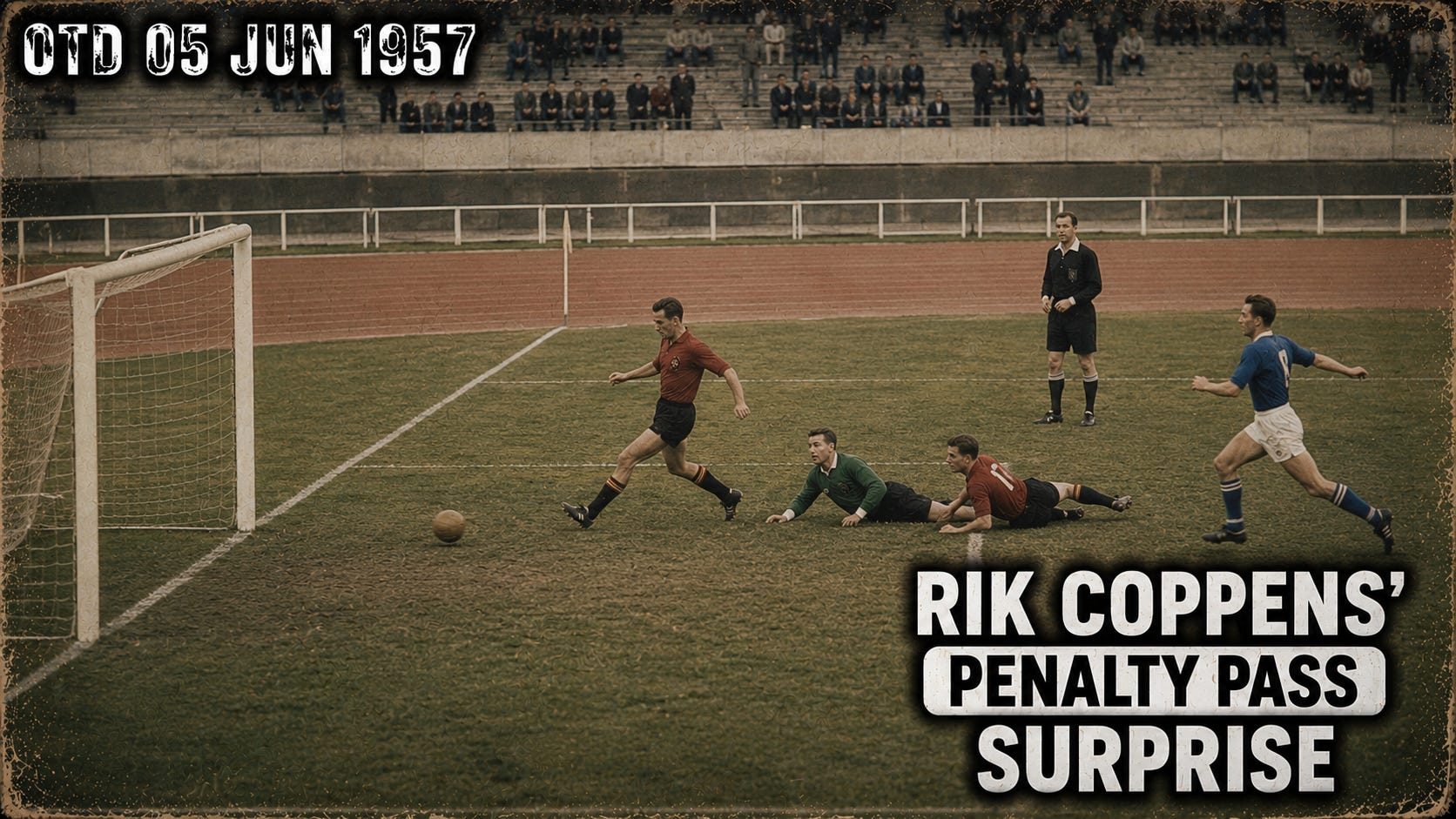
It is 5 June 1957, at Heysel Stadium in Brussels. Belgium against Iceland, a World Cup qualifier — and it’s nearly a rout before half-time, Belgium 6-1 up. Then the referee points to the penalty spot. Up steps Henri “Rik” Coppens: Beerschot idol, Belgian international, showman.
The obvious thing is to shoot and make it seven. Instead, Coppens looks at the spot and sees something else. Not a shot. A pass. And in that moment, football shows off one of its strangest legal tricks: the penalty one-two.
To understand why it works, start with the Law — Law 14, the penalty kick. It’s more flexible than instinct suggests. A goal may be scored directly from a penalty, yes, but the taker doesn’t have to shoot. The ball must be stationary, the referee signals, and the taker must kick it forward; the ball is in play once it’s kicked and clearly moves. The one hard rule: the kicker can’t play it again until it has touched another player.
That’s the door. Small, but open. If the taker nudges the ball forward, and a teammate who stayed outside the area runs in and touches it, the original kicker can then play it again — because someone else has touched it. So the penalty pass isn’t a loophole against the Laws. It’s the Laws, read carefully. The catch is timing: too early and the runner has encroached; too slow and the defenders arrive; too clever and you look ridiculous.
And here’s the crucial pre-history: Coppens wasn’t the first to see the door. Just five weeks earlier, on 1 May 1957, Northern Ireland led Portugal 2-0 at Windsor Park in another World Cup qualifier. Jimmy McIlroy and Danny Blanchflower tried exactly this — one touched it from the spot, the other ran in to finish. The ball went in. But the referee disallowed it, because the runner had entered the area too early. Not because the move was illegal — purely encroachment. The kick was retaken conventionally and McIlroy scored. Northern Ireland had attempted the idea; Coppens and André Piters would make it count.
So, back to Heysel. Belgium are already racing clear — Orlans, Piters, Van den Berg, two from Victor Mees, then Coppens for the sixth — when the penalty comes. The crowd is under seven thousand; not a glamour stage. And Coppens decides to do something half rulebook, half jazz. He nudges the ball forward and to the right. Piters runs in and reaches it. Instead of shooting, Piters returns it first time. The keeper is drawn out, the defenders frozen, and Coppens receives the return and taps into an open goal. Belgium 7, Iceland 1. The stadium only understands it after it’s happened — not a missed penalty, not a rebound, a designed one-two from the spot. The match finishes 8-3, but nobody remembers it for the eight.
The reaction is the fascinating part. The crowd loved it; foreign newspapers noticed it (a Dutch report next day described the combination with Piters). But the Belgian football authorities were not delighted — they considered the trick disrespectful and effectively snubbed Coppens for the return match. Which is almost the better story: a player reads the law correctly, scores legally, thrills the crowd, and the administrators say don’t embarrass us by being that imaginative. That’s football too.
Then the move slips into folklore until someone famous resurrects it. On 5 December 1982, Johan Cruyff, back at Ajax, rolls a penalty sideways to Jesper Olsen, takes the return, and scores. To much of the world this becomes “the Cruyff penalty” — of course it does; any idea near Cruyff joins his mythology. But even Cruyff didn’t invent it. Northern Ireland tried it; Coppens scored it; and in between, in 1964, Plymouth Argyle used it in the English Second Division (Johnny Newman to Mike Trebilcock), proving it could live in league football too. Then the modern versions: Brøndby in 2007; and in 2016, Lionel Messi rolling it for Luis Suárez against Celta Vigo — clips, arguments, admiration and irritation all at once.
Because a normal penalty is private: shooter against keeper. A penalty pass makes it communal — it turns the most individual set-piece in football into a combination move. That’s why it delights some people and offends others. It breaks the ritual.
And when it fails, it fails spectacularly. October 2005: Robert Pirès is meant to roll it for Thierry Henry, but barely touches the ball; Henry hesitates; the whole thing collapses; Manchester City clear. Arsenal still win 1-0, but nobody remembers the win — they remember Pirès stranded between genius and embarrassment. That’s the tax on audacity: shoot and miss, you’re wasteful; pass and fail, you’re a clown.
One more thing: it only works in open play. In a shootout there are no teammates to combine with — one kicker, one keeper, one kick. But in normal play the penalty pass remains legal. Rare, risky, legal.
And that’s Rik Coppens — Belgium’s first Golden Shoe winner, 21 goals in 47 caps, a Beerschot great with 250+ league goals, mostly remembered for one wink at the rulebook. One conversation with Piters. One goal that says creativity doesn’t always require a new law. Sometimes it just requires reading the old one better than everyone else.
🎙️ THE PODCAST GOES DEEPER. The full episode has what this post compresses: the exact wording of Law 14 and how it’s tightened over the years; the Blanchflower-McIlroy attempt in detail; the Belgian-federation reaction; and the full line of descendants from Plymouth and Cruyff to Brøndby, Messi-Suárez, and the Pirès-Henry fiasco. That’s the 10-minute version.
---
🎧 Listen on Spotify, Apple Podcasts, Amazon Music, Overcast, iHeart, and YouTube.
📩 Got an episode idea? otd@17lawsguy.com
Yesterday: 4 June 1950 — The Birth of the Magical Magyars.
Tomorrow: 6 June 1937 — Bologna beat Chelsea in Paris, and Italy tells Europe it has arrived.