

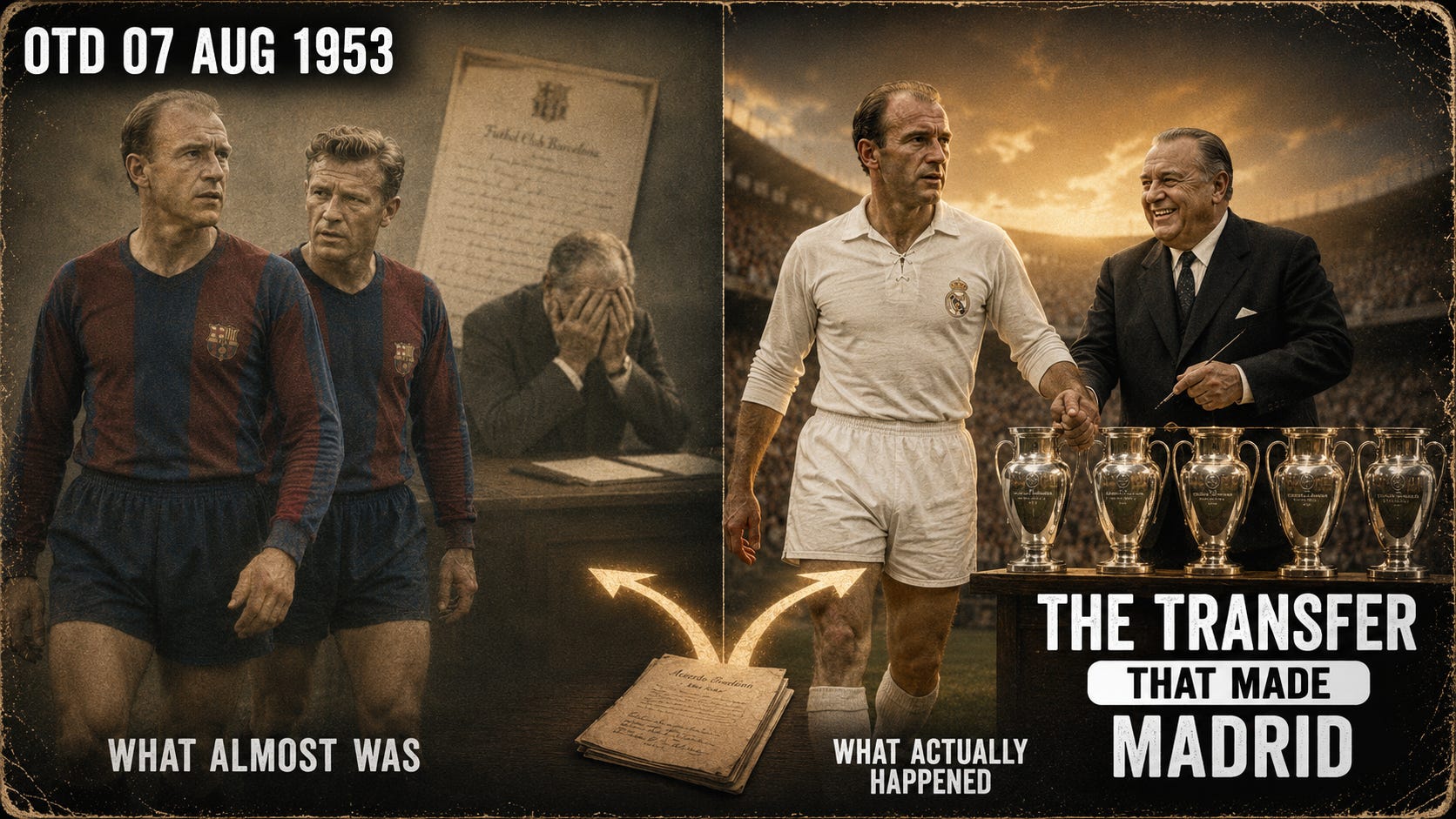
It is August 7, 1953. Buenos Aires. River Plate. And a document confirms that Alfredo Di Stéfano, the most wanted footballer in the world, has been sold to Barcelona. Not Real Madrid. Barcelona. On paper, Barça have their man. He is already in Spain, already seen around Barcelona, seemingly destined to join Kubala at Les Corts. And then the whole thing collapses into one of football history’s most tangled and consequential transfer sagas, because Di Stéfano does not become Barcelona’s future. He becomes Real Madrid’s.
Start with the player. Born in Buenos Aires in 1926, Di Stéfano came through River Plate, a football school of movement and attack, and won the 1947 Argentine league. Then football politics intervened. In 1948 Argentine players struck, and Colombia opened the door: El Dorado, a semi-outlaw golden age of clubs outside normal FIFA control, a transfer market before the paperwork could catch up. Millonarios of Bogotá became the great team of that world, and Di Stéfano its brightest star.
Then Europe saw him. On March 30, 1952, at Real Madrid’s fiftieth-anniversary tournament, Millonarios beat Real Madrid 4-2 and Di Stéfano scored twice. He showed Madrid what they were missing: a player who could be center-forward, midfielder, organizer, scorer, and general, a whole system in one man. Santiago Bernabéu now had a mission.
So by 1953 both Spanish giants knew what he was, and here came the legal mess. River Plate still claimed his official rights; Millonarios had him in practice. One player, two rights-holders, and no transfer system strong enough to make the answer obvious. Barcelona moved first, through River, and on August 7, 1953, the paper trail said River agreed to sell him to Barcelona. Barça paid the first installment. That looks like victory.
But Real Madrid were not asleep. If Barcelona had River, Madrid could go to Millonarios, and soon they had their own claim. Barcelona had the agreement with River; Madrid had the agreement with Millonarios; Di Stéfano was in Barcelona refusing to go back to Colombia. Everyone objected to everyone, and the Spanish federation had a disaster in its hands.
Here we need to be careful. The simple version says Franco stole Di Stéfano from Barcelona and gave him to Madrid. That clean anti-Franco version is powerful, but history is messier. There is no single document where Franco says give him to Madrid. There is also no reason to pretend politics was absent. This is Franco’s Spain, and only yesterday’s episode told of the regime murdering Barça’s president. Federation decisions were not happening in a neutral glass box. The honest sentence is this: politics did not need to write every line of the saga in order to be in the room.
The federation appointed a mediator, and the solution was surreal. Di Stéfano would alternate seasons between the two clubs: four seasons, one superstar shared like an inconvenient diplomatic asset. Barcelona hated it. Their president resigned. Exhausted and divided, the club gave up its claim, Real Madrid bought Barcelona’s rights, and on September 23, 1953, Di Stéfano became a Real Madrid player permanently. Four days later he debuted and scored. The trajectory of football’s future had moved.
For Barcelona, this is the great player who got away, and the pain is enormous because Barça could see the future: Kubala and Di Stéfano together at Les Corts. Instead the saga became a wound and the feeling that history bent away from them. For Real Madrid, Di Stéfano was the hinge. Before him they were a major club that had not won La Liga since the 1930s. Then he arrived, Madrid won the league in his first season, and then came the European Cup: 1956 through 1960, five in a row, Di Stéfano scoring in every final, a hat-trick at Hampden in the 7-3 win over Eintracht Frankfurt while Puskás scored four. That is the foundation myth of European club football, Madrid becoming the first global dynasty of the television age with Di Stéfano at the center, a total footballer before Total Football was a phrase. Because the facts are tangled, the argument never dies, which is why the story survives. It is not only a transfer. It is an accusation machine.
🎙️ THE PODCAST GOES DEEPER. The full episode has the Millonarios 4-2 over Madrid, the surreal alternate-seasons ruling, and Di Stéfano’s five straight European Cups. That’s the 10-minute version.
---
🎧 Listen on Spotify, Apple Podcasts, Amazon Music, Overcast, iHeart, and YouTube.
📩 Got an episode idea? otd@17lawsguy.com
Yesterday: 6 August 1936, Josep Sunyol, Barça’s martyr president.
Tomorrow: 8 August 1979, the Coupe de France trophy is stolen, or rather, borrowed.