

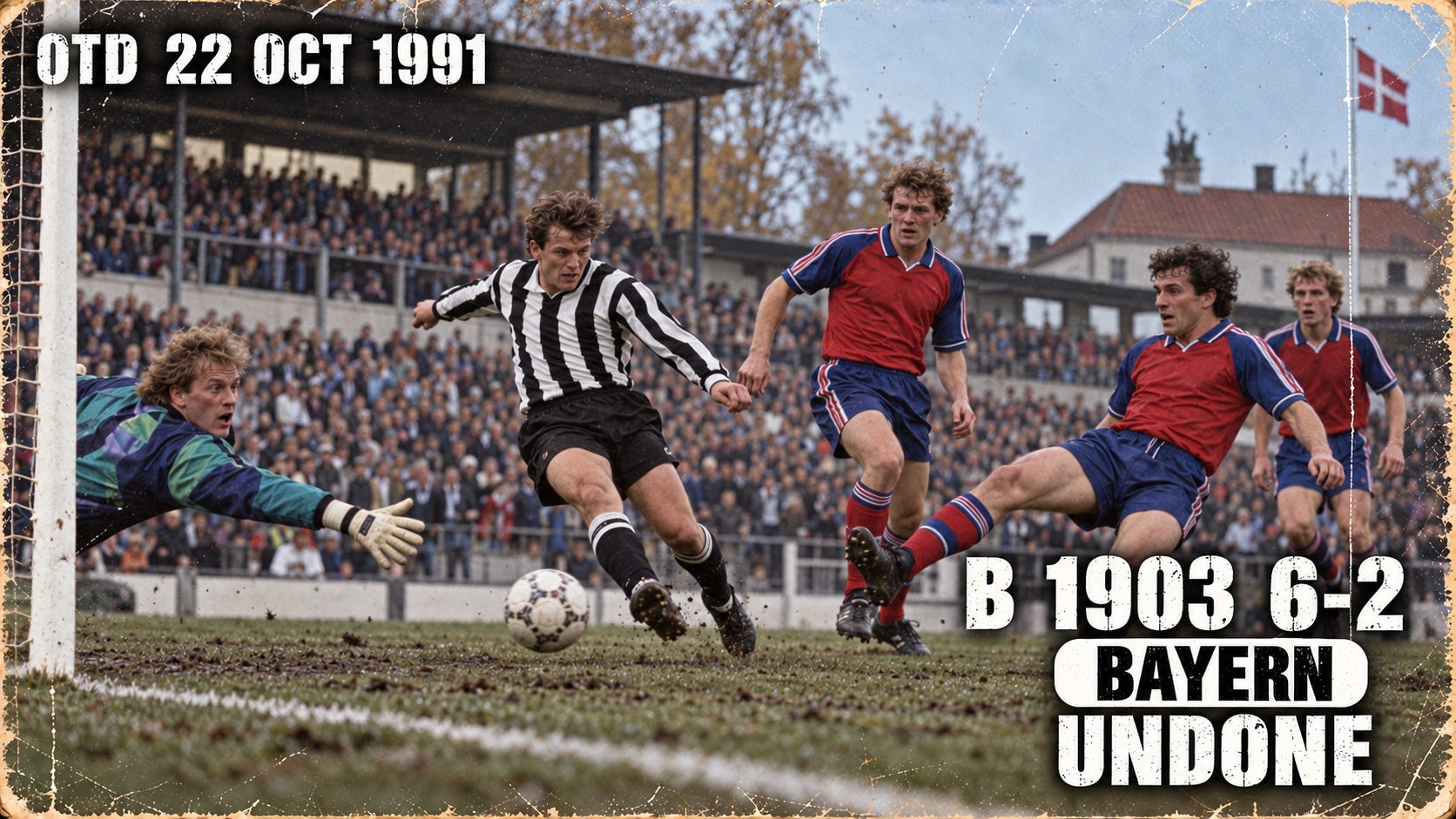
At Gentofte Stadion, north of Copenhagen, the UEFA Cup was supposed to administer a routine correction. Bayern Munich, with world champions in its side and a new Danish coach on its bench, had been drawn against Boldklubben 1903, the runners-up from a country whose domestic game had only recently entered a fully professional age. The first leg began with Bayern scoring. By the end, B 1903 had scored six.
On 22 October 1991, B 1903 beat Bayern Munich 6-2. Michael Manniche scored twice; Ivan Nielsen, Kenneth Wegner, Brian Kaus and Iørn Uldbjerg added one each. Bayern’s Mazinho had given the Germans the lead and Markus Münch pulled back a last-minute second. Neither goal could make the afternoon look normal. Bayern had never previously conceded six in European competition.
The oddest element was on the Bayern bench. Søren Lerby was Danish, a former Ajax and Bayern midfielder who had helped make Denmark’s 1980s side into “Danish Dynamite.” He had been in charge in Munich for less than two weeks. Now he had returned home to watch a Copenhagen club, playing at a packed municipal ground, produce the result that would come to define his brief managerial career.
Less than a year later, Denmark would beat Germany in the European Championship final. On 1 July 1992, B 1903 would transfer its top-flight licence into the new F.C. København. Bayern, naturally, would recover its place among Europe’s permanent powers. But for one autumn afternoon, the European order looked upside down.
How Did We Get Here?
The competition was called the UEFA Cup, a name that now sounds almost quaint. This was not yet the Europa League: there was no group stage, no Thursday-night television identity, no route by which clubs dropped in from the Champions League. It was a large, bruising knockout tournament, played home and away until the final, full of strong sides that had not won their domestic championship. Its breadth was its attraction. A well-organised Danish runner-up could draw Bayern in October; a bad ninety minutes could make a giant’s European season feel perilously short.
Europe itself was changing beneath the tournament. The Berlin Wall had fallen two years earlier. German reunification was complete, Yugoslavia was beginning to break apart, and the Soviet Union was weeks from dissolution. UEFA’s competitions were about to absorb the administrative and sporting consequences: new associations, new flags, new champions and a far more complicated access list. In September 1991, UEFA had already decided that the European Champion Clubs’ Cup would be remade as the Champions League. The 1991-92 season was a hinge, with the new group stage about to appear and the old knockout ecosystem still intact.
That matters because B 1903’s opportunity belonged to the old ecosystem. Danish football had become professional only in 1978, and the domestic calendar was itself being rebuilt. The 1990 Danish 1st Division was the last season in which the old calendar-year top flight carried that name. In 1991, Denmark introduced the Superliga and began the transition to the autumn-to-spring rhythm familiar elsewhere in Europe.
B 1903 had qualified for the UEFA Cup by finishing second in that final 1990 1st Division season. Brøndby had already secured the title with four rounds left and finished eleven points clear. B 1903’s achievement was different: consistency, a second-place finish, and a place in a European competition that could still produce a draw with Bayern Munich.
They were not newcomers. Boldklubben 1903 had been founded in Copenhagen in 1903 and had won seven Danish championships, most recently in 1976, as well as two Danish Cups. But the club was not a European superpower or even the dominant Danish name of the moment. Brøndby had become the national pace-setter and, in the preceding UEFA Cup season, had beaten Eintracht Frankfurt 5-1 and Bayer Leverkusen 3-0 - both in the old Københavns Idrætspark - before losing a semi-final to Roma by a single late goal. Denmark was no longer an exotic football outpost. Yet B 1903 against Bayern still looked like a mismatch.
The setting underlined it. Gentofte Stadion was not the Olympic Stadium or a vast continental arena. It was a compact municipal ground in the Copenhagen area, holding 14,000 for the occasion. Its ordinary scale became an advantage. Bayern arrived with far greater resources and fame; B 1903 could turn the afternoon into a close, noisy, impatient local event. That is a lost pleasure of the old UEFA Cup: a European heavyweight could be sent to a ground that had no need to impersonate a super-club.
There was no domestic evidence that B 1903 were building a new northern empire. The club had earned this tie through its 1990 league position, then entered the new Superliga era while Copenhagen football was already discussing a stronger joint future with KB. Bayern’s parallel domestic problem was more dramatic: their poor early Bundesliga form had helped remove Heynckes and put Lerby in an impossible first job. One side had a coherent occasion; the other had a crisis looking for a result to expose it.
B 1903’s coach was Benny Johansen, and the team used a 3-5-2 shape that gave the match a clear tactical spine. Kenneth Wegner operated as the sweeper, with Ivan Nielsen and Torben Piechnik around him. Nielsen was no provincial unknown: he had played in the Netherlands with Feyenoord and PSV Eindhoven and had won the European Cup with PSV in 1988. Manniche, the former Denmark and Benfica striker, led the line with Iørn Uldbjerg. Around them were players who understood that their chance was not to match Bayern’s reputation but to make Bayern defend transitions, second balls and pressure in front of a fervent crowd.
Bayern, meanwhile, were in a state of acute uncertainty. The club had reached the European Cup semi-finals in 1989, 1990 and 1991; Napoli, Milan and Crvena Zvezda, respectively, had stopped them, and the eventual champions emerged from each tie. That was evidence of Bayern’s standing, not decline. But the 1991-92 side had lost pillars from the previous era, and Jupp Heynckes had been dismissed on 8 October after a poor start. Søren Lerby, only thirty-three and recently retired, took the job the following day.
His appointment was romantic on paper. Lerby had played three seasons for Bayern, winning two Bundesliga titles. Before that, he and Frank Arnesen had left Denmark for Ajax in the 1970s because Denmark had no professional league in which to build a career. Lerby became a fierce, left-footed midfielder, an Ajax winner, a Bayern winner and one of the faces of the Denmark team that dazzled at the 1986 World Cup. He was also a man with almost no coaching experience. He did not yet possess the licence normally expected of a Bayern manager, so Hermann Gerland, the qualified assistant, had to sit beside him for competitive matches.
The irony was precise. Denmark’s great professional export, hired by Bayern to restore control, came back to Denmark just as a Danish club side was demonstrating how far the domestic game had travelled. Bayern’s starting line-up still contained Thomas Berthold, Stefan Effenberg, Olaf Thon, Christian Ziege and Mazinho. These were not names from a reserve side sent north for a distraction. They were internationals, a World Cup winner in Berthold, and players who expected Bayern to impose itself.
For half an hour, the script held. Mazinho put Bayern ahead in the thirty-second minute. A giant had arrived, scored, and seemed ready to restore scale to the occasion. Manniche equalised five minutes later. At half-time it was 1-1, still a perfectly manageable away draw for Bayern. The disaster did not reveal itself until the second half.
Ivan Nielsen converted a penalty in the fifty-seventh minute. Wegner made it 3-1 four minutes later. Manniche scored again in the sixty-fourth. The score was not merely moving away from Bayern; it was acquiring an absurdity that the visitors could not arrest. Brian Kaus made it 5-1 in the seventy-seventh minute, Uldbjerg added the sixth in the eighty-eighth, and Münch’s goal at the death only changed the typography of the humiliation.
The final score was B 1903 6-2 Bayern Munich. At Gentofte, Europe’s old tournament had found its perfect argument for existing.
So What?
The immediate shock needs no inflation. A 6-2 defeat was Bayern’s heaviest European loss to that point, and six conceded was unprecedented for them in continental competition. It was not a narrow away defeat, a red-carded accident or a single freakish result reversed before it could matter. Two weeks later, Bayern won the return leg 1-0 in Munich. The aggregate score was still 6-3. B 1903 went through.
For Lerby, the tie was devastating. The result did not alone destroy the season, but it became its most vivid symbol. Bayern remained unconvincing in the Bundesliga, and Lerby was dismissed in March 1992 after only fifteen competitive matches. He would not establish a substantial coaching career. His story became a particularly harsh football paradox: a Danish player who had proved himself at Bayern, undone as Bayern coach by a Danish club in Copenhagen.
For B 1903, it was a high-water mark rather than the beginning of a long dynasty. They beat Trabzonspor in the next round and reached the UEFA Cup quarter-finals, where Torino ended the run. The team’s route had already included Aberdeen in the first round. In one season, a club now remembered chiefly as one of F.C. København’s parents had beaten Aberdeen, Bayern and Trabzonspor and carried Danish football into spring.
The following summer gave the story its strange double ending. Denmark’s national side, called into Euro 1992 after Yugoslavia’s exclusion, beat Germany 2-0 in the final. Torben Piechnik, B 1903’s defender at Gentofte, started for Denmark. Bayern’s Thomas Berthold started for Germany and Stefan Effenberg also appeared from the bench. The club result did not predict the final, but it belongs to the same moment when Danish football had stopped asking Germany for permission to believe.
On 1 July 1992, B 1903 and Kjøbenhavns Boldklub brought their first teams together to create F.C. København. The new club used B 1903’s Superliga licence. That gives the 6-2 an unusual afterlife. It is not simply a glorious result from a vanished minor club; it is a prehistory chapter for the Copenhagen institution that would later become Denmark’s regular European representative. B 1903 did not disappear into irrelevance. It left a sporting licence, players, memory and a startling European peak inside a new civic project.
Bayern’s arc moved in the opposite direction. The 1991-92 season was one of the club’s most troubled modern campaigns, but it also reinforced the ruthlessness for which Bayern became famous. The club rebuilt. Within a few years, it was winning the UEFA Cup and German titles again; later generations would turn European domination into the expected state of affairs. That is why the score still catches the eye. Bayern have lost European matches since, including painful ones. Very few results make the reader stop and check whether the line has been reversed.
The deeper point is not that Denmark was secretly stronger than Germany. Football does not work like a national ledger. Bayern were a club in disarray; B 1903 were organised, experienced and playing in a compact home environment that transformed a European tie into an event. Germany would remain the larger football power. But in 1990 (Brøndby), 1991 (B 1903) and 1992 (the national team), Danish football produced three of its most exhilarating statements precisely by refusing to respect the size of the opposition.
The old UEFA Cup made such statements legible. It put ambitious runners-up and established giants into the same two-legged argument without insulating either side. In the modern Europa League, the name survives but the ecosystem is different: group or league phases, financial gaps, parachuting teams and relentless scheduling shape the drama. The old competition was less polished and less protected. That was its romance. A 14,000-capacity ground could host Bayern, a 3-5-2 could run wild, and a club about to merge into something new could write the biggest scoreline in the opponent’s European history.
That is the enduring appeal of B 1903 6-2 Bayern. It is a story about a changing Denmark, a changing Europe and a changing club game. It is about Søren Lerby arriving home on the wrong bench. Above all, it is about the moment that football’s ordinary hierarchy ceased to matter: six goals, one afternoon, and Bayern looking very small.
Three Things to Take Away
· This was Bayern’s European outlier. B 1903’s 6-2 win was Bayern’s heaviest continental defeat to that point, and the 1-0 return-leg win could not rescue them.
· The old UEFA Cup created improbable stages. A Danish runner-up could bring Bayern to a 14,000-capacity municipal ground and turn a two-legged tie into a genuine upset.
· The result sits in Denmark’s great 1991-92 arc. B 1903 soon became part of F.C. København; Denmark then defeated Germany in the Euro 1992 final.
On This Day
On 22 October 1991, B 1903 beat Bayern Munich 6-2 at Gentofte Stadion in the first leg of the UEFA Cup second round. Michael Manniche scored twice; Ivan Nielsen, Kenneth Wegner, Brian Kaus and Iørn Uldbjerg also scored for the Copenhagen club.
Do you remember this afternoon at Gentofte, or did you make the trip for Bayern? I would love to hear from you at otd@17lawsguy.com.
*Yesterday:** 21 October 1953 — *The Warning England Applauded.