

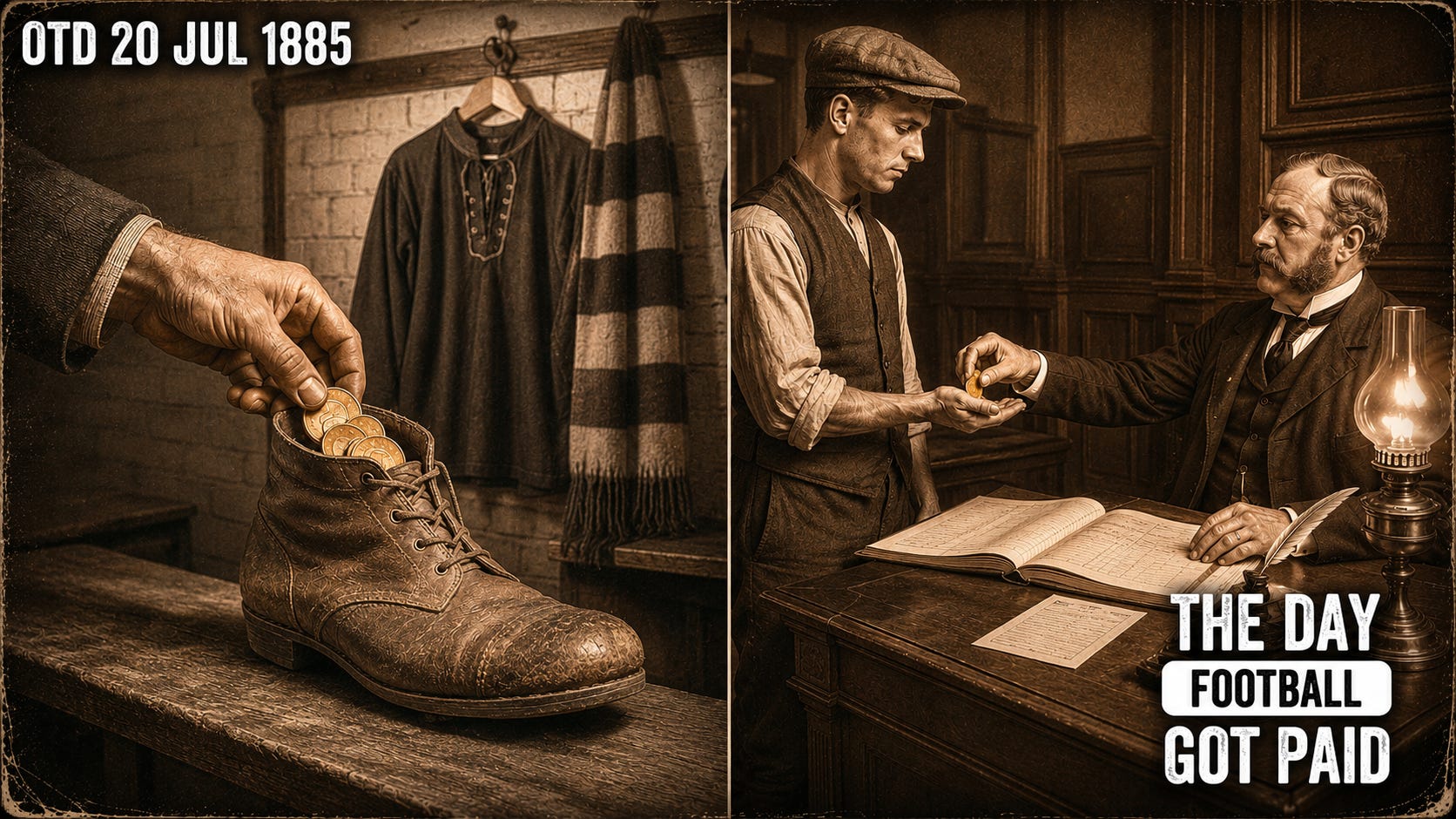
It is July 20, 1885. London. The Football Association. And after years of argument, accusation, hypocrisy, class anxiety, and northern pressure, the FA finally permits professionalism. Footballers can be paid. Openly. Legally. Within limits, of course, because this is still Victorian England. But the principle changes: the game can no longer pretend that players are only gentlemen playing for exercise and fresh air.
This is not the day professionalism begins. It had already arrived. July 20, 1885 is the day the FA stops pretending it can stop it.
The FA had been founded in 1863 in a world of clubs, schools, solicitors, and officers, men for whom football was recreation, a moral exercise played around work. Nobody in that room imagined the footballer as a wage-earner. Then the game spread. The FA Cup began in 1871. Railways made travel easier; Saturday half-days gave working men space to watch and play; the industrial towns of Lancashire and the Midlands took the game seriously. And factory owners saw two things at once: crowds will pay to watch, and crowds want the best players.
Amateurism, it turned out, looked very different depending on your class. With private income or a comfortable profession, you could play for nothing. For a factory worker, a miner, a railway man, an away match cost a day’s wages. So the question became simple: is unpaid football really moral, or just affordable for the right kind of man?
Clubs found answers outside the rules. Jobs. Housing. Meals. Travel expenses that were more than travel expenses. And most famously, boot money, small payments hidden in a player’s boots. The Scots arrived too: English clubs wanted the admired Scottish passing game, and Darwen brought south Fergus Suter and James Love, remembered as early professionals in an era when the word was still dangerous. In 1883, Blackburn Olympic won the FA Cup, a northern working-class club beating Old Etonians in the final. The old amateur elite could still talk about ideals, but the cup had gone north, and the north had crowds, ambition, and players who could not live on ideals.
Then came Preston North End and William Sudell, the secretary-manager who was clear-eyed about what football was becoming. He recruited, especially from Scotland; he found players work in Preston; he paid; he improved the team. When Upton Park, a London amateur club, complained to the FA in 1884 that Preston were professionals, Sudell barely denied it. He argued that paying players was common practice. Preston were expelled from the FA Cup, Sudell refused to apologize, and his line became famous: Preston are all professionals. Now the issue could not be hidden. Bolton, Burnley, Blackburn Rovers, Aston Villa, Sunderland, and others were paying too, and the threat became real: legalize professionalism, or watch the strongest clubs break away into a rival British Football Association.
On July 20, 1885, the FA compromised. Professionalism was legalized, but controlled: paid players had to be registered, and clubs could only pay professionals born within, or resident for two years within, six miles of the ground. Not freedom. Recognition.
The consequences arrived fast. Preston became the Invincibles, winning the first Football League title in 1888-89 without losing a match and the FA Cup without conceding a goal. And the League itself was the direct child of this day: once players were paid, clubs needed regular income, which meant regular fixtures, which meant William McGregor’s twelve founding clubs in 1888 and the shape of modern club football. The fight over the player’s labor did not end there; it ran through the maximum wage, retain-and-transfer, the players’ union, Jimmy Hill, George Eastham, Bosman, and beyond. But it starts here, with an association admitting the obvious.
Professionalism did not corrupt a pure game. The money, the crowds, and the payments were already there. Professionalism made the hypocrisy governable.
🎙️ THE PODCAST GOES DEEPER. The full episode has the boot-money economy, Sudell and Preston’s expulsion, and how professionalism made the Football League inevitable. That’s the 10-minute version.
---
🎧 Listen on Spotify, Apple Podcasts, Amazon Music, Overcast, iHeart, and YouTube.
📩 Got an episode idea? otd@17lawsguy.com
Yesterday: 19 July 1966, two world champions knocked out in one afternoon.
Tomorrow: 21 July 1991, Argentina win the Copa América without Maradona, their first since 1959.
It is obvious: Argentina got robbed in the final of 2026 as in the finals of 1990 and 2014. FIFA favoured Spain with a better calendar (one more day of rest) and also Spain had BIG help from the referee
https://ezequieldoiny.substack.com/p/it-is-obvious-argentina-got-robbed?utm_source=share&utm_medium=android&r=8t2s5