

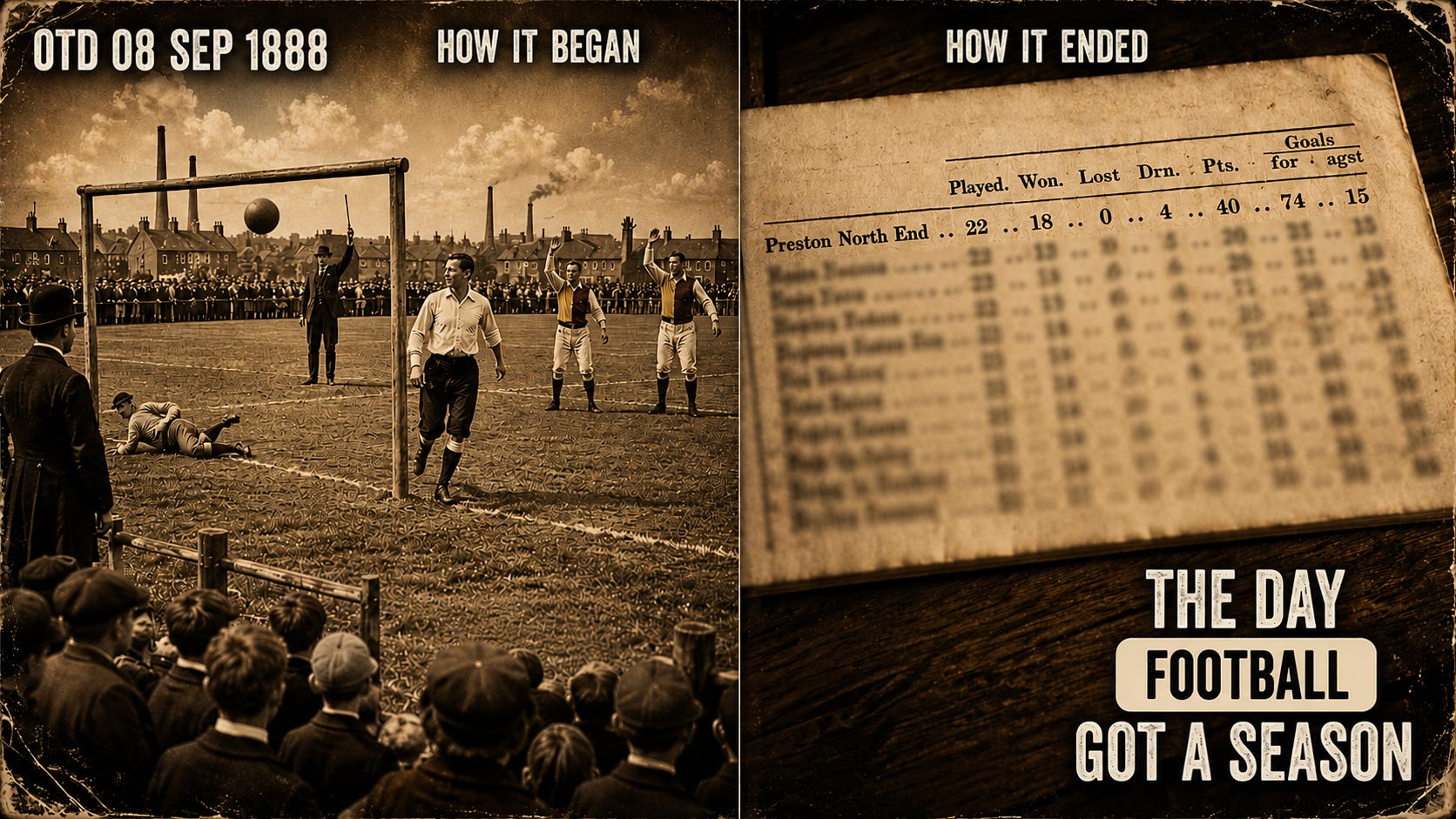
It is September 8, 1888, at Pikes Lane in Bolton, and the match is running late because Derby County have only just arrived. Bolton Wanderers finally kick off at about a quarter to four, and two minutes later Kenny Davenport shoots. A protest for offside goes up and is waved away. Goal. At 3:47 in the afternoon, Davenport has scored the first goal in Football League history, and he has no idea he has done anything of the kind. It is a small moment, and it belongs to something much larger. On this Saturday, football stops being a loose collection of matches and cups and becomes something new: a season.
How the game reached this point is a story about money. Three years earlier, the Football Association had finally legalized professionalism, after years of northern clubs quietly paying players anyway. That solved one problem and created another. Paid players meant wages, wages meant clubs needed regular income, and regular income meant regular matches. Yet football still had no league calendar. There was the FA, founded in 1863, and the FA Cup since 1871, and railways and the Saturday half-holiday had given working people the time to play and watch. But a club’s season was still mostly friendlies, local cups and the occasional fixture arranged by letter and handshake, sometimes cancelled when someone got a better offer.
The answer came from William McGregor, a Scottish draper and Aston Villa director, whose letter in early 1888 argued that ten or twelve leading clubs should combine to play each other home and away, on fixed dates, every season. Representatives met in London and then in Manchester, and settled on a plain name: the Football League. Twelve clubs signed up, six from Lancashire and six from the Midlands, with no London, no Yorkshire and no North-East. Even that tells you something. A weekly national league feels obvious now; in 1888 it was not. Geography mattered, railway fares mattered, and who got invited mattered. Sunderland were left outside, joined only in 1890, and then won the title in their second season.
The League did not even have the field to itself. A rival called the Combination, made up of clubs left outside McGregor’s circle, had already kicked off a week earlier, and its members included the club we now know as Manchester United. Stand somewhere in England that weekend and you could not have said which system would win, and the answer turned out to be organization: the League fixed its programme centrally, while the Combination left too much to individual clubs, and within months it collapsed.
The first Football League Saturday was not one synchronized kickoff but a scatter of them, staggered so workers could finish their morning shift and everything could end before dark, because there were no floodlights, no goal nets, no shirt numbers and no substitutes. Each side even supplied its own umpire, with a referee off the field as the final arbiter. Five matches produced twenty-three goals. West Bromwich Albion won 2-0 at Stoke. Wolves and Villa drew 1-1, and around the half-hour a Villa defender, Gershom Cox, put the ball into his own net for the first own goal in League history. At Bolton, Davenport scored twice and Bolton led 3-0, then somehow lost 6-3 to Derby. At Deepdale, Preston beat Burnley 5-2, the first glimpse of a side that would go through the entire League season unbeaten and win the FA Cup without conceding, the original Invincibles. And at Anfield, then Everton’s home, Everton beat a late-arriving Accrington 2-1, whose injured goalkeeper, with no substitutes, was replaced in goal by an outfield teammate.
For 125 years the history books said Cox’s own goal came first, because Wolves and Villa were thought to have kicked off at three o’clock. Then two researchers went back to the newspapers and found an advertisement giving that match a 3:30 start, which placed the own goal around four, well after Davenport’s strike at 3:47. A blue plaque near the old Pikes Lane site now records Davenport as the scorer of the first Football League goal. It also calls it the first league goal anywhere in the world, which is where I would be careful, because the Combination had already played the week before. The safe claim is the important one: Davenport scored the first goal of the competition that became the world’s great league template.
Because the real invention here was not any club. It was the season. The Combination vanished, another rival appeared and was largely absorbed, a Second Division arrived in 1892, and promotion and relegation eventually replaced a discredited system of end-of-season test matches, after two clubs once realized a goalless draw suited them both. The grammar spread everywhere, to Copenhagen and Buenos Aires and then across the world, in different calendars and different sizes, but always recognizable. Even when England’s biggest clubs broke away in 1992 to form the Premier League, they did not replace McGregor’s invention. They inherited it. Autumn to spring, home and away, played, won, drawn, lost, goals, points, a table, one champion at the end. Open any football app today and you understand it instantly. That is the legacy of September 8, 1888. Football had always had matches. Now it had a season.
---
🎧 Listen on Spotify, Apple Podcasts, Amazon Music, Overcast, iHeart, and YouTube.
📩 Got an episode idea? otd@17lawsguy.com
Yesterday: 7 September 1957, a Hong Kong selection wins the first Merdeka Tournament.
Tomorrow: 9 September 2006, the champions of Italy walk out for their first-ever Serie B match.