

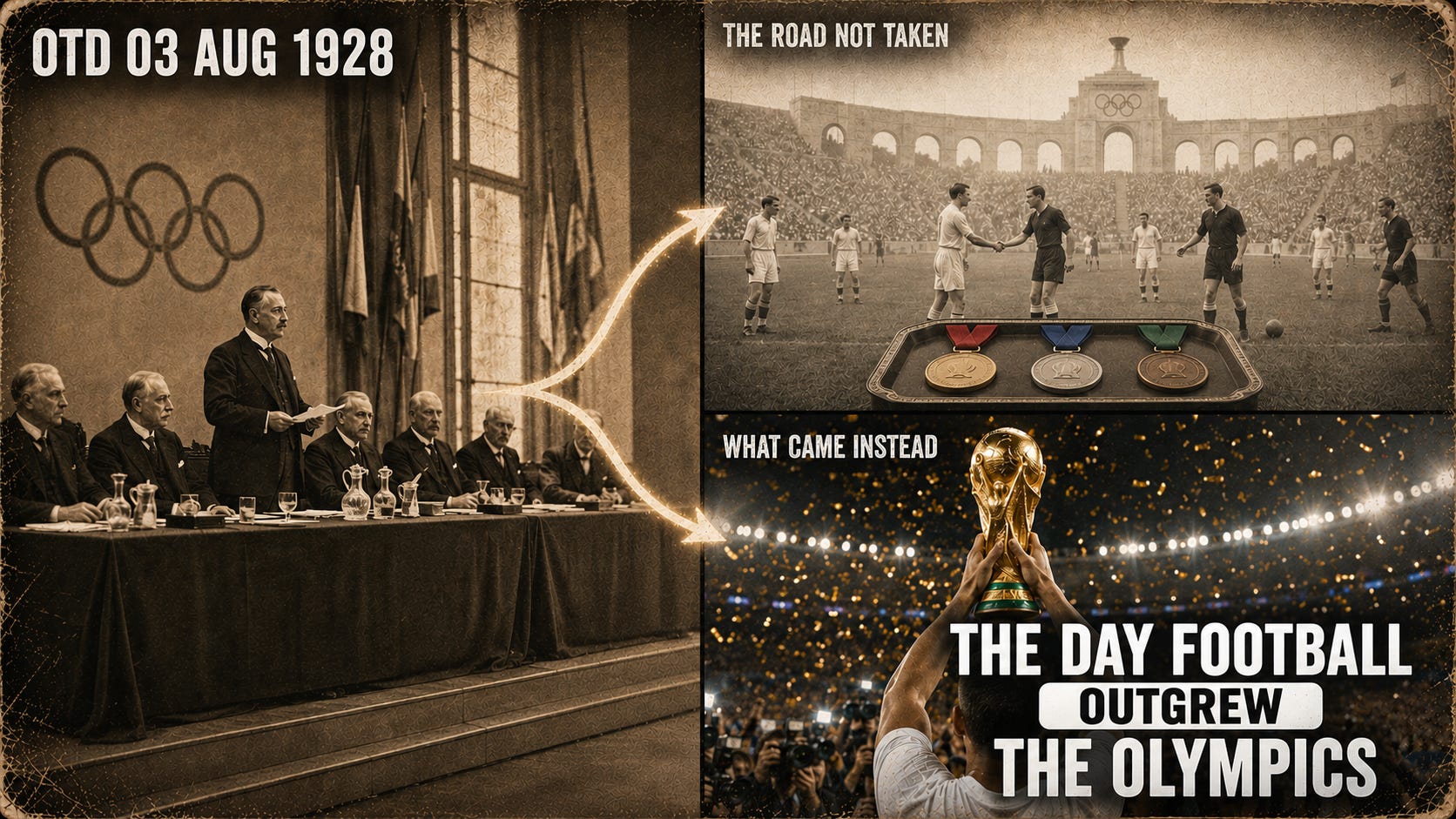
It is August 3, 1928. Amsterdam. The Olympic Games are still going on. Football has just delivered one of its greatest Olympic tournaments, Uruguay beating Argentina after a replay. And then, inside an IOC meeting, football gets its warning. Not a headline ban, not yet, but something close to an ultimatum: if FIFA will not accept the Olympic definition of amateurism, or let compliant members compete under it, football cannot stay on the Olympic program. By 1932, in Los Angeles, football is gone, and the World Cup has the open road.
Football had been at the early Games in messy form, at Paris 1900 and St. Louis 1904. London 1908 gave it a clearer shape, national teams and a serious competition, and Great Britain won there and again at Stockholm 1912. But the Olympic rule was clear: amateurs only. And football was already uncomfortable with that word, because the game was growing, clubs were selling tickets, players were being paid. In England professionalism had been legal since 1885, and Austria, Hungary, and Czechoslovakia all professionalized in the mid-1920s. The strongest football in Europe was increasingly outside the clean amateur settlement.
This was not just a sporting argument. It was a labor argument. Can a player be compensated for wages lost while representing his country? That is broken-time payment. To the IOC it looked like professionalism entering through the side door. To FIFA it looked like reality.
Then came 1924 and 1928, Uruguay in Paris and Amsterdam, and the Olympic tournament became, in effect, the world championship football did not yet have. By then the FIFA-IOC relationship was cracking. And the British Home Nations added fire: in February 1928 the four British associations withdrew from FIFA over amateurism. The people who codified the game were walking away from its world federation. Then, on May 26, 1928, FIFA voted to create its own world championship, open to all members, professionals included. So when the IOC met later that summer, the question was no longer what an amateur footballer is. It was who owns international football, the IOC or FIFA.
The key meeting was chaired by IOC president Count Henri de Baillet-Latour, who explained what had happened: in 1927 FIFA had made a proposal, the IOC had treated it as a new circumstance and allowed football at Amsterdam 1928 as an exception, but had never approved FIFA’s amateur rules or broken time. It had parked the problem long enough for the tournament to happen, because football drew crowds and helped Olympic finances. The concession was temporary. Then General Charles Sherrill of the United States pushed to settle the amateurism conflict once and for all.
That matters, because one lazy version says football was dropped in 1932 simply because soccer had not caught on in the United States. But in the record, the hard line comes from an American IOC member in Amsterdam, not from Los Angeles asking for fewer sports. On August 3, 1928, Sherrill summed up the resolution: the IOC regretted that FIFA had modified its view of amateurism so it no longer fit the Olympic rules. It named tennis too, in a related fight. This was not only a football dispute. It was an authority dispute. Unless FIFA and tennis altered their rules, or let compliant members take part, those sports could not be included. Carried unanimously.
It was a warning. But it loaded the gun, and the Berlin Congress of 1930 pulled the trigger: strict amateurism won 90 to 20, FIFA did not comply, and football disappeared from Los Angeles 1932. The reason was not American indifference. It was jurisdiction, amateurism, and the IOC discovering that football had grown too big for its rules.
So the IOC won the legal point and lost the sport. The World Cup began in 1930 and worked. By 1934 it needed qualification, thirty-two entrants for sixteen places. The Olympics never fully recovered their status in men’s football. The modern hierarchy, World Cup first and a separate under-23 Olympic tournament, starts here, not with a match or a goal, but with committee language, broken time, and FIFA refusing to let football’s future be defined by the IOC’s past.
🎙️ THE PODCAST GOES DEEPER. The full episode has the broken-time dispute, Baillet-Latour and Sherrill, and the Berlin 1930 vote that confirmed the split. That’s the 10-minute version.
---
🎧 Listen on Spotify, Apple Podcasts, Amazon Music, Overcast, iHeart, and YouTube.
📩 Got an episode idea? otd@17lawsguy.com
Yesterday: 2 August 1952, the Magical Magyars win Olympic gold.
Tomorrow: 4 August 1905, Billy Meredith, one of football’s first superstars, suspended over an attempted bribe.