

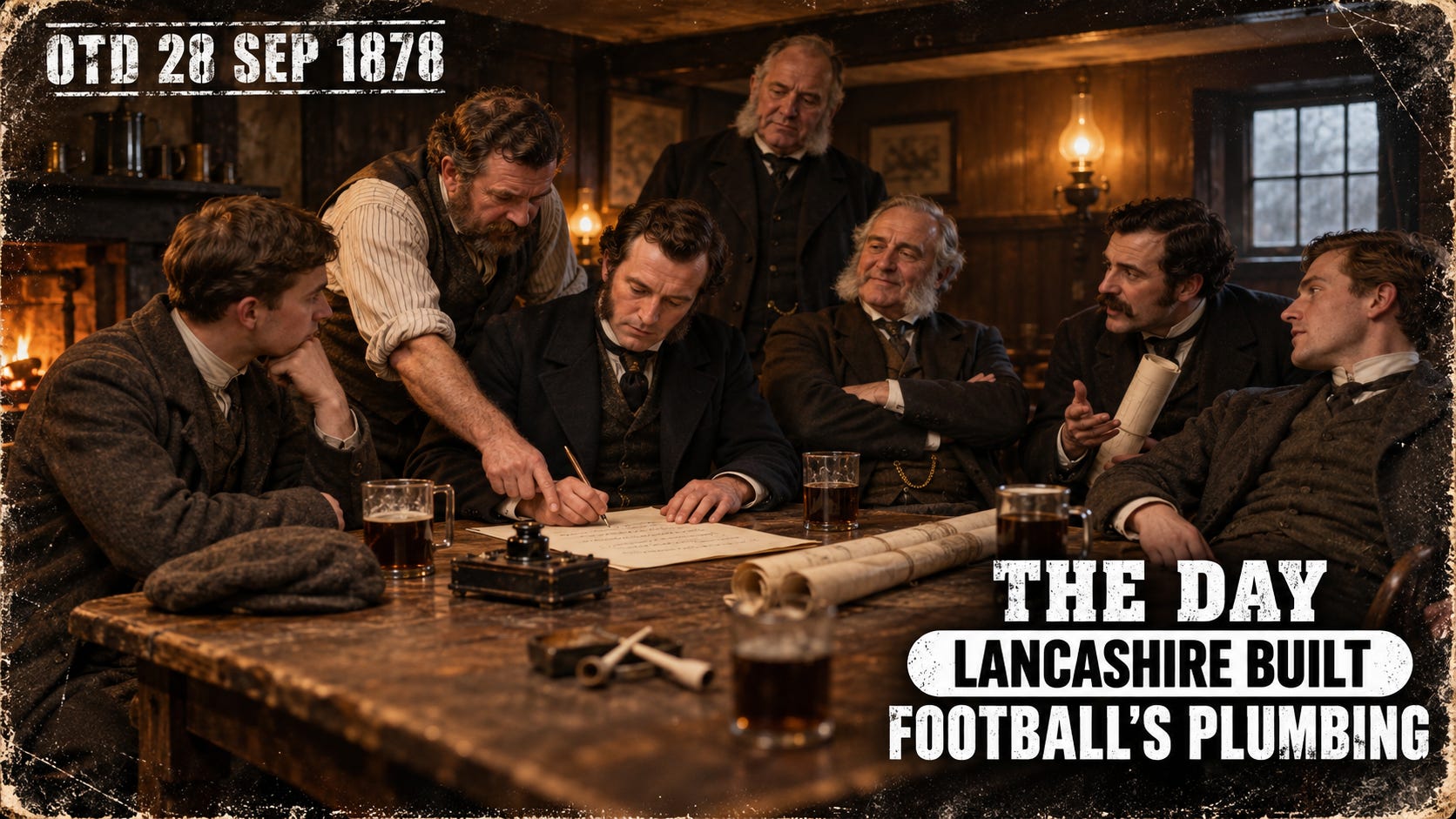
Today is not about a match. There is no goal, no trophy, no famous player. On Saturday, September 28, 1878, representatives of Lancashire’s rapidly multiplying football clubs gathered at the Volunteer Inn in Bromley Cross, north of Bolton, and founded the Lancashire Football Association. It does not sound as dramatic as an FA Cup final or the launch of the Football League. But football could not become a national and eventually global sport through matches alone. It required rules, competitions, referees, registration, discipline, administration, and somebody to decide which club belonged where. In other words, football needed plumbing, and on this day, Lancashire began installing some of the most important pipes.
How did we get here?
By 1878 the Football Association was fifteen years old. Its creation in London in 1863 had given the sport a common set of laws, separated it from rugby football, and established a national authority, and in 1871 the FA had launched its Challenge Cup. But “national” could be misleading. The early FA was dominated by London, the Home Counties, and public-school old boys, and its reach outside southern England was limited: no national league, no professional game, and no dense administrative network connecting local clubs back to headquarters. Association football was spreading faster than the organization built to govern it. Sheffield had already developed its own football culture and its own association, dating from 1867, and other regional bodies gradually followed. Then the game caught fire in Lancashire, one of the engines of industrial Britain, a landscape of cotton towns, engineering works, mines, mills and railway lines. Blackburn, Darwen, Bolton, Accrington, Preston and Burnley, along with dozens of surrounding communities, were close enough to play one another and distinct enough that every match became an expression of local pride. Industrialization supplied concentrated populations, railways made away fixtures possible, and the spread of the Saturday half-holiday created a block of leisure time in which working men could play, and increasingly watch. Cricket clubs opened football sections to stay active through the winter, and churches, schools, workplaces and temperance organizations formed teams of their own. Football was becoming something the early FA had not fully anticipated: a mass working-class spectator sport.
One important starting point was Turton, between Bolton and Blackburn, whose football club traced its origins to 1871 and had gradually spread organized football toward Darwen and Blackburn. In 1876, Turton’s W.T. Dixon discussed a county competition with John Lewis of Blackburn Rovers and Thomas Hindle of Darwen. The idea was premature, but the need behind it did not go away. Clubs needed fixtures against opponents playing under the same laws, agreement on player eligibility, recognized referees, and a process for resolving disputes. They also needed a competition that did not require repeated trips to London. The FA Cup existed, but entering it was expensive and logistically difficult for a northern club, a problem the 1878-79 competition would illustrate almost comically. Darwen reached the quarterfinal that season and faced the Old Etonians at the Kennington Oval, recovering from 5-1 down to draw 5-5, then traveling south again for a replay that finished 2-2, then traveling south a third time before finally losing 6-2. For an Old Etonian, another afternoon at the Oval was a mild inconvenience. For a Lancashire mill worker, it meant lost wages on top of the fare.
That cup run was still in the future when the meeting took place on September 28, 1878. Local histories tell the story slightly differently, some splitting it into an early conversation at the Volunteer Inn and a larger representative gathering afterward, but they agree on the date and the three principal organizers: Dixon of Turton, Hindle of Darwen and Lewis of Blackburn Rovers. Around 28 clubs are credited with forming the new body, most drawn from the concentrated area around Turton, Bolton, Darwen and Blackburn rather than from the whole of a very large historic county. This was a response to a local football boom, and its original name said as much: the Lancashire Association of Football Clubs. It adopted the Football Association’s own laws rather than inventing a rival code, and joined the national game while building the local machinery that let those laws actually function on a Saturday afternoon. A county association could affiliate clubs, organize competitions, recognize officials, hear disputes, and create a chain of authority running from an ordinary local match all the way up to the national FA. Rules written in London meant little if two clubs in Lancashire could not agree on a referee, a player’s eligibility, or where a replay should be held. The Lancashire FA translated national law into local football.
Its single most transformative creation was the Lancashire Senior Cup. The first edition was played in 1879-80, and the contrast with the national competition tells the whole story in one statistic: only four Lancashire clubs, Darwen, Blackburn Rovers, Eagley and Turton, entered that season’s FA Cup, while forty entered the new Lancashire competition. Four clubs could realistically take on the expense and travel of a national cup; forty could enter a properly organized county tournament close to home. The Lancashire Cup created a meaningful competitive calendar before any national league existed, producing local rivalries, gate receipts, newspaper attention, and a reason for clubs to organize themselves more seriously. Darwen and Blackburn Rovers met in the first final, played at Darwen’s Barley Bank ground on March 20, 1880, where around 9,000 spectators watched Darwen win 3-0. Nine thousand people for a county final is not a casual pastime played out in front of friends and family. Football had found a public.
So what?
The Lancashire FA did not single-handedly invent professional football, the FA Cup’s northern takeover, or the Football League. But it built the environment in which all three became possible. A cup competition rewarded stronger teams, stronger teams attracted spectators, spectators produced gate money, and gate money gave clubs a reason to recruit better players, improve their grounds and advertise their fixtures. Recruiting better players raised the most explosive question in Victorian football: could they be paid? Darwen had already brought two Scottish players, Fergus Suter and James Love, south to Lancashire in 1878. Suter was said to have taken up work as a stonemason, though he appears to have done very little actual stonework once he arrived, and whether he and Love deserve the title of English football’s first professionals is genuinely contested, since direct proof of payment from that era is thin and players had received inducements in various forms before them. What matters is not the label but the shift underneath it: football ability now had economic value. Lancashire’s industrial clubs wanted players good enough to train, travel and compete with the best, and working men could not simply keep leaving their jobs unpaid to provide it. The FA’s amateur ideal, in which gentlemen supposedly played purely for enjoyment, was never as neutral as it sounded. It favored the men who could afford to live by it.
The conflict came to a head in 1883, when Blackburn Olympic beat the Old Etonians in the FA Cup final. Olympic’s side was built from weavers and ironworkers, and they had prepared with a training trip to Blackpool, an extraordinary commitment for the time, before winning 2-1 after extra time. For the first time a northern club had won the FA Cup, and a working-class team had beaten the old public-school order on its own ground. Blackburn Rovers then won the trophy in 1884, 1885 and 1886, and the FA Cup effectively moved north and stayed there. Suspicion of hidden payments grew alongside the winning, and when Preston North End, built by William Sudell around a formidable squad of Scottish players, were expelled from the 1884 FA Cup over professionalism, Lancashire’s clubs moved toward open rebellion, meeting in Blackburn to discuss forming a rival association that would openly accept professional players. The national FA faced a stark choice: defend an amateur principle and risk losing the country’s strongest clubs, or regulate the reality that had already taken hold. In 1885 it legalized professionalism under defined conditions. Lancashire did not win that argument through speeches alone. Its clubs won it by building better teams and drawing bigger crowds, and they could organize that pressure collectively because the Lancashire FA had already given them a shared administrative home.
Then came the Football League itself. In 1888, Aston Villa director William McGregor proposed a regular league programme, and of its twelve founding clubs, six came from historic Lancashire: Accrington, Blackburn Rovers, Bolton Wanderers, Burnley, Everton and Preston North End, against six drawn from the whole of the Midlands. That league quickly took on a structure still recognizable today, home and away fixtures, a table, points and a champion, and Preston won the first championship without losing a match, then won the FA Cup without conceding a goal, becoming football’s first league and cup double winners. That achievement did not appear from nowhere. It grew directly out of the ecosystem Lancashire had spent a decade building: a county cup supplying regular meaningful matches, local administration connecting clubs, crowds generating revenue, and revenue supporting better players and grounds. The Football League simply converted that accumulated energy into an annual national championship. It also explains why the map of English football looks the way it does. Historic Lancashire extended well beyond the modern county to include Liverpool and Manchester, so its nineteenth-century football footprint runs from Everton, Liverpool, Manchester United and Manchester City through Blackburn Rovers, Bolton Wanderers, Burnley, Blackpool, Preston North End and Accrington Stanley. Greater Manchester and Merseyside were only created in 1974, but Lancashire FA still operates largely along that old football geography rather than the modern boundary, its reach still extending to Manchester, Liverpool and Barrow-in-Furness. The map preserves an administrative fossil: it shows where the game was organized, not where a later government drew a line.
County associations still matter for the same reason today. The Premier League can make English football look entirely global. But beneath that elite layer, the game still needs the functions identified in 1878: affiliating clubs and leagues, training referees, administering discipline and registration, developing coaches, and supporting youth, women’s and disability football. Lancashire FA today is based at the County Ground in Leyland and governs around one hundred leagues, four thousand teams and fifteen hundred referees across its historic patch, a scale that would have astonished the twenty-eight clubs who sent representatives to a pub in Bromley Cross. Its cup competitions now sit far below the Premier League or the FA Cup in prestige, and major clubs often use them for reserve or academy sides, which can make the Lancashire Senior Cup look like a historical leftover. But its reduced status should not obscure its original purpose. Before league football existed, it provided the accessible competition from which stronger club organizations could grow, and the grassroots game today needs shared infrastructure like it more, not less, since a village club has none of the legal departments or academies an elite club now takes for granted. County associations are not free from criticism, and referee shortages and disciplinary disputes remain real problems. But those problems argue for administration, not against it. Nobody notices plumbing until it fails.
Three things to take away
First, Lancashire FA was created because football’s growth had outrun its organization. Clubs needed common rules, recognized authority and affordable local competition, and nobody in London was going to build that for them.
Second, the first Lancashire Cup shows the scale of what changed. Only four Lancashire clubs entered the 1879-80 FA Cup; forty entered the new county cup. Local administration turned scattered clubs into a functioning football culture almost overnight.
Third, that organization helped fuel football’s working-class revolution. The rise of Darwen, Blackburn Olympic and Preston North End, the legalization of professionalism in 1885, and a Football League with six of its twelve founders from historic Lancashire all grew out of the structure built in that room above a pub.
On this day in 1878, the Lancashire Football Association was formed. Its founders did not score a decisive goal or invent a famous tactic. They arranged fixtures, standardized rules, organized clubs and created a competition. Football history is not made only by the people who play. It is also made by the people who build the structures that let everybody else play, and on this day, Lancashire installed the plumbing.
---
📩 Got an idea to an OTD story? otd@17lawsguy.com
Yesterday: 27 September 1978, Progrès Niederkorn's coach went in goal against Real Madrid and conceded six.
The four-versus-forty comparison is the whole argument in miniature. A national competition meant little until ordinary clubs had a local one they could actually enter. Modern sport often starts at the other end: sell the top tier, name its franchises, then ask where the roots went. Lancashire suggests that belonging was not a marketing campaign. It was a fixture list, a referee and a cup within reach of the train fare.