

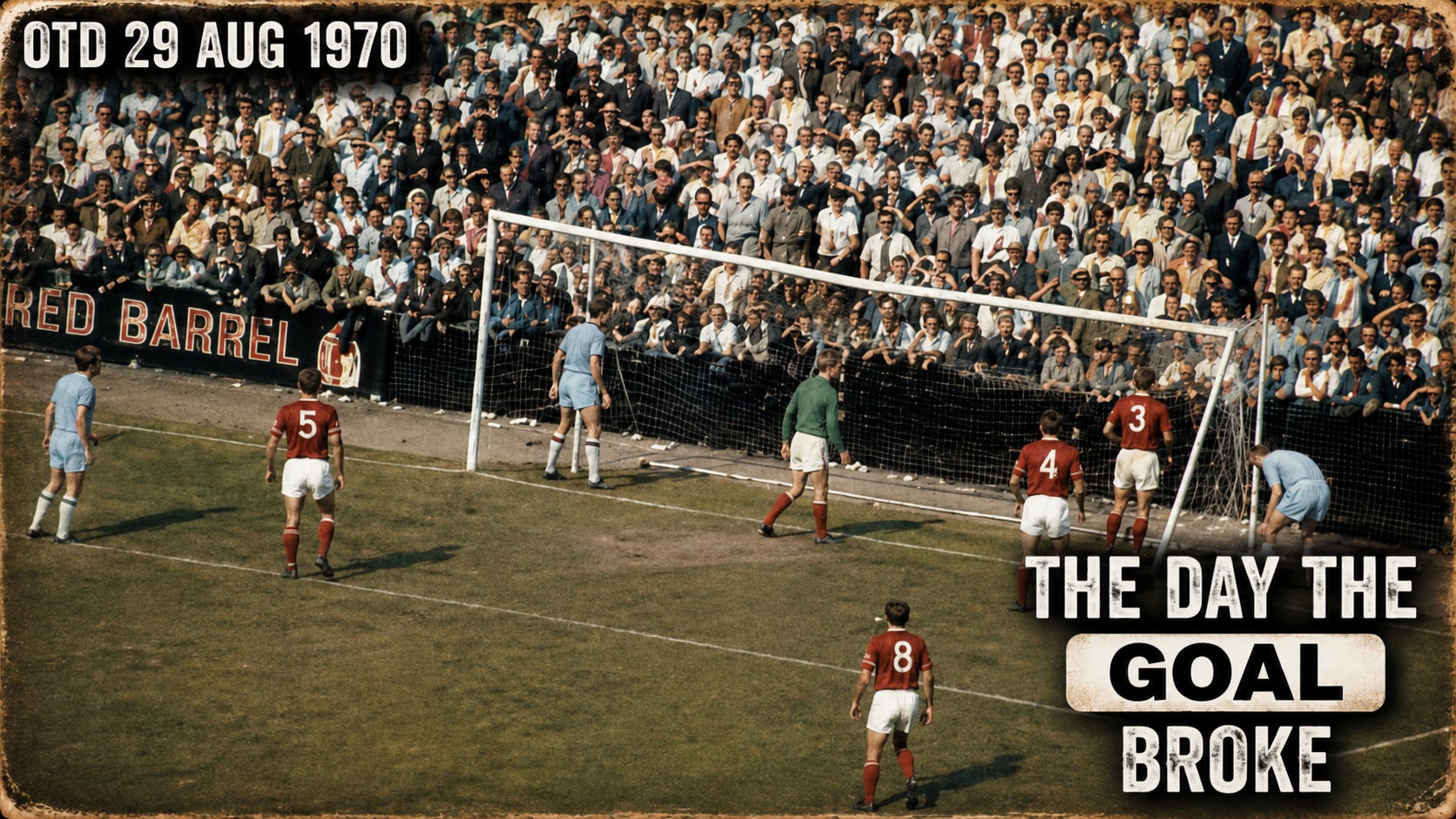
It is August 29, 1970, at the County Ground, and Swindon Town are beating Sunderland 2-0 in the Second Division. Tony Gough has marked his Swindon debut with a goal, his first Football League appearance in more than eleven years. Then, in the second half, Sunderland’s Bobby Kerr does something stranger than score. He breaks the goal. One of Swindon’s crossbars comes down, the groundsmen hurry on, and everyone is left with a wonderfully basic problem. Football needs two goals. What do you do when one of them is no longer a goal?
The answer runs through more than a century of quiet rule-making, because the goal we take for granted was invented in slow motion. Before the Football Association wrote its Laws in 1863, there was no single definition of one. The Cambridge Rules of 1848 already imagined flag-posts with a string between them, and a goal meant putting the ball under that string. The FA in 1863 did something odd by comparison: two upright posts, eight yards apart, no tape and no bar, and a goal counted if the ball passed between them at any height at all. Three years later, sanity arrived. The 1866 Laws stretched a tape across the posts eight feet up, and for the first time the goal had the dimensions we still use, eight yards wide and eight feet high. It was still two sticks and a ribbon. In 1875 a solid bar was allowed instead of tape, and in December 1882 the leading associations agreed to make the crossbar compulsory, so that by 1883 the target was a rigid rectangle.
Once the rectangle mattered, so did measuring it. In an 1888 FA Cup tie, Crewe Alexandra lost and then protested that a goal was the wrong height. The protest worked, and the FA soon insisted that such complaints be made before kickoff rather than after you had lost. Then came the question of proof: how do you know the ball went through? A Liverpool civil engineer named John Alexander Brodie had the answer. His goal net was trialled in 1891 and quickly became compulsory, so that by the 1892 FA Cup final the phrase back of the net finally had a net behind it.
But woodwork was wood, and wood breaks. The enormous Sheffield United goalkeeper William Foulke proved it in 1897 by pulling down on a crossbar and snapping it. By the late 1920s the FA was already telling clubs to paint the woodwork white, peg the nets properly, and warn players that deliberately hauling on the bar could bring a caution and, if repeated, dismissal.
By 1970 the Laws were precise. The goal was eight yards by eight feet, the posts and bar no more than five inches thick, made of wood, metal or another approved material, and permitted in almost any shape: square, rectangular, round, half-round or elliptical. The Laws even knew what to do when a crossbar broke in a competitive match. Stop play. Repair it or replace it safely. If you cannot, abandon the match. And no, you could not simply tie a rope across and carry on. That is exactly why Swindon could continue. The groundsmen restored the goal, the referee restarted the game, and the Robins finished off their 2-0 win. No emergency rewrite was needed, because football already had a rule.
Seven months later, the same rule produced the opposite ending. On April 3, 1971, Herbert Laumen of Borussia Mönchengladbach collided with the Werder Bremen goalkeeper Günter Bernard, fell backwards into the net, and snapped a wooden post. Players and officials spent about twelve minutes trying to rebuild the goal, and failed. The match was abandoned at 1-1, and because the home club could not provide a usable replacement, Bremen were awarded a 2-0 win. Gladbach still took the title that year, but the lesson stuck, and German clubs moved from wooden frames to aluminium.
Then there is the folklore. At the 1976 European Cup final at Hampden Park, Saint-Étienne hit the woodwork twice, Dominique Bathenay against the bar and Jacques Santini against a post, both of them square, both rebounding out, and Bayern Munich won 1-0. For generations, Saint-Étienne fans have sworn that round posts would have sent at least one shot in, and the poteaux carrés, the square posts, became part of the club’s identity. They eventually bought the actual Hampden posts for their museum. You will sometimes read that FIFA banned square posts in 1987, but the lawbook does not support it. Square, rectangular, round and elliptical posts were all still legal then, and they are legal now.
Color took longer to settle. At the 1978 World Cup in Argentina, many goals carried colored bands, black at several grounds and red in Mendoza, and the Laws of the 1970s did not actually require white posts at all. Only by 1990 was white made explicit, as it remains. Modern Law 1 is otherwise remarkably familiar: eight yards and 7.32 metres wide, eight feet and 2.44 metres high, no more than five inches thick, white, made of approved non-dangerous material, and firmly secured, because the modern worry is not only a bar breaking but a whole portable goal tipping over. If the crossbar breaks, you stop, and you fix it or you abandon. The basic logic the Swindon groundsmen faced in 1970 has not changed at all.
---
🎧 Listen on Spotify, Apple Podcasts, Amazon Music, Overcast, iHeart, and YouTube.
📩 Got an episode idea? otd@17lawsguy.com
Yesterday: 28 August 1981, football’s great wandering coach dies in Vienna.
Fascinating article.