

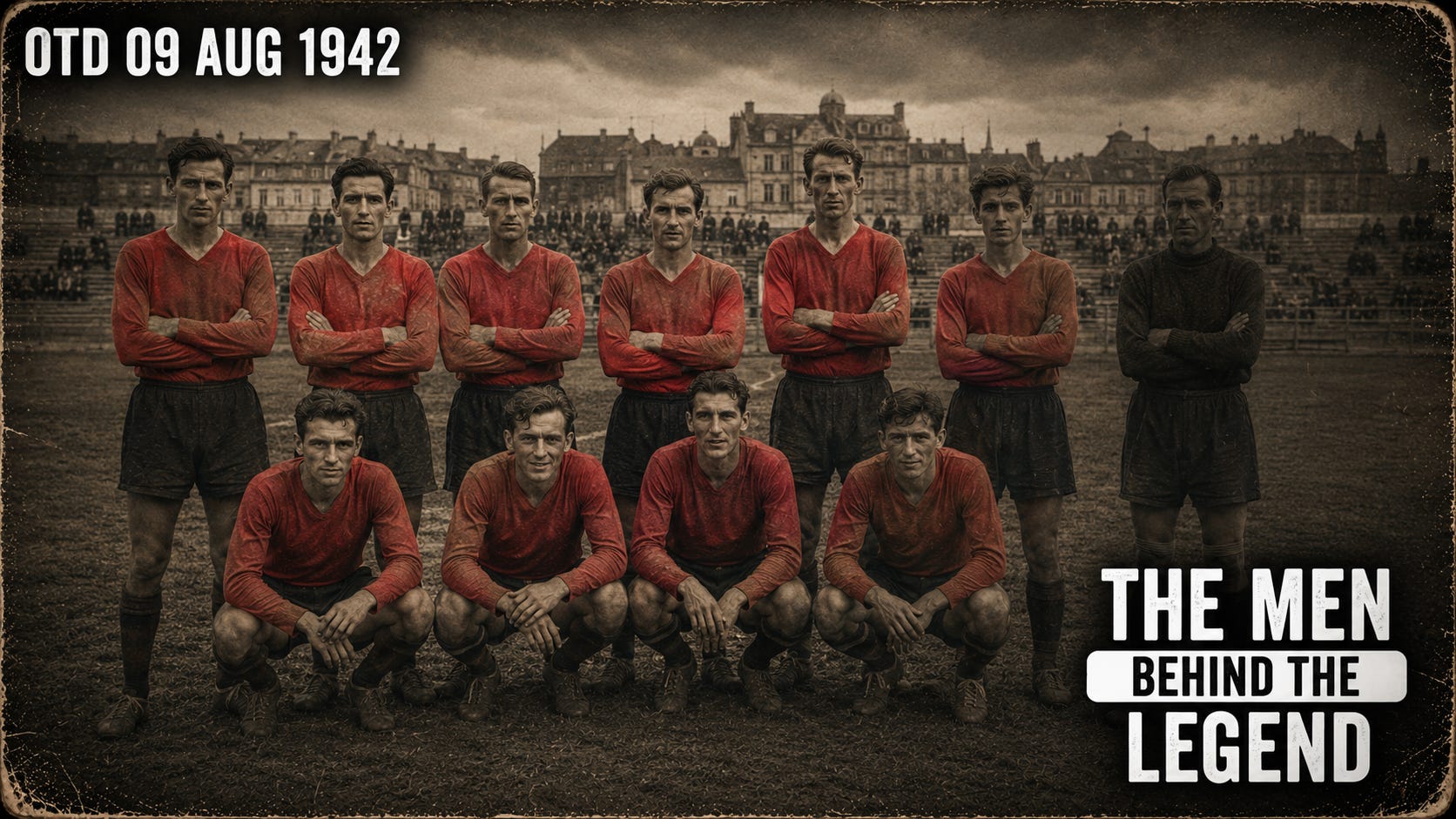
It is August 9, 1942. Kyiv, in Nazi-occupied Ukraine. FC Start, a team of former Dynamo Kyiv and Lokomotiv Kyiv footballers, against Flakelf, a German Luftwaffe side. Start win 5-3, and the match becomes known as the Death Match. It has to be told, but carefully, because the truth is more complicated than the legend.
Start with Kyiv before the match. On June 22, 1941, Hitler invaded the Soviet Union, and on September 19 the city fell. Nazi ideology saw Slavs as inferior; Ukraine was land to be controlled and crushed. Food became scarce, people were deported as forced labor, and reprisals were constant. And then came Babyn Yar. On September 29 and 30, 1941, German forces and collaborators murdered almost 34,000 Jews in a ravine outside Kyiv. Two days. That is the world this match belongs to. Not a sports film. A city under terror.
Now the footballers. Dynamo Kyiv had been a Soviet club connected to the security structures, which under occupation made former Dynamo players politically suspect in German eyes. Then Josef Kordik, who ran a bread factory, recognized Mykola Trusevych, the former Dynamo goalkeeper, in terrible condition, and gave him work and shelter. Trusevych found other footballers: Makar Honcharenko, Ivan Kuzmenko, Oleksiy Klymenko, and others from Dynamo and Lokomotiv. A team formed around the bakery: FC Start.
Football restarted in occupied Kyiv in 1942 partly because the authorities wanted the appearance of normal life. In the simplified legend, Start are the resistance side, but reality is messier. They were not an underground unit. They were footballers trying to live, eat, play, and survive. But in occupation, even trying to be yourself can become political. Start began winning heavily against garrison teams, and whether they meant it or not, victory felt like defiance.
Then came Flakelf. On August 6, Start beat them 5-1. A rematch was arranged quickly, billed as revenge, for August 9. The match itself is where we must be careful. There are legends: an SS-officer referee, a demanded Nazi salute refused, a half-time warning that losing was mandatory, a player refusing to score as ultimate humiliation. Some may be true, some memory, some Soviet-era myth. The safest version: there was pressure, Start understood that beating the Germans again was dangerous, and they won anyway. It finished 5-3.
But here is the part that matters most, where legend and record part ways. The players were not arrested as they walked off the pitch. That is a myth. A week later Start played again, winning 8-0. Then, on August 18, players were arrested at the bakery, and the pattern suggests the Germans were targeting former Dynamo men, linked in their eyes to Soviet security, not simply the eleven who beat Flakelf. They were interrogated at Gestapo headquarters and some were tortured. Mykola Korotkykh, found to have security connections, died after torture. The others were sent to the Syrets camp near Babyn Yar. Then, in February 1943, after resistance attacks in Kyiv, the Nazis carried out reprisals at Syrets, and among the dead were Trusevych, Kuzmenko, and Klymenko. Killed not in a Hollywood climax, but in a camp, in a reprisal, inside a system of terror.
That distinction matters. The legend says they won the match and were shot for winning. The record says they won; later several were arrested; later still some were murdered by the Nazi system. The deaths cannot be reduced to one cause. They were killed because Nazi occupation was murderous, because former Dynamo players were suspicious, because reprisals were routine.
And yet correcting the myth does not strip the story of courage. Even if nobody said lose or die, Start played under occupation, hungry and watched, against men connected to the power ruling their city, and they won. In a city where open resistance could mean execution, watching local footballers beat the occupiers could be a way of feeling human again, a silent way of saying they have not taken everything. That is why we tell it. Not to polish the myth, but to remember the people inside it: Trusevych, Kuzmenko, Klymenko, Korotkykh, Honcharenko, and the others. Not characters. Men. Footballers, with families and hunger and boots and a ball.
🎙️ THE PODCAST GOES DEEPER. The full episode has the bakery team’s formation, the contested legends around the match, and the arrests, Syrets, and the 1943 reprisal. That’s the 10-minute version.
---
🎧 Listen on Spotify, Apple Podcasts, Amazon Music, Overcast, iHeart, and YouTube.
📩 Got an episode idea? otd@17lawsguy.com
Yesterday: 8 August 1979, when the Coupe de France was borrowed.
Tomorrow: 10 August 1975, East Germany win the last Pequeña Copa in Caracas.