

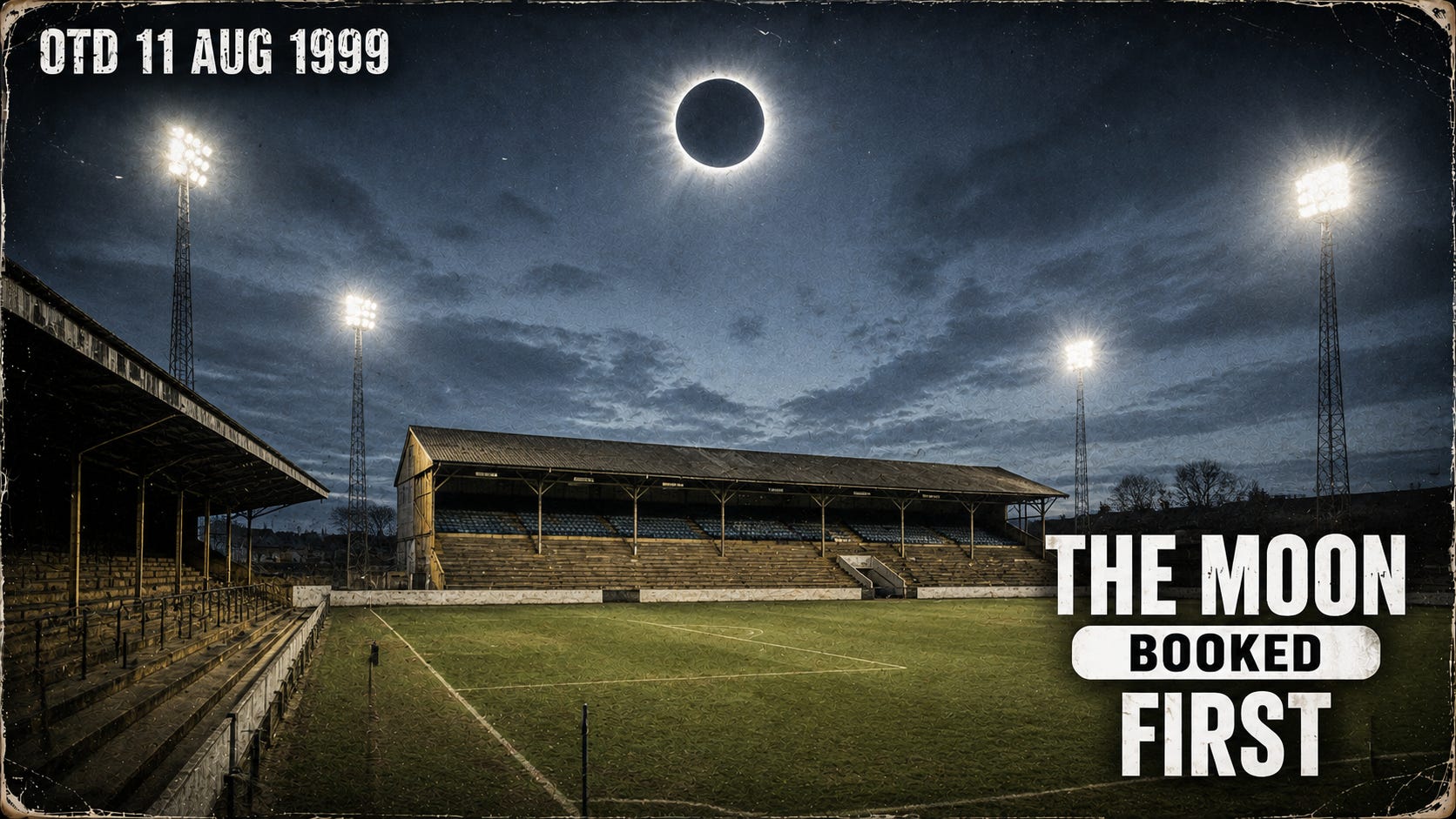
It is August 11, 1999. Torquay. Plainmoor. Torquay United against Portsmouth, a League Cup first-round first leg. Except there is no match, because this is also the day of the total solar eclipse, the first visible from mainland Britain since 1927. And Devon police have a problem. Not the darkness, floodlights exist. The problem is people. Thousands of eclipse-watchers are expected in the South West, and one seaside town cannot absorb everything at once. Something has to move, and the eclipse will not. So the match is postponed. Football loses to astronomy.
Start with the competition. The League Cup began in 1960, a midweek floodlit cup, and by 1999 it was the Worthington Cup, early rounds over two legs. Torquay were in the fourth tier, Portsmouth in the second: a classic early-season tie, smaller club at home against a higher-ranked visitor.
But the fixture landed on August 11, a date long marked in the astronomical diary, with Cornwall and parts of Devon in the eclipse path. Torquay is exactly the kind of place people might choose: coast, holiday town, the English Riviera. You might think someone would have noticed at fixture-planning stage, but the real issue only becomes obvious once you think through the day. A football match is not only ninety minutes. It is buses, pubs, rail stations, away fans, stewarding, emergency cover, people moving against the flow. Now add eclipse tourism. So the match was called off, not because the players could not see, but because the town could not absorb everything at once. The sky is predictable. The crowd is not.
Torquay-Portsmouth was the football outlier. Other League Cup matches went ahead that day, and the eclipse crossed France, Germany, Austria, Hungary, and Romania without a wave of postponements. A total eclipse crosses a continent, and the football story is one midweek tie in Torquay. The match moved six days and finished 0-0. No eclipse and no goals. Then Portsmouth won the second leg 3-0 and went through. No romance, no upset, no cosmic twist. The football was far less interesting than the reason it did not happen on time.
But that is the point. Football scheduling is never only football scheduling. A fixture is a public event, sitting inside transport, policing, weather, and crowd behavior. Torquay-Portsmouth matters because it shows a match can be beaten by something known centuries in advance if the human logistics are wrong. And nature affects football in different ways. Some is known well ahead: an eclipse, extreme heat. Some is anticipated but uncertain: thunderstorms, lightning, snow, where you know the risk but not the minute. And some arrives so suddenly that a match becomes an emergency.
Here the examples stop being funny. In 2012, Ukraine against France at the Euros was stopped in Donetsk when a thunderstorm broke, and in 2024 Germany against Denmark was halted in Dortmund by lightning and hail. And Danish football knows why that matters. In 2005 a 17-year-old Danish amateur was struck by lightning during a match and later died. In 2009 Jonathan Richter of FC Nordsjælland was struck during a reserve match, survived cardiac arrest, but had part of his leg amputated. In Peru in 2024 a player was killed by lightning during a local match. That is why referees stop games. Footballers on wet grass are exposed human beings in studs.
Interruptions can change results too. Weather does not score goals, but it changes the conditions in which goals happen: bodies cool, momentum dies, a coach gets a second team talk. So the rules matter, and every competition needs the rule before the emergency. You do not want to invent justice in a thunderstorm. Weather policy has become player-welfare policy. Heat is the obvious example: cooling breaks entered World Cup consciousness in 2014, and by 2026 hydration breaks are mandatory in every match. We can complain about rhythm, but nobody should want players treated as accessories to television. Football has learned, slowly and painfully, that weather is not atmosphere. It is risk, and risk must be managed. And one day in 1999, a solar eclipse reminded the Football League that the fixture computer may be clever, but the Moon had booked first.
🎙️ THE PODCAST GOES DEEPER. The full episode has the crowd-control reason for the postponement, the ordinary rescheduled result, and how weather became player-welfare policy. That’s the 10-minute version.
---
🎧 Listen on Spotify, Apple Podcasts, Amazon Music, Overcast, iHeart, and YouTube.
📩 Got an episode idea? otd@17lawsguy.com
Yesterday: 10 August 1975, East Germany win the last Pequeña Copa.
Tomorrow: 12 August 1964, Independiente win Argentina’s first Copa Libertadores.