

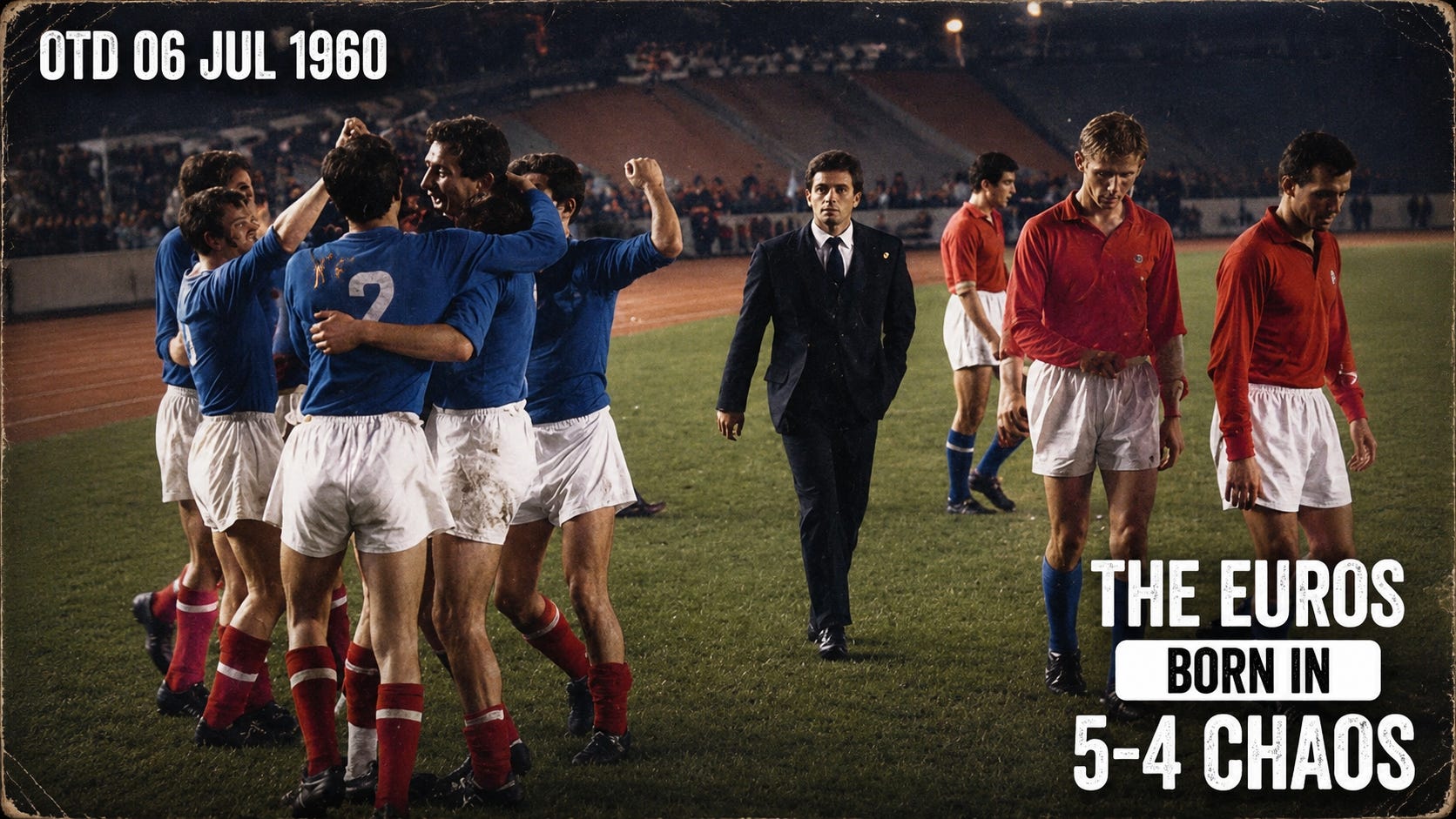
It is 6 July 1960, at the Parc des Princes in Paris. France against Yugoslavia, the first match ever played in a European Championship final tournament. Europe’s new competition could have opened with caution. Instead it opened with nine goals. France lead 4-2 with less than half an hour to play. Then Yugoslavia score three times in five minutes, and win 5-4. More than sixty years later, it is still the highest-scoring match the Euros have ever staged.
The tournament itself was a French idea long before it was a French heartbreak. Henri Delaunay had pushed for a European national-team competition since the 1920s, but FIFA was busy building the World Cup, and the proposal slept for decades. Delaunay passed in 1955, before it became real, and the trophy still carries his name. When the European Nations’ Cup finally launched, it was a modest thing: only seventeen countries entered, and England, West Germany, and Italy all stayed away, unconvinced by the calendar or the idea.
The four who reached France carried the Cold War with them. France were the hosts; Yugoslavia, the Soviet Union, and Czechoslovakia were all socialist states, and even among them the politics split, Tito’s non-aligned Yugoslavia was a different thing from the Soviet machine. France, missing the stars of their brilliant 1958 World Cup side, still had enough at home to look the stronger team for an hour. Heutte, Wisnieski, and Vincent had them 4-2 up and cruising, their first European final in sight.
Then Yugoslavia remembered how good they were. Knez pulled one back on seventy-five minutes. Jerkovic equalized on seventy-eight. Jerkovic scored again on seventy-nine. Three goals in five minutes turned a two-goal French lead into a Yugoslav victory, and the Parc des Princes fell silent. France attacked desperately at the end, and found nothing.
Yugoslavia went on to lose the final to the Soviet Union, who became the first European champions with Lev Yashin in goal. France collapsed entirely, losing the third-place match and then entering a long drought, failing to qualify for the 1962 World Cup and fading through the decade. Their redemption came, fittingly, in the same competition they had helped invent: at Euro 1984, on home soil, Michel Platini scored nine goals in five matches and France finally won their first major trophy.
Yugoslavia’s story bends toward something heavier. They became one of Europe’s great almost-teams, runners-up here, runners-up again in 1968, World Cup quarterfinalists in 1990. Then, at Euro 1992, a gifted generation, Savicevic, Prosinecki, Boban, Suker, won its qualifying group, only for war to tear the country apart. Sanctions and UEFA action removed Yugoslavia from the tournament, Denmark were called in as replacements, and Denmark won the whole thing. So watching Yugoslavia in 1960 means watching both a football tradition and a coming tragedy: a country able to produce extraordinary players from many republics and cultures, whose political structure would one day rupture so completely that its national team simply disappeared.
The competition that began that afternoon started small, with modest crowds and major absentees, and grew into one of the hardest tournaments in the world to win. But the first finals match stayed almost childlike in its excess. No caution, no brand management, no month-long mega-event. Just France and Yugoslavia trading goals in the rain until the new tournament had a legend before it even had a champion.
🎙️ THE PODCAST GOES DEEPER. The full episode has Delaunay’s decades-long fight for the tournament, the goal-by-goal collapse, and the Cold War politics of the final four. That’s the 10-minute version.
---
🎧 Listen on Spotify, Apple Podcasts, Amazon Music, Overcast, iHeart, and YouTube.
📩 Got an episode idea? otd@17lawsguy.com
Yesterday: 5 July 1982, Paolo Rossi 3, Brazil 2.