

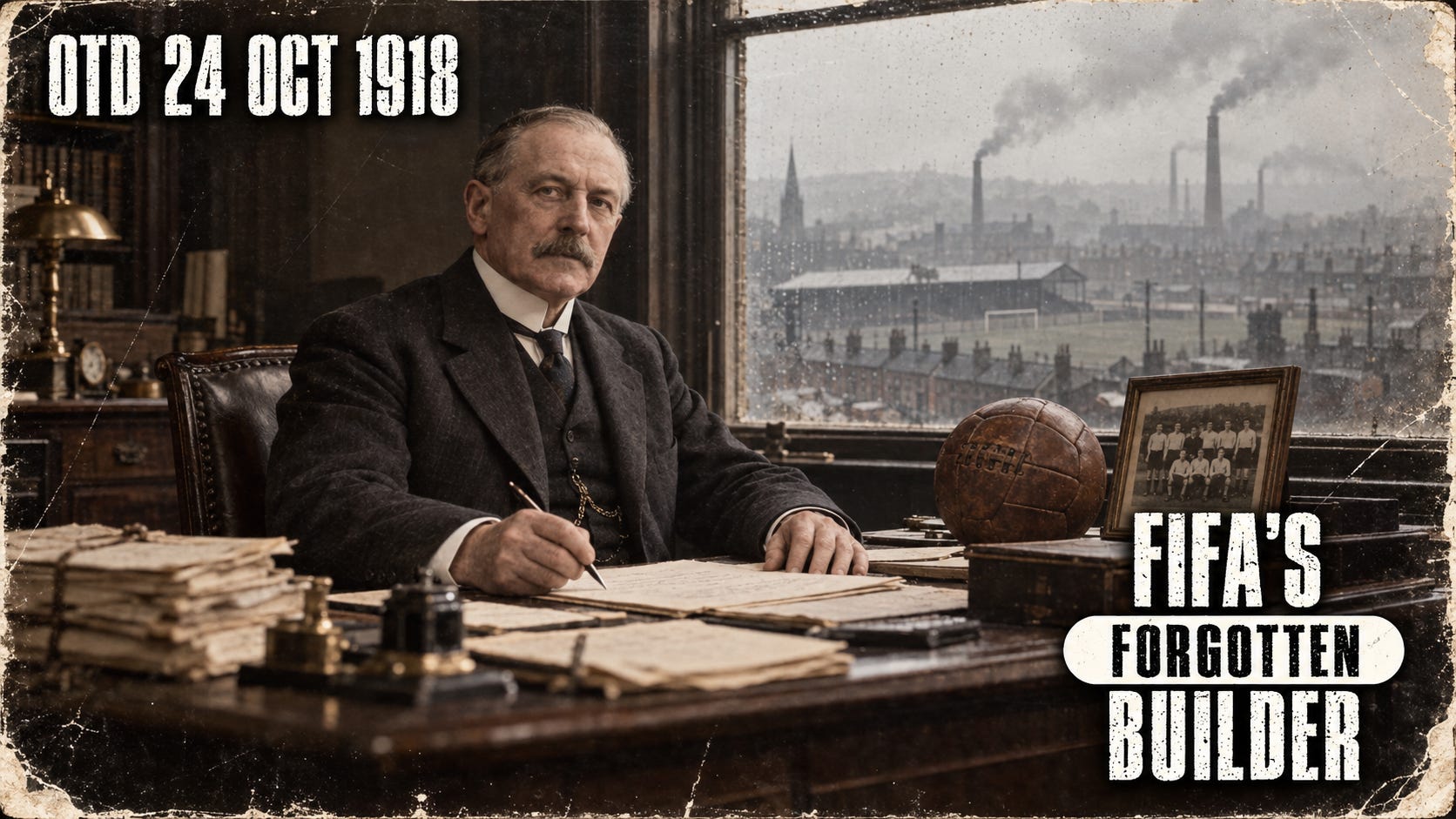
On October 24, 1918, Daniel Burley Woolfall died in Blackburn, eighteen days before the Armistice. His death made no famous stadium fall silent. There was no World Cup, no television tribute, no trophy carrying his name. Yet the man who died at 66 had spent twelve years as FIFA’s second president, and in those twelve years he helped turn a nervous committee of European associations into an organization capable of speaking for international football.
That is the oddity of Woolfall’s place in the game. Robert Guérin founded FIFA in Paris in 1904. Jules Rimet later gave it the World Cup and a global mythology. Woolfall sits between them, less glamorous than either: a Blackburn tax official, Lancashire administrator and meticulous keeper of rules. But without the bridge he built between English football and the continent, the Olympic tournament that showed national-team football could work, and the first steps beyond Europe, Rimet would have inherited far less to rescue and enlarge.
How Did We Get Here?
Woolfall belonged to football before football belonged to the world. Born in Blackburn in 1852, he grew up in the industrial Lancashire in which the modern game was learning how to organize itself: clubs, county associations, cup competitions, paid players, disciplinary committees and the increasingly consequential question of who got to make the rules. Blackburn Rovers were formed in 1875 by former pupils of Blackburn Grammar School. Woolfall was not one of the players who made the club famous, but in 1881 he became Rovers’ representative to the Lancashire Football Association.
That was the beginning of a lifetime in the machinery of the game. He became a Lancashire FA vice-president in 1885, its president in 1901, and remained so until his death. He was trained as an accountant and worked as an inspector of taxes, which may sound remote from football romance but was exactly the kind of expertise its young institutions needed. When he became honorary treasurer of the Football Association in 1901, he reorganized accounts that the local obituary said were far from ideal. He chaired commissions, sat on England selection business and, as early as 1881, chaired a Lancashire FA subcommittee that drew diagrams to interpret offside.
That last detail matters. The early game was not only fighting over whether a player had been offside. It was fighting over whether the same game was being played when a team crossed a border. England had codified association football in 1863; professionalism had been legalized there in 1885; the Football League followed in 1888. Continental associations were growing, but the authority of the Laws, the definition of an international match and the status of professionals were all unsettled. An international federation could announce itself in Paris. Making it useful was harder.
FIFA’s founding president, the French journalist Robert Guérin, had done the announcing. Seven associations signed the foundation act in May 1904, and England joined the following year. At the 1906 Congress in Berne, Guérin did not appear, amid a split in French football. Delegates elected Woolfall on June 4. He was a logical choice: an FA administrator from the country whose game had the deepest institutional roots, but also a man sufficiently embedded in continental congress work to be acceptable beyond Britain.
The significance was not that FIFA suddenly became English. The opposite is closer to the truth. Woolfall’s job was to make English football usable internationally without allowing England to own the whole enterprise. Under his presidency, application of the Laws on the English model became compulsory in FIFA competition and a clearer definition of international matches emerged. He played a prominent role in drafting FIFA’s new constitution. The organization acquired rules for the rules.
He did not do this alone. FIFA’s early executive culture was international even when its office was tiny. The Belgian Louis Mühlinghaus had been the first secretary and treasurer; the Dutch co-founder Carl Anton Wilhelm Hirschman succeeded him as honorary secretary in 1906 and did the patient correspondence and record-keeping from Amsterdam. Victor Schneider of Switzerland, FIFA’s original vice-president, represented another founding strand before later helping lead the rival amateur body. Woolfall was president, but the body depended on men who could convene, minute, translate, write letters and keep a delicate association alive between congresses.
The most visible test came in London in 1908. Football had appeared at earlier Olympics, but it had been a confused affair of club or representative sides. The London tournament was the first properly organized Olympic football competition built around national associations, and FIFA recognizes national teams as appearing there for the first time. The Football Association ran the tournament for the British Olympic authorities, with Woolfall’s FIFA presidency giving the new venture both connection and legitimacy. Great Britain won gold, beating Denmark 2-0 in the final at White City.
Woolfall was one of the people building that structure. The tournament did not solve everything. Britain’s amateur selection was not the same proposition as the professional game that had made England powerful, and Olympic eligibility guaranteed that amateurism would continue to haunt international football for decades. But London showed that national associations could send teams, follow one competition’s rules and produce a result that mattered beyond a single city.
It also showed why the amateur question could not be ignored. Woolfall was a Lancashire football man from the world that had accepted professionalism. In 1885-86, the Lancashire FA had lobbied the national FA for the legislation of professional football. But the Olympics were tied to amateur principle, while many continental sporting leaders saw amateurism not merely as an eligibility rule but as a social ideal. It was the language of a game run by educated voluntary associations, suspicious of wages, working-class mass competition and the commercial force of English football.
That conflict became institutional in 1909. The Union Internationale Amateur de Football Association, or UIAFA, was founded in Paris as a rival to FIFA. It drew together organizations alienated by FIFA’s claims to decide who could represent a country and which matches were legitimate. Its first president was Victor Schneider, once FIFA’s vice-president. The organization was not a footnote at the time: it was a warning that FIFA was still a contested proposition, not the inevitable world government it later came to resemble.
Woolfall’s FIFA answered not with a grand spectacle but with the less glamorous work of legitimacy. At the 1909 Congress in Budapest, it prohibited matches between clubs under FIFA associations and UIAFA clubs. That sounds severe, but it was an assertion that an international body had to define its own membership and jurisdiction or become an address to which anyone could send a letter. UIAFA faded by 1912-13 as its underlying domestic conflicts eased and national associations proved more durable than its coalition of dissenters. FIFA had survived its first serious competitor.
Meanwhile, Woolfall took FIFA beyond the European circle in which it had been born. South Africa joined in 1910, Argentina and Chile followed, and the United States entered in 1913. The dates and membership labels matter less than the direction. A federation that had begun with European associations was beginning to imagine a geography larger than Europe, and to require a common language of affiliation, recognition and rules across it. The same period brought the 1912 Stockholm Olympic tournament, where Woolfall served as an international jurist and Great Britain won again.
There was no neat staircase leading from this to the World Cup. The First World War broke the staircase. International football did not simply pause in 1914 and resume where it had been. Travel, communications, congresses and trust all fractured. The International Olympic Committee’s amateur framework still constrained the sport’s grandest available tournament. Woolfall’s last years were therefore years of maintenance, not expansion. His Blackburn obituary reports that illness kept him from the Lancashire FA annual meeting in June 1918. On October 24 he died at his home on Azalea Road, still Lancashire FA president, FA treasurer and FIFA president.
So What?
Woolfall’s legacy is easiest to miss because it is institutional rather than cinematic. Guérin gave FIFA its birth certificate. Rimet gave it the competition that became the World Cup. Woolfall gave it some of the operating habits without which a birth certificate and a future dream would not have been enough: a constitution, a common framework for international matches, stronger links between the English and continental games, a credible Olympic event and the beginnings of non-European membership.
The war makes every question about what he might have achieved necessarily speculative. It would be careless to claim that Woolfall was about to invent the World Cup in 1914. There is no evidence of a tournament plan ready to launch. The proper counterfactual is smaller and more telling. Had war not intervened, FIFA might have continued to turn Olympic experience, membership growth and rule standardization into a stronger pre-war international calendar. Woolfall had already demonstrated the instinct to solve the practical problem in front of him: make the laws common, clarify representation, organize the tournament, add members, protect institutional authority.
The amateur-professional dispute explains why that would still have been difficult. Professional football was not an unfortunate detail to be tidied away. It was the central contradiction of international football’s first decades. England’s professional league was the most advanced club system in the world, while the Olympics offered the most prestigious international stage and excluded professionals. FIFA needed the Olympic stage but also needed to govern a sport increasingly shaped by paid players. Under Woolfall, the question remained open enough for a rival federation to form. Under Rimet, it became the pressure that ultimately made a separate world championship necessary.
That is where the connection between the two presidents becomes meaningful, even if they should not be made into an imagined partnership. Rimet did not succeed Woolfall directly. After Woolfall’s death, Carl Hirschman kept FIFA alive from Amsterdam, largely through his own administrative persistence, before Rimet was elected in 1921. Rimet then used post-war Olympic football as proof of demand, expanded FIFA and pushed the 1928 decision to create a world championship, realized in Uruguay in 1930. Woolfall did not hand him a World Cup plan. He handed the future organization a reason to believe that a common international competition could be administered at all.
The sequence also tells us something uncomfortable and enduring about FIFA. Its presidents are not interchangeable caretakers. Guérin’s energy made a foundation possible. Woolfall’s administrative authority shifted FIFA toward standardized international governance. Rimet’s imagination turned that governance toward the World Cup. Later presidents have similarly left their own fingerprints, for better and worse: expansion, television money, commercialization, political reach, institutional scandal and, in the present era, the arguments around the scale and direction of the competitions FIFA chooses to build. The presidency sets an agenda. The office can make a federation larger, more coherent, more powerful, or more vulnerable to the ambitions of its leader.
Woolfall is important precisely because his agenda was not self-mythologizing. He was a club and county association man who understood that the game’s grand future rested on invoices, minutes, eligibility, offside diagrams and a rulebook accepted by people who did not share a language or a domestic system. He was not even a Blackburn Rovers player. He was the Rovers representative who learned to make institutions work, then carried that skill through Lancashire, the FA and FIFA.
The local detail gives the global story its proper scale. At the 1908 Olympic final, the referee was John Lewis, a founder of Blackburn Rovers. Woolfall is buried in Blackburn Cemetery close to Lewis. One had helped create a famous local club and became a renowned, and sometimes controversial, referee; the other helped create the administrative conditions for international football to become recognizable across the world. Neither left the kind of monument that makes later generations instantly recall a name. Both mattered because early football depended on organizers as much as scorers.
Woolfall’s death before Armistice Day also tells us why FIFA’s history is not a smooth ascent toward Zürich, World Cups and billions of viewers. In 1918 it was fragile enough that one Dutch secretary’s files and correspondence helped decide whether the federation endured. The organization that could later dictate calendars and stage 48-team World Cups had once been a small association interrupted by war, weakened by internal division and deprived of its president at the moment its basic work was unfinished.
Woolfall therefore deserves more than the label of “the man between Guérin and Rimet.” He was the president who made the middle matter. He brought a Lancashire administrator’s discipline to an organization that needed credibility; he helped bind British and continental football without erasing their differences; he supervised the first significant Olympic tournament of national teams; and he saw FIFA take its first institutional steps beyond Europe. His achievement was not the destination. It was the roadbed.
Three Things to Take Away
1. Daniel Burley Woolfall was FIFA’s second president from 1906 until his death in Blackburn on October 24, 1918. His priority was making international football governable through common rules, clearer definitions and a workable constitution.
2. Under Woolfall, the 1908 London Olympics became the first properly organized Olympic football tournament of national teams, and FIFA admitted its first non-European members. Those were practical demonstrations that the organization could operate beyond its founding circle.
3. World War I, not a lack of importance, interrupted Woolfall’s presidency. Carl Hirschman preserved the organization, then Jules Rimet inherited a viable but fragile FIFA and used the Olympic pathway to reach the World Cup.
On This Day
On October 24, 1918, Daniel Burley Woolfall died in Blackburn while still FIFA president. Football remembers the founder before him and the World Cup creator after him. It should also remember the Lancashire organizer who helped make an international game possible in between.
Have a football memory, a correction or a story that belongs here? Write to otd@17lawsguy.com.
Yesterday: The Country That Vanished Before Kickoff — 1. FC Magdeburg 0-1 Bordeaux, 23 October 1990.