

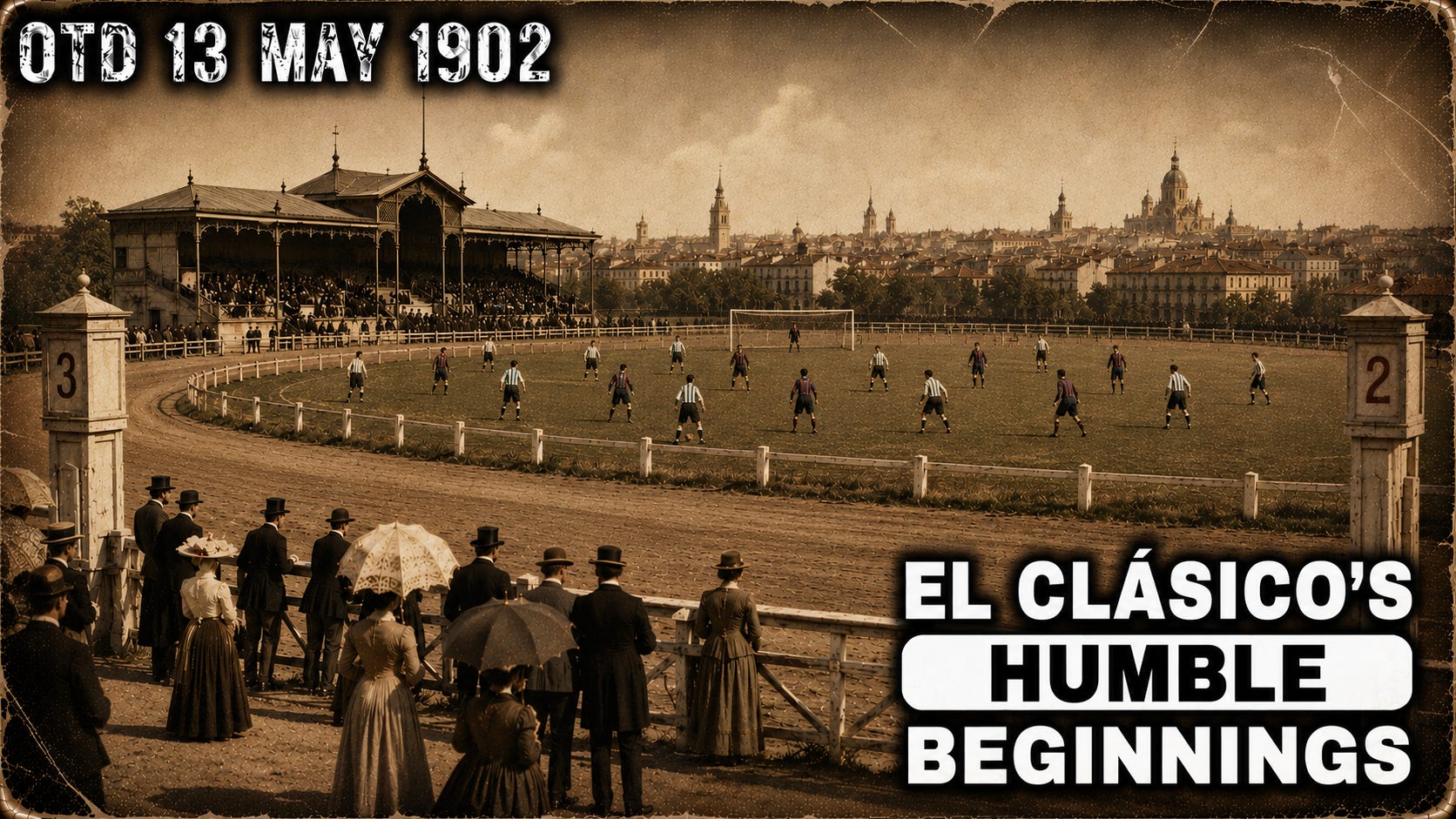
It is 13 May 1902. Madrid.
A football tournament arranged for the coronation celebrations of King Alfonso XIII. On a horse-racing ground in the Spanish capital, two young clubs meet for the first time.
Madrid Foot-Ball Club. Foot-Ball Club Barcelona.
Barcelona win 3-1.
Nobody calls it El Clásico yet. There is no La Liga. No Bernabéu. No Camp Nou. No Franco mythology. No Di Stéfano dispute. No Cruyff. No Figo. No Messi. No global broadcast audience.
But the ingredients are already there.
Madrid and Barcelona. Capital and Catalonia. Power and identity. Administration and emotion.
And from this first meeting, one of football’s great fixtures begins.
Spanish football at the turn of the twentieth century is still an imported habit. It travels through British workers, students, sailors, engineers, merchants and sporting clubs. It takes root first in places with ports, industry, foreign connections and urban curiosity: Huelva, Bilbao, Barcelona, Madrid.
Barcelona’s club comes first.
In 1899, Joan Gamper — Swiss, athletic, restless, already steeped in football culture — helps found FC Barcelona with a group of Swiss, Catalan, German and English enthusiasts. From the beginning, Barça is not simply a football side. It is international in its origins and local in its emotional pull. Long before “més que un club” becomes the slogan, Barça is already more than a Sunday team. It is a way for a modern, self-aware Barcelona to play itself into public life.
Madrid’s club comes slightly later. Madrid football grows out of small turn-of-the-century circles: students, young men, imported rules, informal matches, and one early seedbed called Foot-Ball Sky. Sky splits. Former members build something more durable. On 6 March 1902, Madrid Foot-Ball Club is formally founded (check out episode 126 about that).
And the key figure is Juan Padrós, Barcelona-born, but central to Madrid’s football institution-building. Along with his brother Carlos and other former members of Foot-Ball Sky, he helps create Madrid FC. He is not just a club founder. He is a football administrator, later tied to the path toward a Spanish national federation.
That already tells you something. Barcelona feels like identity becoming a club. Madrid feels like organization becoming a club.
And then, only weeks after Madrid FC’s formal founding, Carlos Padrós helps create the occasion that brings the two together: the Copa de la Coronación. The Coronation Cup.
It is arranged in Madrid in honor of Alfonso XIII. It is not recognized today by the Spanish federation as the first official Copa del Rey, but historically it is the hinge. It is the first national football competition staged in Spain. Five teams take part: Madrid FC, FC Barcelona, Club Español from Barcelona, New Foot-Ball Club from Madrid, and Club Bizcaya, a Basque combination built from Athletic Club and Bilbao Football Club.
So already the map is there. Madrid. Barcelona. Bilbao. The future power centres of Spanish football, all in miniature.
And on 13 May 1902, Madrid FC and Barcelona meet in the semi-final. The venue is the Hipódromo de la Castellana, a horse-racing track in Madrid. Not a football cathedral. Not a purpose-built stage. A borrowed space for a borrowed sport that is still learning how to become Spanish.
Madrid score first. Arthur Johnson gets the goal. That is perfect early-football symbolism. Madrid’s first competitive Clásico goal comes from an Englishman — a reminder that even this most Spanish of rivalries begins inside an imported game.
Then Barcelona answer. Udo Steinberg scores twice. Joan Gamper himself adds another, from the penalty spot. Madrid FC 1, Barcelona 3.
The first Clásico belongs to Barça.
But Barcelona do not win the tournament. They lose the final two days later to Club Bizcaya. Madrid go on to win the consolation event, the Copa de la Gran Peña, beating Club Español.
That is the wonderful smallness of it. The first Clásico is not the final. It does not crown the Spanish champion. It is not yet loaded with the weight of a century. It is a semi-final in a coronation festival, played by amateur pioneers on a racing ground.
And yet, in hindsight, it is the spark.
What it shows is that the rivalry begins before the infrastructure. Before La Liga is founded in 1929, Madrid and Barcelona are already meeting in cup football. Before the professional era, before radio, before television, before global brands, the fixture already has the essential architecture: two young clubs from two cities that will come to imagine Spain differently.
The 1902 match does not yet carry the full political charge that El Clásico later acquires. It is not Franco versus Catalonia. It is not dictatorship versus resistance. That comes later. The 1930s deepen the meaning. After the Civil War, Barça’s identity is repressed, its name and crest altered, its presidents politically managed.
Then the rivalry hardens. The 1943 Copa del Generalísimo semi-final, with Madrid’s 11-1 second-leg win, becomes one of the great contested myths of the rivalry. The football result is real. The meaning is still argued. And that is exactly how Clásico memory works: facts become scars, and scars become inheritance.
Then comes the Di Stéfano dispute. Barcelona believe they have him. Madrid get him. And the player who had dazzled in Colombia with Millonarios — whom we discussed in our El Dorado episode just 10 days ago — becomes the man who transforms Real Madrid into the first great European Cup dynasty.
That is what “Clásico” really means. Literally, it means “the classic.” At first, the idea belongs to league football: the classic match between Spain’s two biggest clubs. Over time, the term expands.
But the deeper meaning is not marketing. A Clásico is a fixture that has learned to remember.
Every new match carries the old ones inside it. The first 3-1. The 11-1. The 5-0s. The Di Stéfano argument. The Messi-Ronaldo decade. The political banners. The whistles. The applause. The sense that a goal is never only a goal.
That is why 13 May 1902 matters. Not because the players knew they were inventing the world’s most famous club rivalry. They did not. But because some matches become historic twice. First when they are played. And then later, when history realizes what they started.
🎙️ The full episode (linked above) has more on Clásico history’s later chapters — the Cruyff 5-0 of 1974, the Laudrup back-to-back manitas (covered in episode 68), Figo’s 2000 betrayal, Mourinho-Guardiola’s four matches in eighteen days, and Messi’s famous 92nd-minute shirt moment. That whole expansion is in the audio.
---
🎧 Also available on Apple Podcasts, Amazon Music, Overcast, iHeart, and YouTube.
📩 Got an episode idea? otd@17lawsguy.com
Yesterday: 12 May 1996 — Two Goalkeepers, Two Headers, Two Goals.
Tomorrow: 14 May 1931 — the day football invented shirt-swapping.