

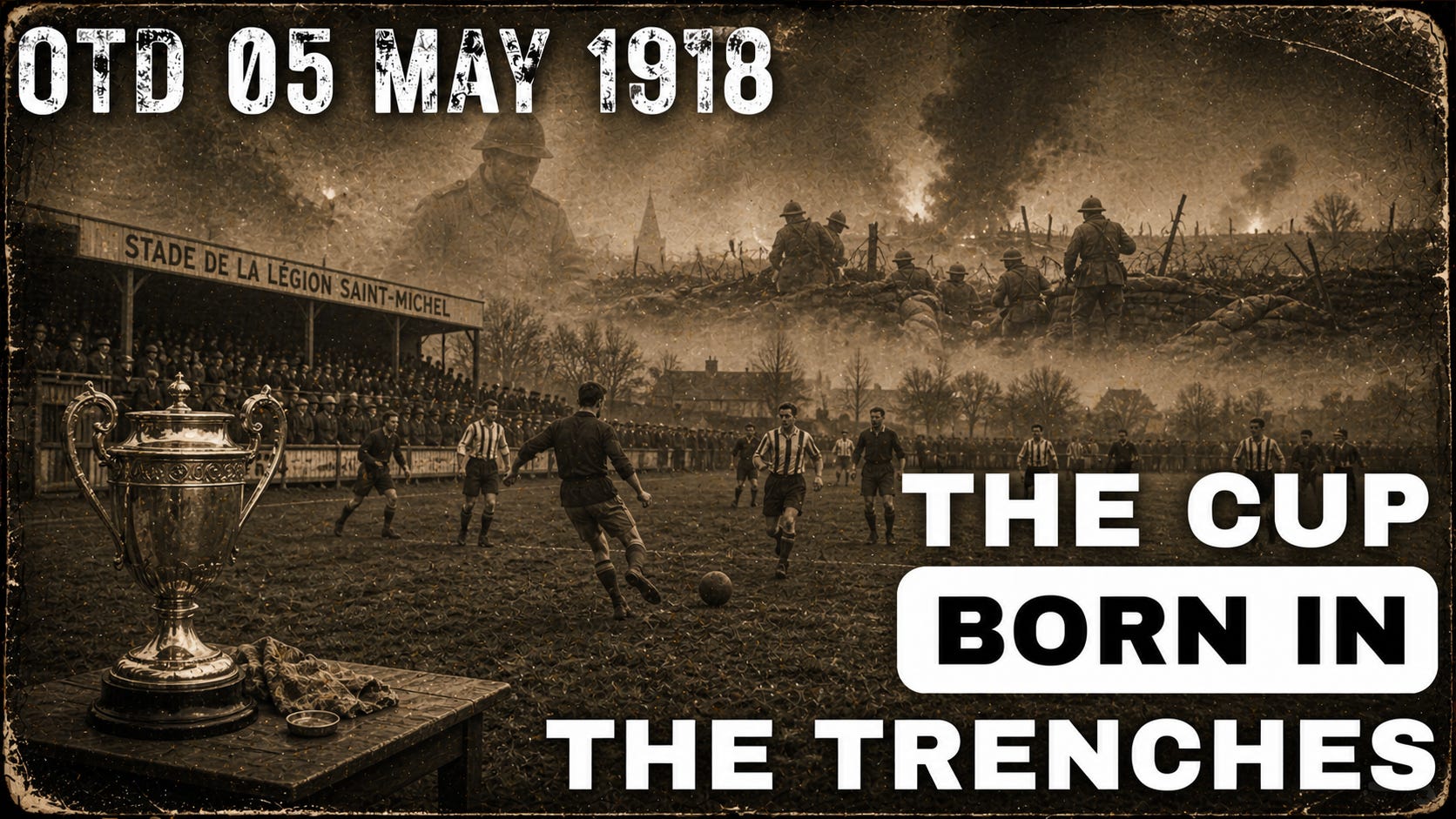
It is 5 May 1918. Paris. A small ground in the fifteenth arrondissement.
Wooden huts being used as dressing rooms. No showers. A bumpy pitch. A little stand. Around two thousand people watching. And France is still at war.
The Western Front has not gone quiet. The armistice is six months away. Men are still in the trenches. Clubs are missing players. Some regions cannot properly take part at all. And yet, here in Paris, two football teams are playing for a new national trophy.
Olympique de Pantin against Football Club de Lyon. The first final of what we now call the Coupe de France. Back then, it is the Coupe Charles-Simon. And it is born in one of the most unlikely settings imaginable: not after the war, when France can breathe again, but during it.
A national cup, inspired by England’s FA Cup, created by Henri Delaunay, supported by Jules Rimet, named after a football organizer killed at the front. Olympique de Pantin win 3-0. Émile Fiévet scores twice. Louis Darques adds the third. And French football, still divided, still grieving, still improvising, has created a tournament that will outlive the war, the pandemic, the federations that made it, and almost every club that played in its first edition.
The seed had been planted sixteen years earlier. In April 1902, a teenage Henri Delaunay had crossed the Channel to watch Sheffield United against Southampton in the FA Cup final at Crystal Palace. Seventy-five thousand people. The match itself ended 1-1. But for Delaunay, the result mattered less than the ritual. The scale. The way a cup final could pull a sport together.
He left London with a promise to himself: one day, French football should have an event of that size.
It would take fifteen years, a war, and a dead colleague to make the seed grow.
Charles Simon was one of the great organizing figures of early French sport — energetic, administratively gifted, central to creating the Comité Français Interfédéral in 1907 to bring France’s fragmented football federations together. In 1915, he was killed at the front. The first version of the cup would not bear France’s name. It would bear his.
The competition was officially created on 15 January 1917, under Delaunay’s impulse and with Jules Rimet’s support. Look at that cast: Delaunay, future father of the European Championship. Rimet, future father of the World Cup. Simon, early federal pioneer, killed in the war. And in the middle of them, a trophy — a real one, made by the Parisian jeweller Chobillon. The magazine Lectures pour tous funded travel and medals. Even during war, the organizers understood that ritual matters. The cup had to look like a cup.
The first tournament began in October 1917. Forty-eight clubs entered, mostly from Paris and its suburbs because the north and east of France were too affected by war to participate as they would in peacetime. Format: straight knockout. One match. Extra time. Replays if necessary.
Olympique de Pantin reached the final by beating Légion Saint-Michel, Lyon Olympique Universitaire, Club Français, and the great Parisian corporate side CA Société Générale. FC Lyon’s road was equally remarkable — and the semi-final against AS Française was refereed by Henri Delaunay himself.
The final itself was fast, physical, and strange. Olympique’s Decoux was sent off for striking André Weber, then reinstated when Lyon captain Roger Ébrard asked for him to be allowed back on. Fair play, paternalism, chaos — all in one incident. Then Fiévet, twice. Then Darques. 3-0.
And there is one detail that makes the war impossible to keep outside the story.
FC Lyon’s usual goalkeeper, Carlos Mutti, was serving with the Foreign Legion. He had been expected to take part, but chose instead to remain with his comrades at the front.
A few months later, in August 1918, he was killed.
That is the hinge of the whole episode. A cup final in Paris. A missing goalkeeper in the trenches. A trophy on display in a shop window. A country still fighting for survival. You cannot separate the football from the war. The competition was born right inside it.
And it survived. The 1918-19 edition expanded to fifty-nine clubs and moved the final to Parc des Princes. By 1919, the Fédération Française de Football Association had been created with Rimet as its first president. The Coupe de France became one of the rituals through which that federation could make itself real.
Olympique de Pantin became the first great almost-club of the Coupe de France — first winners, then runners-up in 1919 and 1921. Eventually, by then known as Olympique de Paris, they merged with Red Star in 1926. So the institutional afterlife of the first Coupe de France winner flows into one of the most evocative clubs in Parisian football history. Red Star still exist today, at Stade Bauer in Saint-Ouen.
If you want to follow the ghost of Olympique de Pantin, you follow it there.
And the men around the cup did not stop there. Rimet helped turn international football into the World Cup. Delaunay helped give Europe its national-team championship. The Coupe de France sits at the beginning of that same administrative imagination: the belief that football becomes bigger when you give it structure, ritual, and a trophy worth dreaming about.
It is not merely that Olympique de Pantin beat FC Lyon in 1918. It is that France created a competition in which that kind of story could keep happening.
---
🎧 Also available on Apple Podcasts, Amazon Music, Overcast, iHeart, and YouTube.
📩 Got an episode idea? otd@17lawsguy.com
Yesterday: 4 May 1976 — QPR’s 10-Day Title Dream.
Tomorrow: 6 May 1970 — Feyenoord beat Celtic in Milan and the Dutch decade begins.