

Six months ago today, OTD published its first episode — about Saarbrücken’s shocking away win at Milan in 1955. Today is episode 182. Thank you for being here.
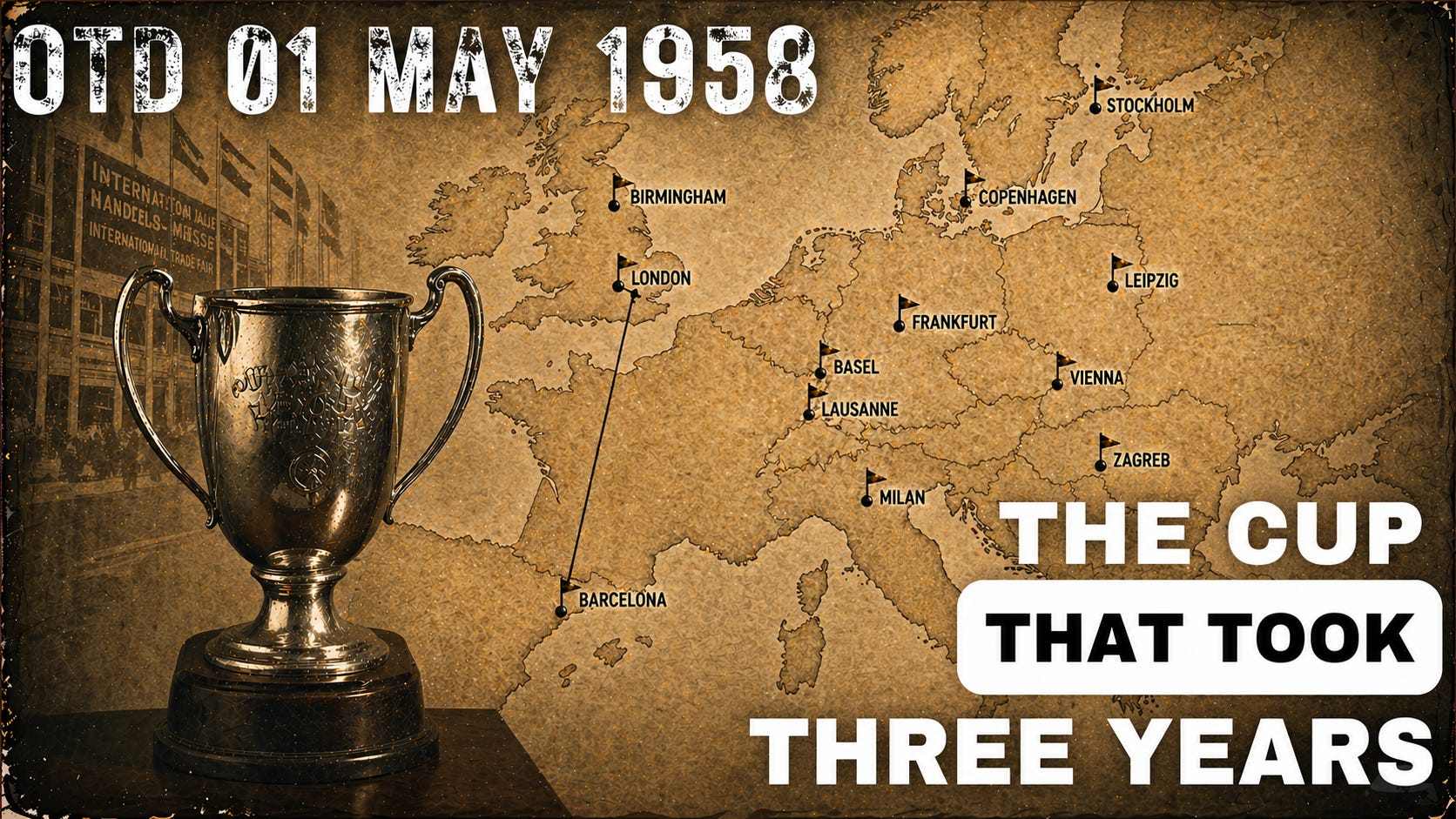
A football tournament that took three years to finish.
It is 1 May 1958. Camp Nou. And nearly three full years after this strange new European tournament first kicked off, it finally ends.
Barcelona 6, London 0. 8-2 on aggregate.
CF Barcelona become the first winners of the Inter-Cities Fairs Cup — a competition that was not quite a UEFA tournament, not quite a normal club tournament, not quite short enough to be practical, but important enough to help shape the future of European football anyway.
The Fairs Cup was the brainchild of three serious operators in postwar Europe: Ottorino Barassi of Italy, Ernst Thommen of Basel, and Stanley Rous of the English FA. Their idea was to connect football to the international trade fairs that were spreading across Europe in the broader commercial atmosphere of the Marshall Plan.
Hence the name.
The rule was simple: only cities with international trade fairs could enter, and only one team per city. Most cities sent clubs. Some sent representative selections — players gathered from across the city’s smaller and bigger sides. London was one of those: an actual all-star team, drawn from Chelsea, Fulham, Brentford, Leyton Orient and Millwall, with Jimmy Greaves up top.
Even Barcelona were treated as the city of Barcelona’s representative. Sometimes in those early Fairs Cup years, they did not appear in blaugrana — they wore white and blue with the city emblem instead.
It started in June 1955. The first goal in the tournament’s history was scored in Basel by Eddie Firmani, the South African-born Charlton forward, for the London selection. Then it crawled — through groups, through long calendar gaps, through semi-finals played 18 months after qualifying — until finally, in the spring of 1958, it had a winner.
The structural lessons were obvious. Too long. Too loose. Too odd. While the Fairs Cup was still crawling, Real Madrid were lifting European Cups in annual rhythm.
So the Fairs Cup adapted. It tightened. It dropped the city-selection rule. It became more clubby, more disciplined, more European. In 1971, when the autonomous Fairs Cup committee gave way and UEFA took over, the format was renamed the UEFA Cup. A one-off match was staged between the first winners (Barcelona) and the last winners (Leeds United) to decide who would keep the original trophy forever.
Barcelona won that too. Of course they did.
The line from there runs clean: Fairs Cup → UEFA Cup → Europa League.
The Inter-Cities Fairs Cup was versatile, improvised, untidy, institutionally odd.
And yet it helped build Europe.
🎧 Also available on Apple Podcasts, Overcast, iHeart, and YouTube.
📩 Got an episode idea? otd@17lawsguy.com.
Yesterday: 30 April 1938 — The Final Where the Commentator Ate His Hat.