

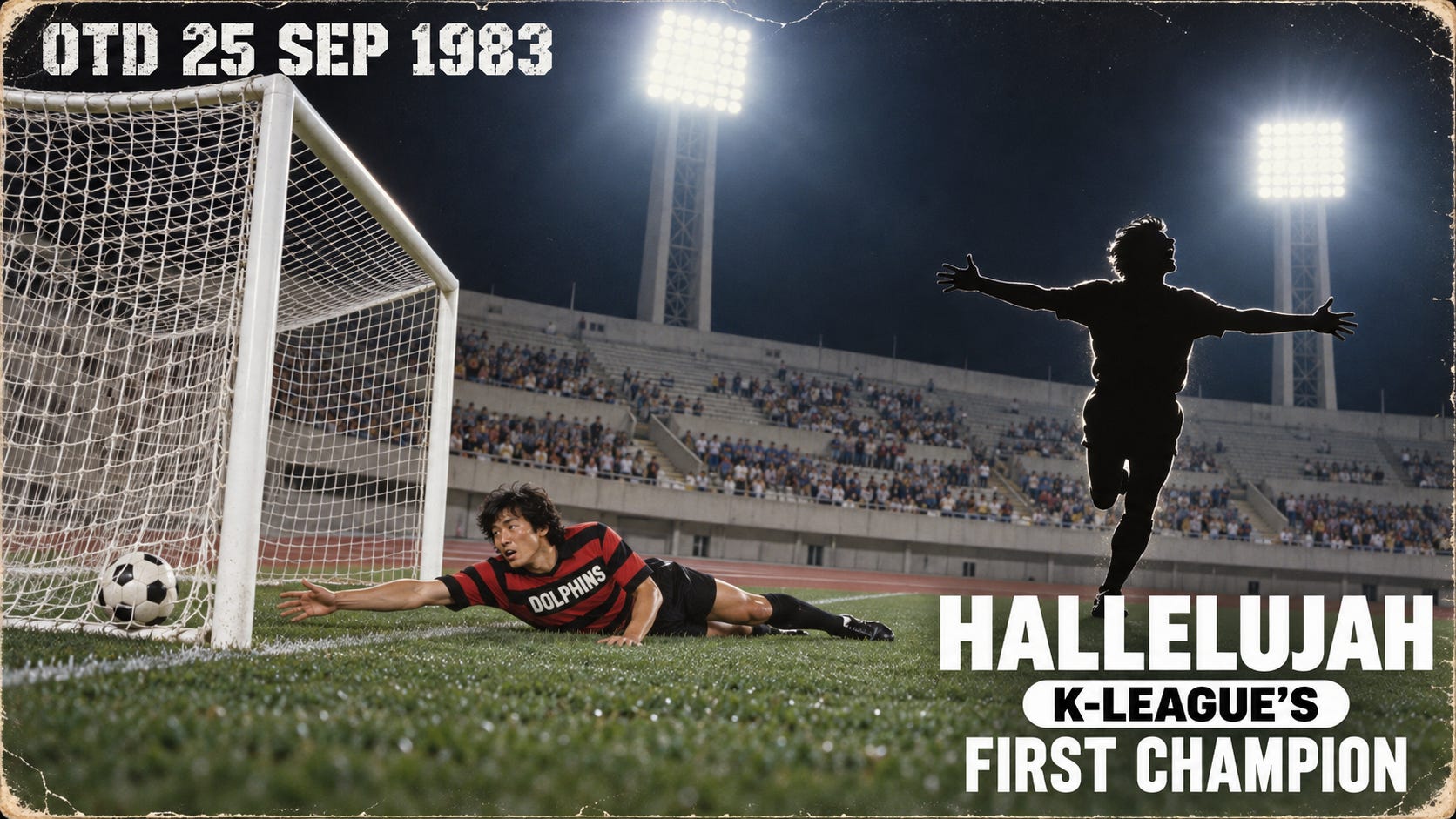
It is September 25, 1983, in Masan, on Korea’s south coast, and five football teams are finishing the first season of a national league that does not quite know what it is yet. It is called the Korean Super League, but only two of its clubs are fully professional, it has no settled home-and-away calendar, and it has toured the country like a traveling festival. Its teams carry the names of a church mission, an oil company, a steelmaker, an industrial conglomerate and a bank. And with ten minutes left in the entire season, the first championship is still undecided. Hallelujah Football Club need to beat the POSCO Dolphins, while Daewoo Royals sit one point behind and play later that afternoon, so a draw might not be enough. Then Oh Seok-jae scores. Hallelujah win 1-0, their players become the first champions of professional football in South Korea, and a league born from war, reconstruction, corporations and politics finally has its first name in the record book. This is the story of the road to that first Hallelujah.
How did we get here?
Football in Korea begins, in the traditional telling, with British sailors kicking a ball at the port of Incheon in 1882, but the organized game grew during a far more difficult period, Japanese colonial rule. The first All-Joseon Football Tournament was staged in 1921, clubs from Seoul and Pyongyang built one of the peninsula’s great sporting rivalries, and in September 1933 the Joseon Football Association, ancestor of today’s Korea Football Association, was founded under its first president, Park Seung-bin. Football was already doing more than filling an afternoon; under colonial rule it could offer an arena for Korean organization and identity. Then came liberation in 1945, division, the establishment of separate states in 1948, and in 1950 the Korean War, which destroyed cities, institutions and lives. A coherent football system had to be rebuilt inside a country rebuilding almost everything else.
Even so, the Republic of Korea joined FIFA in 1948 and helped found the Asian Football Confederation in 1954. That year its national team eliminated Japan to reach the World Cup in Switzerland, where, after an exhausting journey and almost no preparation, Hungary beat them 9-0 and Turkey won 7-0. Yet simply qualifying mattered: a country devastated by war had appeared on football’s largest stage. Two years later, in Hong Kong, Korea drew with the hosts, beat Israel and defeated South Vietnam 5-3 to become the first champion of Asia, then retained the title in 1960. Before South Korea possessed a professional league, it possessed a continental football identity.
The domestic game, however, remained a patchwork. Universities were powerful, and so were military, bank and company teams. The National Semi-Professional League, launched in 1964, gave works sides regular competition, but its footballers were employees as well as athletes, and clubs could be reorganized to suit the institutions behind them. That structure mirrored South Korea’s development model, in which rapid industrialization was driven by the state and by large corporations, and teams attached to banks, steel plants and conglomerates belonged to the same landscape. They could provide jobs and produce strong sides, but they did not yet create a stable professional culture built around local supporters. Politics entered directly, too: after North Korea reached the World Cup quarterfinals in 1966, the South Korean intelligence service created Yangzee Football Club, gathering leading players to train intensively. Yangzee dominated at home and reached the 1969 Asian Club Championship final, an extraordinary team but also a Cold War project, football prestige treated as evidence of national strength.
There were signs, too, that Korean quality could travel, and the greatest was Cha Bum-kun. After emerging through school, university, a bank side and the Air Force, Cha reached the Bundesliga in 1978, winning the UEFA Cup with Eintracht Frankfurt in 1980 and the German Cup in 1981; in the summer of 1983, just as the Super League found its feet, he moved to Bayer Leverkusen. His speed, power and goals made “Cha Boom” an overseas star before Korean club football had a fully professional home. By then the case for change was urgent. The national team had not returned to the World Cup since 1954, the semi-professional system scattered elite players among institutions, and professional baseball had launched in 1982, immediately competing for crowds, television and corporate money. Under the authoritarian government of Chun Doo-hwan, professional sport was also encouraged as mass entertainment, so the league’s birth mixed genuine football reform with corporate strategy and state politics.
The key institutional figure was Korea Football Association president Choi Soon-young. In 1980 he helped create Hallelujah, generally recognized as South Korea’s first professional football club, and the name was literal: a Christian missionary team built to combine elite football with evangelism. Hallelujah were soon joined in the professional ranks by the Yukong Elephants, backed by the Yukong oil company. But two clubs do not make a league, so the 1983 Super League combined them with three established works teams: the POSCO Dolphins of the Pohang steel company, the Daewoo Royals of the Daewoo conglomerate, and Kookmin Bank. Four of the five were tied to major economic institutions; Hallelujah, the champion to come, was the exception, and even it answered to a mission larger than any single town. Nor did the clubs truly belong to five home cities. The season was marketed as a series of regional double-headers, a tour that visited Seoul, Busan, Daegu, Jeonju and Daejeon before broadening through Gwangju, Chuncheon, Andong and Masan. It was national exposure before local rootedness.
On May 8, a crowd of 22,420 filed into Seoul’s Dongdaemun Stadium for the beginning. Yukong’s Park Yoon-ki scored the league’s first goal against Hallelujah, Park Chang-sun equalized in the seventieth minute, and the first professional-league match in Korean history ended 1-1. This was no procession. The new competition offered goals and parity in equal measure, with three-three shoot-outs and long unbeaten runs, and Park Yoon-ki would take the scoring title with nine. Hallelujah’s strength, by contrast, was collective. Their goalkeeper, Cho Byung-deuk, would be named the season’s best; the defender Park Sung-hwa was voted its most valuable player; Park Chang-sun supplied the assists; Oh Seok-jae and Park Sang-in shared the goals. Their coach was Ham Heung-chul, the goalkeeper from Korea’s Asian Cup triumphs of 1956 and 1960, a living connection between the representative age and the professional one.
Daewoo controlled first place for much of the second half of the season, and Hallelujah kept drawing when they needed to win. Then came the final week. On September 20 they lost 3-2 to POSCO in Andong; three days later, facing Daewoo, they answered through Park Chang-sun and Kim Hyun-bok in a 2-1 win that lifted them above the Royals for the first time since the opening rounds. So everything came down to September 25 in Masan, and to POSCO once again. For eighty minutes Ham’s team could not score. Then Oh Seok-jae did. Hallelujah finished with six wins, eight draws and two defeats, twenty points from sixteen games, and Daewoo’s later goalless draw left the Royals one point short. The first title in Korean professional football had been won in the last ten minutes of the first season.
So what?
The temptation is to treat 1983 as the moment Korean football became modern, and it was not that clean. The league was part professional and part semi-professional, its corporate identities were stronger than its local ones, and Hallelujah themselves left the professional competition after 1985 and returned to the works-game world. Crowds and formats would fluctuate, clubs would relocate and rename, and building durable supporter identities took decades. What 1983 created was not a finished system but permanence. Existing sides professionalized, new corporate clubs arrived, and from 1987 the league was fully professional. POSCO evolved into the Pohang Steelers, Daewoo’s lineage runs through the club now called Busan IPark, and Yukong became the ancestor of Jeju United. The names kept changing; the national professional structure survived the changes.
It also transformed the national team’s working environment, concentrating players, coaches and competitive matches in one place. Three years later, Korea returned to the World Cup after a thirty-two-year absence, and it was Hallelujah’s Park Chang-sun who captained the 1986 side and scored against Argentina, the first goal the Republic of Korea had ever scored at a World Cup finals, with POSCO’s Choi Soon-ho adding one against Italy. The league had not conjured those players out of nothing; both were already excellent. What it gave their generation was a permanent professional stage at home. That stage soon became formidable across the continent. Daewoo won the Asian Club Championship in 1986, Pohang were crowned Asian champions in 1997, 1998 and 2009, and titles followed for the clubs later known as Seongnam, Suwon Samsung Bluewings, Jeonbuk and Ulsan. No national league has contributed more champions across the history of Asia’s premier club competition. The clear boundary is the global one: no Korean club has won the world title, with Pohang’s third place in 2009 the closest. The K League became an Asian power without becoming financially comparable to Europe’s richest leagues, and more recently it has had to compete with the greater spending of clubs in Saudi Arabia, Japan and China.
The league did not, by itself, win Korea the right to co-host the 2002 World Cup; that 1996 decision was a political compromise between rival Korean and Japanese bids. But a functioning professional league made the claim credible, demonstrating organizational capacity, supplying players and coaches, and providing a football public onto which new stadiums and a global tournament could be grafted. The World Cup then transformed the league in return, as a team built largely of K League products reached the semifinals and filled the streets with red-shirted crowds. Korea has reached every World Cup since 1986, a run of remarkable persistence, even as the domestic league could never keep every star it developed, and even as recent tournaments have delivered the familiar Korean mix of famous scalps and early exits. Hallelujah’s own afterlife captures the instability beneath the achievement. The original champions dissolved amid the Asian financial crisis of 1998, and the name, passed to a later Christian club, drifted through the lower reaches of the pyramid before disappearing from the league after 2016. The first champion has no continuous place in today’s top division. But it has a permanent place in the beginning.
Three things to take away
First, the 1983 league was a hybrid, not a clean modern start. It was born of football reform, corporate money and state politics at once, and it was national exposure before it was ever local belonging.
Second, its lasting gift was permanence rather than perfection. The structure survived every rename and relocation, made the K League the most successful in Asian club history, and gave the national team a home stage that helped return it to the World Cup and keep it there.
Third, permanence is not the same as stability. Even the first champions eventually vanished from the top flight, a reminder that a durable system is one that keeps having to remake itself.
On this day in 1983, Korean professional football was five teams, a touring schedule, corporate backing, political purpose and a title decided by one late goal in Masan. It did not solve Korean football. It gave Korean football somewhere to keep solving itself.
---
📩 Got an idea to an OTD story? otd@17lawsguy.com
Yesterday: 24 September 1961, Dino Zoff’s Serie A Debut. Five Goals Before Greatness.