

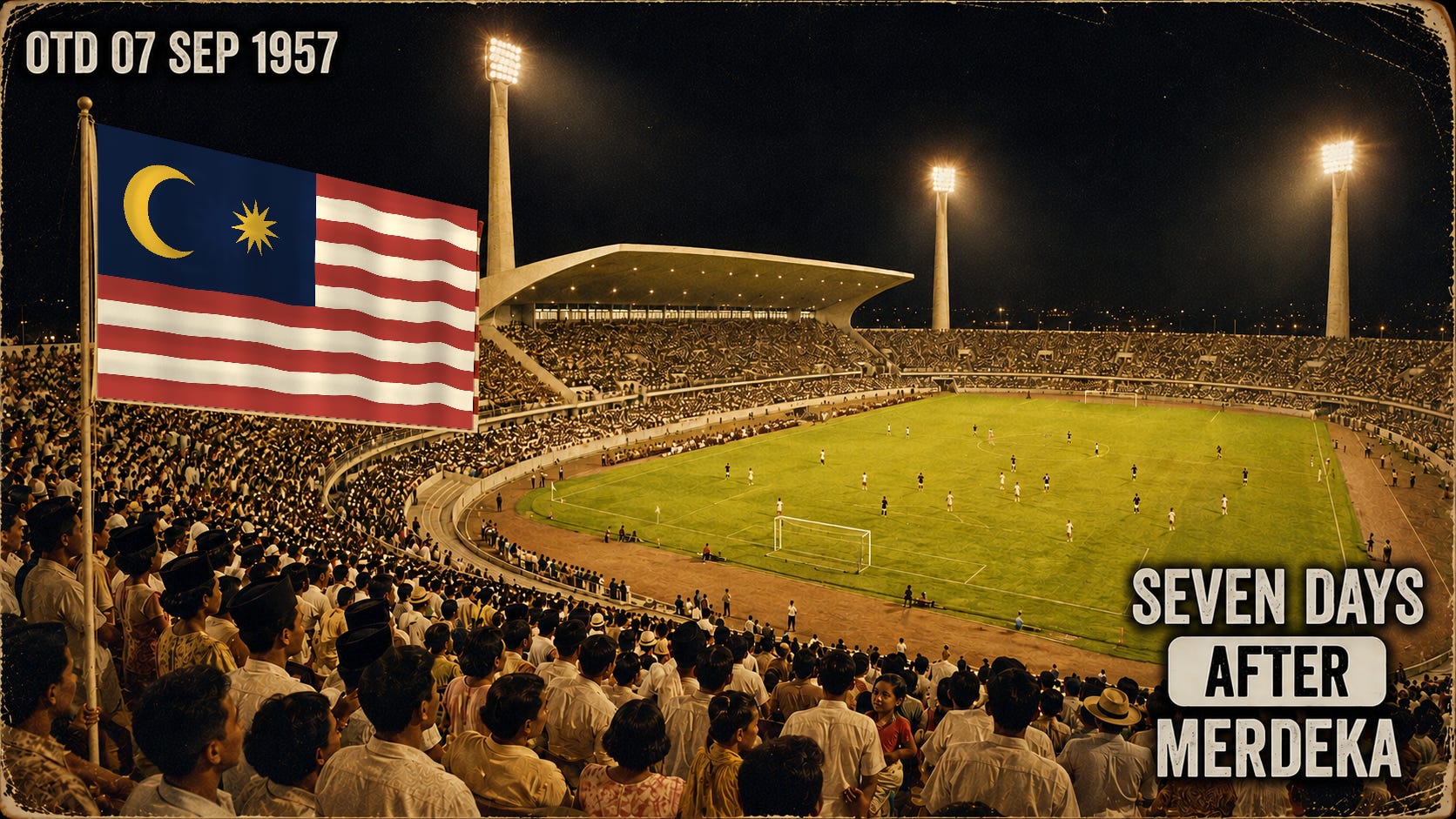
It is September 7, 1957, in Kuala Lumpur, at a Stadium Merdeka barely two weeks old, in a country that has been independent for exactly one week. Tonight a Hong Kong selection beats South Vietnam 3-1 to become the first winner of a brand-new competition, the Merdeka Tournament, which will grow into Asia’s oldest enduring international invitational tournament. What begins as part football, part independence celebration is about to become one of the institutions of Asian football.
To understand it, start with Asia itself, where the political map was being redrawn. Indonesia had declared independence in 1945, Burma in 1948, Cambodia in 1953, and across the region European empires were retreating while new states decided what independence should look like. Sport became part of that project. The first Asian Games, in New Delhi in 1951, saw India take the football gold, a new Asia staging tournaments rather than merely talking about itself. In 1954, football built its own continental institution when representatives gathered in Manila during the Asian Games to create the Asian Football Confederation, with thirteen founding associations including Hong Kong, Indonesia, Burma, Singapore and South Vietnam. Two years later Hong Kong hosted the first Asian Cup, which South Korea won. So by 1957 Asian football had a confederation, a championship and the Asian Games. What it lacked was a calendar. International matches were scarce and travel expensive, and teams needed places to meet.
Enter Tunku Abdul Rahman, about to become the first Prime Minister of independent Malaya, and also a football man, president of the Football Association of Malaya, who believed sport could help bind together a country divided by ethnicity, religion and colonial history. He pushed for a great national stadium, and it was built astonishingly fast. On August 30, 1957, Tunku opened Stadium Merdeka. The next morning, more than twenty thousand people gathered there again as British rule ended and the new flag was raised, and Tunku cried Merdeka, freedom, seven times, the crowd answering him each time. Then football took over, because that very day the first Merdeka Tournament began. Eight teams took part: Malaya, Burma, Cambodia, Indonesia, Siam, which is today Thailand, Singapore, South Vietnam and Hong Kong. These were direct invitations from the Football Association of Malaya, a wonderful snapshot of a region in transition, some independent, some newly so, some still colonies, all playing inside a stadium named for freedom.
Hong Kong arrived in a strange form. This was not a conventional national expedition but, in the main, the club side Eastern, reinforced by a player from South China. Eastern had just won their first Hong Kong league title and had spent that summer touring, playing their way through New Zealand and Australia and Singapore for the best part of three months before reaching Kuala Lumpur. They may have been tired, but they were certainly match-sharp. The tournament itself was gloriously high-scoring. Hong Kong beat Cambodia 6-2, Indonesia beat Siam 4-0, and South Vietnam and Singapore produced a 5-5 draw after extra time and had to replay the next day, South Vietnam winning 2-1. The four winners went into a championship group, the four losers into a consolation competition, so nobody went home early. Across both groups, seventeen matches produced eighty-five goals.
Hong Kong then beat Indonesia 2-1, drew 3-3 with Malaya, and, on September 7, beat South Vietnam 3-1 to finish their championship group unbeaten, a point clear of Indonesia. The Eastern-based Hong Kong side were the first champions of the Merdeka Tournament. And that could have been the end of it, a one-off independence festival, a nice idea and a nice trophy. Instead, they did it again, and again, and again.
The tournament’s importance was never that it outranked the Asian Cup, because it did not; it was not an official continental championship. Its importance was repetition. It was held every year from 1957 through 1988, and it gave Asian teams something they badly needed in the 1950s and 60s: regular international games, different opponents, tournament pressure, travel and scouting, a place to measure themselves against the region. Through the 1960s and 70s it became important enough to earn the nickname the Mini Asian Cup. Tunku’s influence grew alongside it; he became AFC President in 1958 and stayed for nineteen years, and the AFC itself credits his Merdeka Tournament as a blueprint for later international events in Asia. Other countries built their own: Thailand created the King’s Cup, South Korea the President’s Cup, Indonesia the Jakarta Anniversary Tournament, all part of the same tournament culture Merdeka helped prove could work.
Eventually the football world changed. World Cup qualification expanded, the Asian Cup grew, club competitions developed, and international calendars filled up, so that by the late 1980s Merdeka was no longer essential in the way it had been. After 1988 it became intermittent, but it never quite disappeared, and the historical claim endures. Asia’s oldest enduring international invitational tournament began not in Tokyo or Seoul, but in a brand-new stadium in a brand-new country whose founding Prime Minister happened to love football.
---
🎧 Listen on Spotify, Apple Podcasts, Amazon Music, Overcast, iHeart, and YouTube.
📩 Got an episode idea? otd@17lawsguy.com
Yesterday: 6 September 1995, the Scorpion Kick at Wembley.
Tomorrow: 8 September 1888, twelve clubs kick off the very first Football League.