
The First Old Firm
28 May 1888 · Celtic beat Rangers 5-2 in their first ever match — then both teams sat down together for supper. The fiercest rivalry in British football began as a friendly.

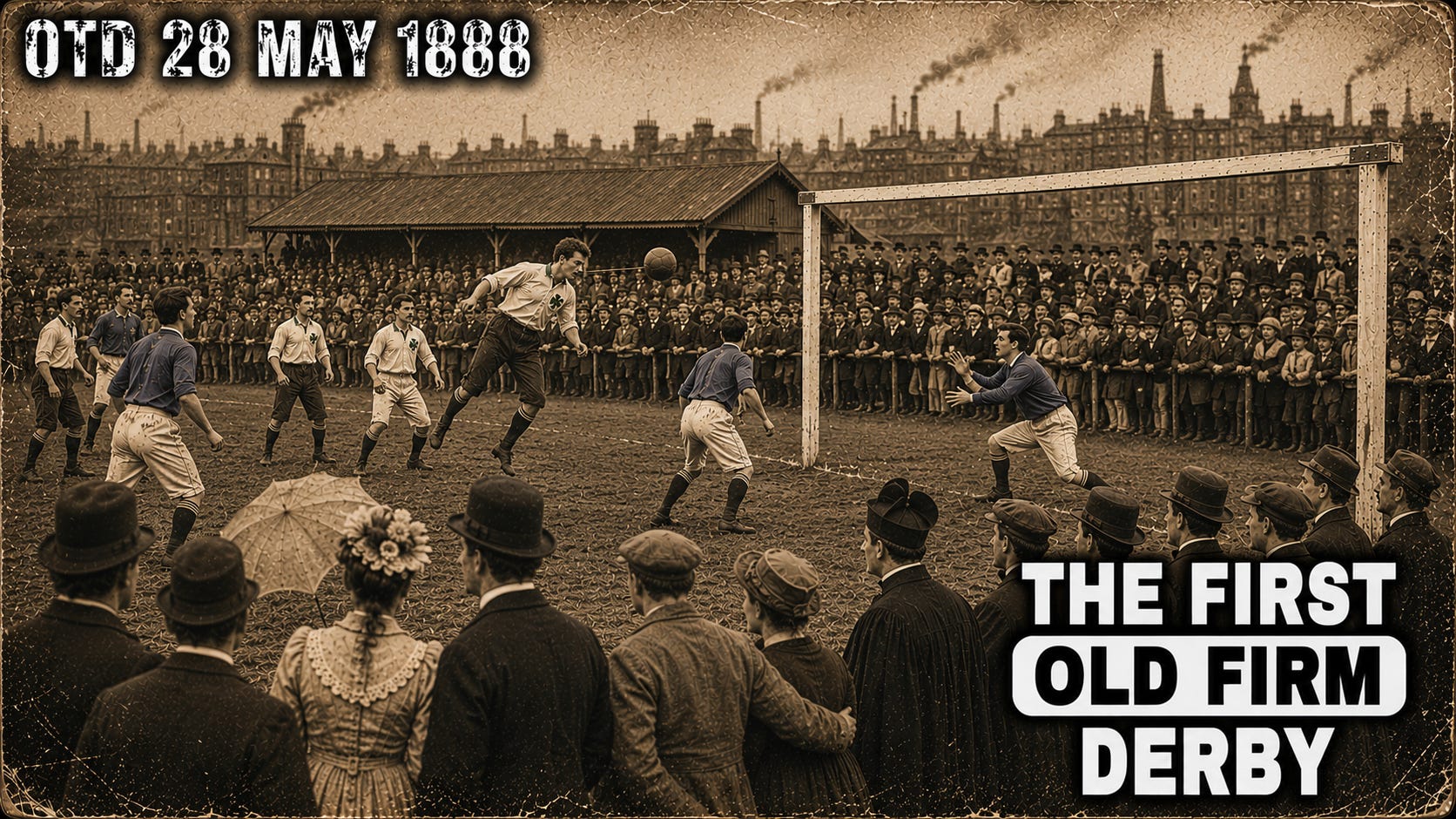
It is 28 May 1888, in the east end of Glasgow. A new football club finally plays its first match. The club is Celtic. The opponent is Rangers. The score is Celtic 5, Rangers 2.
And afterwards, the players and officials do not separate into hostile camps. They go indoors. They eat supper. They listen to music. They make speeches. They toast one another’s health.
Because nobody in that room knows what history will later call this match: the first Old Firm.
To understand the night, you need two stories running side by side — the game becoming organized, and Irish Catholic Scotland finding a football voice.
The first: football was being codified. England’s FA formed in 1863; Scotland’s in 1873, with Queen’s Park the pioneer and the Scottish Cup its prize. Scotland and England had met in the first official international in 1872. And a footballing idea was already taking shape — the English game associated with dribbling, the Scottish game with passing and combination. By the 1880s, football wasn’t just being codified. It was being argued over.
Rangers were born into that world, founded in 1872, part of Glasgow’s developing football scene. And in March 1888, William McGregor wrote the letter that would create the Football League. By May 1888, football was right on the edge of becoming modern.
But that’s only half the story. The other half begins with famine, migration, poverty and charity.
After the Great Famine, large numbers of Irish migrants settled in Scotland. In Edinburgh, the Irish Catholic community formed Hibernian in 1875 — and Hibs became proof of concept: a football club could raise money, create pride, and gather a scattered community around something joyful.
In Glasgow, Brother Walfrid was watching. Born Andrew Kerins in County Sligo, he was a Marist Brother working among poor Irish families in the east end. His concern wasn’t trophies. It was hunger — the Poor Children’s Dinner Table. But he understood what Hibernian had shown: football could feed people and build an institution. So in November 1887, at a meeting in St Mary’s church hall, Celtic was founded. Walfrid insisted on the name — Celtic, meant to bridge Scotland and Ireland.
A club needs a ground, and 1888 made it urgent: Glasgow was hosting a great International Exhibition, and Celtic’s founders wanted to be ready for the crowds. The first Celtic Park was built by volunteers near Dalmarnock Street. And twenty days after it opened, Celtic played their first match.
Why Rangers? Not prophecy. Rangers were local, had name value, and could field a side late in the season. It was, simply, a sensible friendly. History turned it into something else.
Celtic wore white shirts with green collars, before a crowd of around two thousand. Rangers pushed early with the wind. Then Celtic attacked: Mick Dunbar’s corner, Neil McCallum heading in the first goal in Celtic history. Rangers equalized through Soutar. Another Dunbar corner, and James Kelly made it 2-1. After the break, the Maley family entered the story — Tom Maley scoring, Soutar answering again, 3-2 — before Maley struck twice more to complete a hat-trick. A sixth was disallowed for offside. Final score: Celtic 5, Rangers 2.
And then the part that feels almost impossible from a modern distance. At St Mary’s Hall, the clubs gathered together: supper, a concert, speeches, toasts. Men from Celtic, Rangers and Hibernian shared the evening. This was not hatred. This was a new club being welcomed into the Glasgow game.
The name came later. The best-documented explanation points to 1904, when the periodical The Scottish Referee ran a satirical cartoon before a Celtic-Rangers cup final: an old man with a sandwich board reading ‘Patronise The Old Firm: Rangers, Celtic Ltd.’ ‘Firm’ as in business. By the 1900s, the two clubs had become Scottish football’s great box-office pairing — rivals, yes, but mutually profitable ones.
Because rivalries are not always born as rivalries. Sometimes they begin as fixtures. Then money enters. Then trophies. Then identity. Then memory. The early religious and political lines hardened over decades — Celtic increasingly representing Irish Catholic Glasgow, Rangers the Protestant and Unionist side — layered onto the fixture, not present at its birth. And once that happened, Celtic against Rangers was no longer just sport. It became a way for Glasgow to argue with itself.
More than a century later, the ledger between them remains almost impossibly level. But it began with supper, toasts, and a friendly match at a ground built to feed poor children.
🎙️ THE PODCAST GOES DEEPER. The full episode has what this post compresses: Queen’s Park and the Scottish passing game; the full story of Walfrid and the Poor Children’s Dinner Table; the rent rise from £50 to £450 that pushed Celtic ‘from the graveyard to Paradise’; the 1902 Ibrox disaster and how the rivalry hardened; and the great Old Firm days from the 7-1 of 1957 to the modern title duopoly.
---
🎧 Listen on Spotify, Apple Podcasts, Amazon Music, Overcast, iHeart, and YouTube.
📩 Got an episode idea? otd@17lawsguy.com
Yesterday: 27 May 1934 — Second World Cup Begins.
Tomorrow: 29 May 1958 — why clubs and countries wear stars above the crest.