

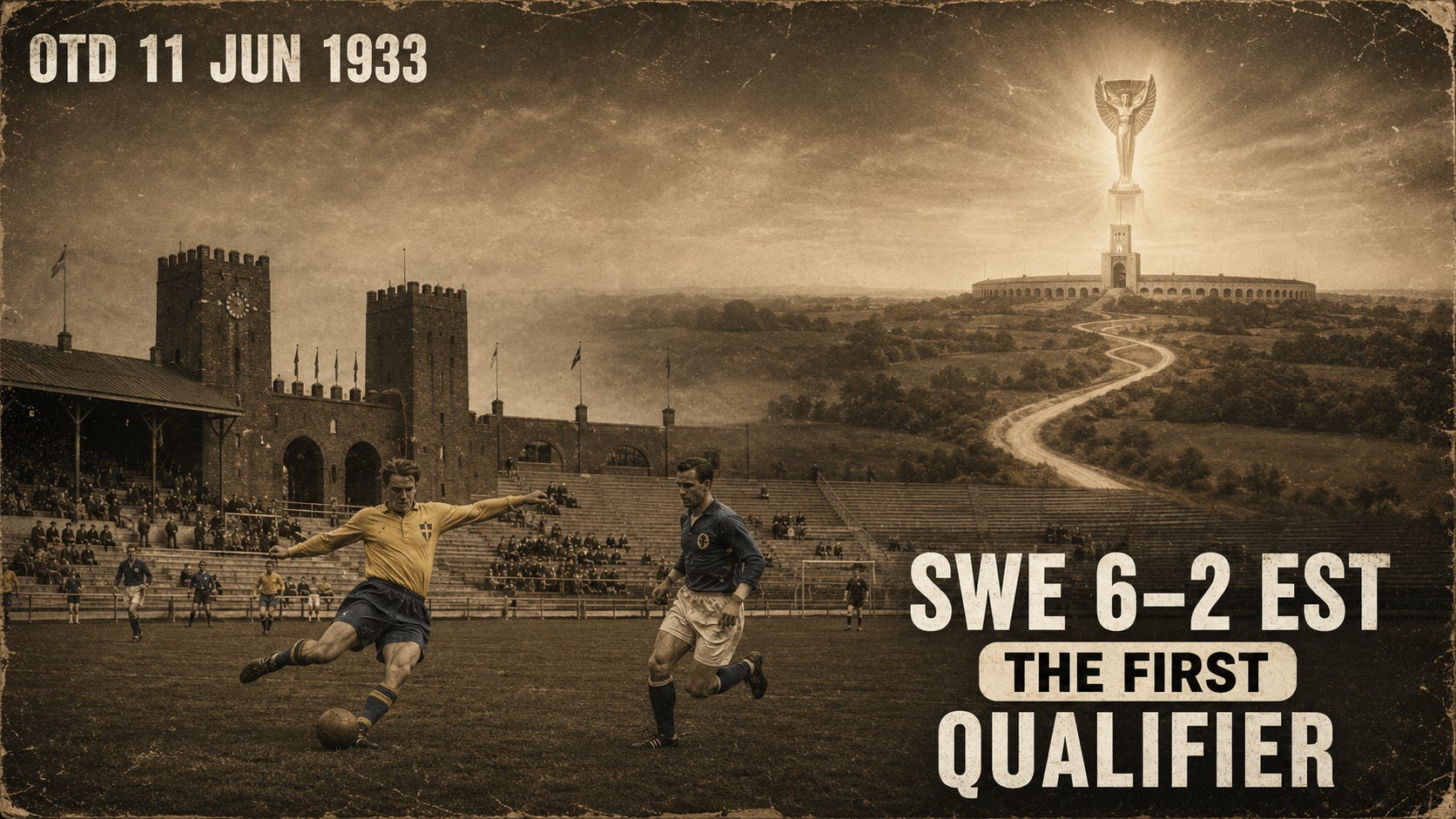
It is 11 June 1933, at the Olympic Stadium in Stockholm. Sweden against Estonia. And today, football does something it had never really needed to do before. A match is played not to win a tournament, not to win a cup, but simply to get into one. Sweden win 6-2. This is the first World Cup qualifier, and effectively the first qualifying match for any major international football tournament.
How did we get here? International football began simply. Scotland met England in 1872, and the British Home Championship followed in the 1880s, the first regular international tournament. But there was no qualification. You were a Home Nation, or you were not. Olympic football grew from the 1900s, and Uruguay used the 1924 and 1928 Games to announce South America’s arrival, but again, no qualification in the modern sense. Committees accepted entries, and politics, amateur rules, travel and money decided who turned up. The South American Championship (from 1916) gathered the continental powers. The Central European International Cup (from 1927) brought together Austria, Hungary, Czechoslovakia, Italy and Switzerland. The Balkan Cup, the Baltic Cup, the Nordic Championship, the Far Eastern Games: all serious, all evidence that international football was spreading, and none of them yet facing the problem that would define the World Cup. Too many nations wanting to play in one final tournament.
That is the real invention. In 1930, the first World Cup in Uruguay did not need qualifying. FIFA invited sixteen nations, thirteen came, the British stayed outside FIFA, and many Europeans declined the long voyage. But when the tournament returned to Europe for 1934 in Italy, the demand changed completely. Thirty-two countries entered for sixteen places. Now FIFA had a mathematical, logistical and political problem. You could not invite everyone. You could not stage a 32-team finals. So you needed filters. You needed preliminary rounds. You needed qualification.
There was no standardized modern system yet. The teams were divided into twelve groups, organized mostly by geography, travel and cost. Some were home-and-away ties, some were small groups, some had two qualifying spots. The American section was a multi-stage scramble that ended with the United States beating Mexico in a one-off match in Rome, three days before the World Cup began. It was improvised, not elegant. But it was the beginning of the system. Italy themselves had to qualify, beating Greece 4-0. It remains the only World Cup where the host had to qualify for its own tournament, which tells you how new the rules still were.
So, on 11 June 1933, the whole thing started in Stockholm. Sweden and Estonia were in a group with Lithuania. Sweden were the established side, with Olympic pedigree and a serious Nordic football tradition, playing in the 1912 Olympic Stadium, a venue built for one global festival now hosting the start of another. Estonia were younger, independent after the First World War, still building, but not anonymous: their goalkeeper Evald Tipner became an early Estonian sporting great, and the Baltic Cup gave the region real competition.
Then the first whistle, and the goals came fast. Seven minutes in, Sweden scored, a goal history usually credits to Knut Kroon, though some sources treat it as an own goal by Tipner. Either way, it was the first goal in World Cup qualification history. Three minutes later it was 2-0, and by the 13th minute 3-0. Sweden led 4-0 at the break. Then Estonia answered through Leonhard Kass and Richard Kuremaa to make it 4-2, and for a moment the first qualifier was not an administrative milestone but a real match. Sweden finished it off, 6-2. The first ever qualifier was high-scoring, open and decisive. A few weeks later Sweden beat Lithuania 2-0 in Kaunas and were through, and in Italy in 1934 they even beat Argentina before losing to Germany in the quarterfinals. But all of that came later. On 11 June 1933, the main thing was simpler: the road to the World Cup had begun.
They could not have known what they were starting. The finals are the visible summit; the qualifiers are the mountain range. The 1934 campaign had 27 qualifying matches and 141 goals. The 2026 cycle grew into a monster: a 48-team finals, more than 200 eligible nations, and over 900 qualifying matches across six confederations. Across World Cup history, qualifying has become its own universe, with more than 9,000 matches and more than 26,000 goals, and more heartbreak than the finals could ever hold.
That is the genius of qualification. It democratizes longing. Only a few teams can win the World Cup, but almost everyone can dream of reaching it. And the road gives football stories the finals never could: Tomaszewski’s night at Wembley in 1973 that put Poland through and England out; the grief of Wales against Scotland in 1985, when Jock Stein died at the final whistle; Ireland’s breakthrough against Spain in 1989; the late collapse of France against Bulgaria in 1993; Australia’s agony against Iran in 1997. Honduras and El Salvador in 1969. By 2026, the road even carried Curaçao to the finals, the smallest nation ever to reach a men’s World Cup.
That is why 11 June 1933 matters. Qualification was not inevitable. Football invented the long road only when demand outgrew capacity, and once it did, the journey became as dramatic and painful as the destination. It all began with eight goals in Stockholm.
🎙️ THE PODCAST GOES DEEPER. The full episode has more on the early tournaments that needed no qualifying, the improvised 1934 group system, the goal-by-goal in Stockholm, the all-time qualifying statistics and top scorers, and a fuller set of great qualifying nights from around the world. That is the 10-minute version.
---
🎧 Listen on Spotify, Apple Podcasts, Amazon Music, Overcast, iHeart, and YouTube.
📩 Got an episode idea? otd@17lawsguy.com
Yesterday: 10 June 1978, Allez les Verts? Plus: Argentina Lose Buenos Aires.
Tomorrow: 12 June 1938, the Battle of Bordeaux.