

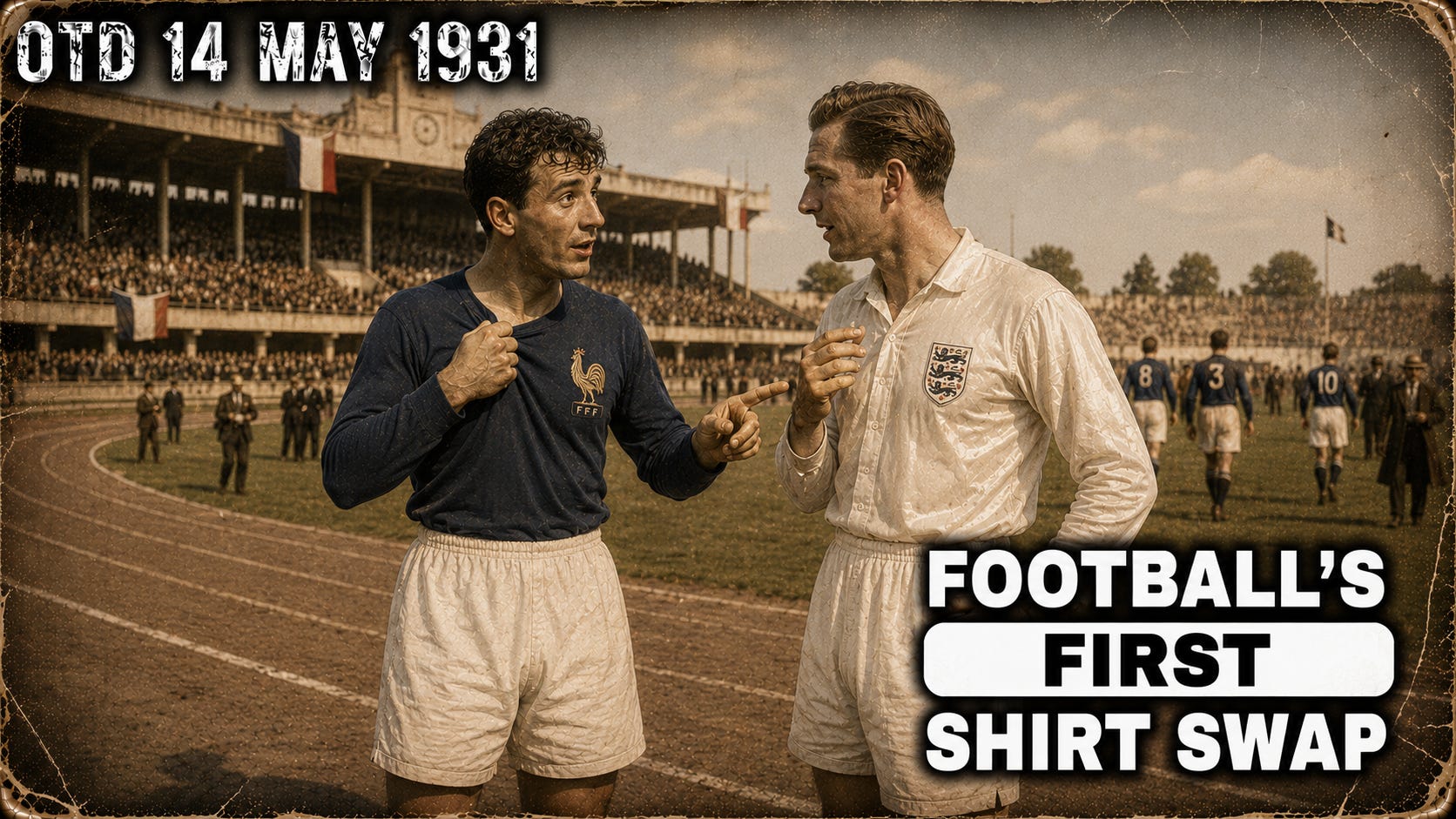
It is 14 May 1931. Colombes, outside Paris. France against England.
England are the inventors of the game. France have never beaten them in a full senior international. And for the French players, this is not just a friendly. It is a chance to beat the masters at their own game.
They do more than beat them. They win 5-2.
And after the final whistle, something happens that feels completely normal today, but had to be invented by someone, somewhere, once.
The French players ask the English players if they can exchange shirts.
England agree.
And football gains one of its most familiar rituals: the shirt swap.
To understand why this needed to be invented, you have to remember what shirts were in 1931. They were not personal brands. No names. Often no numbers. The shirt belonged to the association, the club, the kit bag, the institution. You did not automatically give it away because, quite literally, it may not have felt like yours to give.
There was also the culture of the match. After games, teams and officials often met in clubhouses, dining rooms, hotels, receptions. They shook hands. They spoke. They dined. They toasted. The game still carried traces of amateur sociability even while professionalism was changing everything.
But nobody had yet turned the opponent’s shirt into the object of memory.
France had been waiting for this match. They had lost to England six times in a row going into Colombes. Some heavily: 6-0 in 1927, 5-1 in 1928, 4-1 in 1929. There had been a famous French win over an English amateur side in 1921, but this was different. This was England’s professional touring team.
France had important players in 1931. Alexis Thépot, the goalkeeper, was captain — he had played at the 1930 World Cup in Uruguay. Lucien Laurent was there, the man who had scored the first goal in World Cup history, against Mexico in Montevideo. Marcel Capelle, Étienne Mattler, Edmond Delfour, Ernest Libérati and Marcel Langiller — all part of the generation carrying France from amateur disorder into the international modern age.
England were strong but comparatively inexperienced as a group. Hugh Turner in goal. Alf Strange as captain. Sam Crooks, Tom “Pongo” Waring, Harry Burgess, Eric Houghton. A real England side, but not an untouchable machine.
The match began exactly as the old pattern suggested. After ten minutes, England led through Sam Crooks. France could have folded into the familiar script.
Instead, five minutes later, Lucien Laurent equalized. Then Robert Mercier, the debutant, made it 2-1. Then Marcel Langiller made it 3-1. At half-time, France were not surviving. They were winning.
After the break, Edmond Delfour scored. Pongo Waring pulled one back for England. Then Mercier scored again. France 5, England 2.
That is the sporting context for the shirt swap.
Because after the final whistle, the French players wanted a souvenir. They had beaten England. Not England’s amateurs. Not an English club. England. The inventors. The professionals. The measuring stick.
So they asked for the shirts. And the little detail is wonderful: the French shirts were cotton; the English shirts were silk chemisettes. This was not only a swap of colours. It was a swap of football cultures.
The gesture made sense because it combined respect with possession. You kept the opponent’s shirt because the opponent mattered. It was a textile autograph. A relic from a match that had meant something.
The shirt exchange did not instantly become the fully standardized ritual we know today. There was no football tournament at the 1932 Olympics. The 1934 World Cup did not suddenly turn shirt-swapping into a formal custom. Through the 1930s, money, kits, amateur codes and national-association habits still made it occasional rather than automatic.
But the seed was planted.
After the Second World War, the practice became easier to imagine. International tournaments grew. Travel increased. World Cups produced once-in-a-lifetime meetings. Shirts became visual records of football’s expanding world. The 1954 World Cup is often cited as a further stage in the spread of the custom. By 1970, the practice gave us perhaps the most famous shirt swap of all: Pelé and Bobby Moore after Brazil beat England 1-0 in Guadalajara. Two champions, one photograph, and the idea of mutual respect made visible.
And shirt-swapping can also reveal when football refuses respect. In 1966, after England beat Argentina at Wembley, Alberto González tried to swap shirts with George Cohen. Alf Ramsey stopped it. The image became the opposite of Pelé and Moore: not friendship, but hostility; not exchange, but refusal.
That is why 14 May 1931 still matters. Not because every player immediately walked off every pitch swapping shirts from that day forward. They did not. But because the French players understood something after beating England.
That the opponent’s shirt could hold the memory of the match better than any newspaper headline.
🎙️ The full episode (linked above) has more — including the wider history of shirt-swaps in club football, Eusébio asking Di Stéfano for his shirt after the 1962 European Cup final, and the modern controversies (half-time swaps, swaps after heavy defeats). The whole arc is in the audio.
---
🎧 Also available on Apple Podcasts, Amazon Music, Overcast, iHeart, and YouTube.
📩 Got an episode idea? otd@17lawsguy.com
Yesterday: 13 May 1902 — The First Clásico.
Tomorrow: 15 May 1974 — the day Scotland’s Jinky Johnstone drifted out to sea in Largs.