
The First Star Above a Crest
29 May 1958 · Juventus won a tenth title, chose a gold star to mark it — and gave football a symbol every fan now reads at a glance.

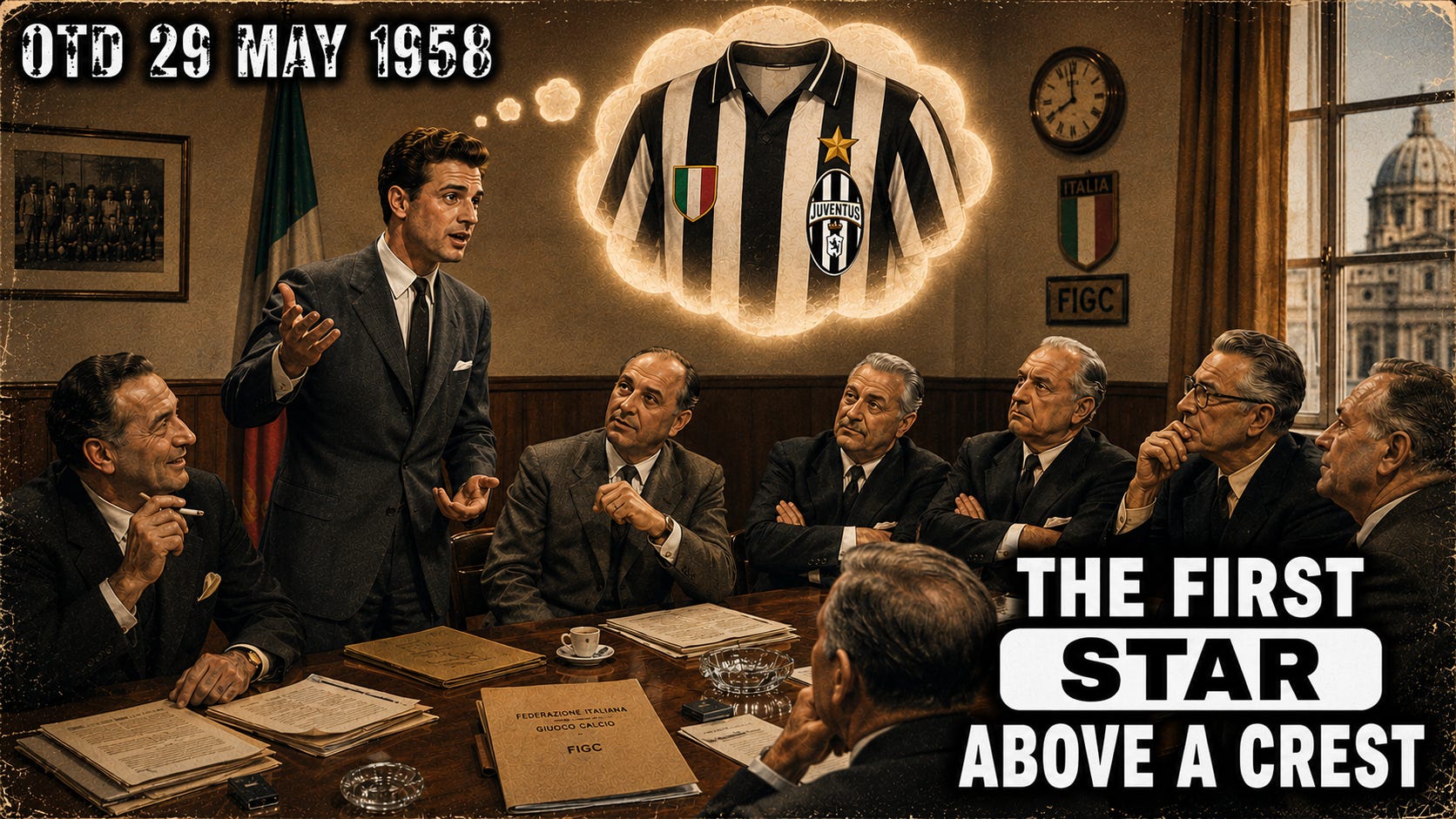
Two friends of the pod — Nick in London and Rodrigo in Washington — have both asked me the same thing in different ways: why do some clubs and national teams have stars above the crest? One star, four stars, sometimes dozens. What do they mean, and where did it begin?
The answer takes us to Italy, to Juventus, to a tenth national title, and to a quiet federation decision on 29 May 1958 that changed the visual language of football.
Start with what came before the star: the scudetto, the “little shield.” Since 1924, the Italian federation had let the defending champion wear a small shield in the colors of the flag — green, white, red — on the shirt the following season. Genoa wore it first. Over time the word itself became the title: to win the Italian championship is to win the scudetto.
But the scudetto is temporary. It moves to whoever wins next. And at the start of 1957-58, Juventus and Genoa were tied on nine championships each. No club had ever reached ten.
Then Juventus, rebuilt around the Trio Magico — Giampiero Boniperti, the elegant captain; Omar Sívori, the abrasive Argentine genius; and John Charles, the Welsh colossus Turin loved as Il Gigante Buono — made the season a statement. On 4 May 1958, a 0-0 draw with Fiorentina was enough. With three matches to spare, Juventus were champions of Italy for the tenth time. The first club ever to reach ten.
Their young president, Umberto Agnelli, saw that this milestone needed more than applause. He wanted the shirt to show it — something permanent in addition to the temporary scudetto. Like a marker of accumulated greatness. So on 29 May 1958, four days after the season ended, the federation approved the principle: any club reaching ten titles, or a multiple of ten, could wear a “special distinction”. Agnelli chose a gold star. One for ten, two for twenty, three for thirty.
That choice turned a Juventus milestone into a football language. The Scudetto della Prima Stella — the First Star Scudetto — became the origin point. And the Italian code is still readable at a glance today: Juventus with three stars, Inter with two, Milan with one.
But Italy also gives us the complications — because stars are never as simple as they look. After Calciopoli in 2006, Juventus were stripped of one title and another went unassigned, opening a gap between titles the club counts “on the pitch” and titles the federation officially recognizes. For a while Juventus wore no third star, just the slogan “30 sul campo” — thirty on the pitch — until they had thirty officially.
And the rules diverge by country. Germany runs a formal Bundesliga scale (one star for three titles, up to five for thirty) — but Bayern’s 1932 German championship doesn’t count, because the system “only” counts Bundesliga titles from 1963. Boca Juniors’ crest became famous for a galaxy of stars, one for each major honor — less regulated, visually unforgettable. In Scotland, Rangers wear five for league milestones; Celtic wear a single star, not for domestic titles but for the 1967 European Cup.
Then there are national teams, where most fans know the rule: one star per World Cup. Brazil five, Germany and Italy four, Argentina three, France two, England and Spain one.
But Uruguay are the great history lesson. They wear four stars: 1930 and 1950 for the World Cups, and 1924 and 1928 for Olympic football gold. And those four are defensible — because before the World Cup existed, FIFA itself agreed that the Olympic football tournament, played under FIFA regulations, would count as a world championship. Uruguay won both, then won the first World Cup too. They weren’t retrofitting mythology. They were champions in the world-championship format of their time.
So the star is not one single rule. It’s a family of rules — domestic leagues one way, national teams another, confederations restricting them, clubs mythologizing them. And fans read them instantly, because a football shirt is not just clothing. It’s history worn in public.
That’s why 29 May 1958 matters. A federation decision about a Juventus shirt became a global habit — a gold star over a crest as shorthand for achievement, hierarchy, argument, memory, and identity.
🎙️ THE PODCAST GOES DEEPER. The full episode has what this post compresses: the fascist-era Stella al Merito Sportivo and how Italy was already thinking in symbols; the full Trio Magico season; the complete Calciopoli star saga and Andrea Agnelli’s refusal to wear three stars until a rival reached two; the 1908/1912 Olympic debate; and the UEFA multiple-winner badge and FIFA Champions Badge. That’s the 10-minute version.
---
🎧 Listen on Spotify, Apple Podcasts, Amazon Music, Overcast, iHeart, and YouTube.
📩 Got an episode idea? otd@17lawsguy.com — like Nick and Rodrigo, you might inspire one.
Yesterday: 28 May 1888 — The First Old Firm.
Tomorrow: 30 May 1919 — Roberto Chery, the save, and the tribute in sky blue.