

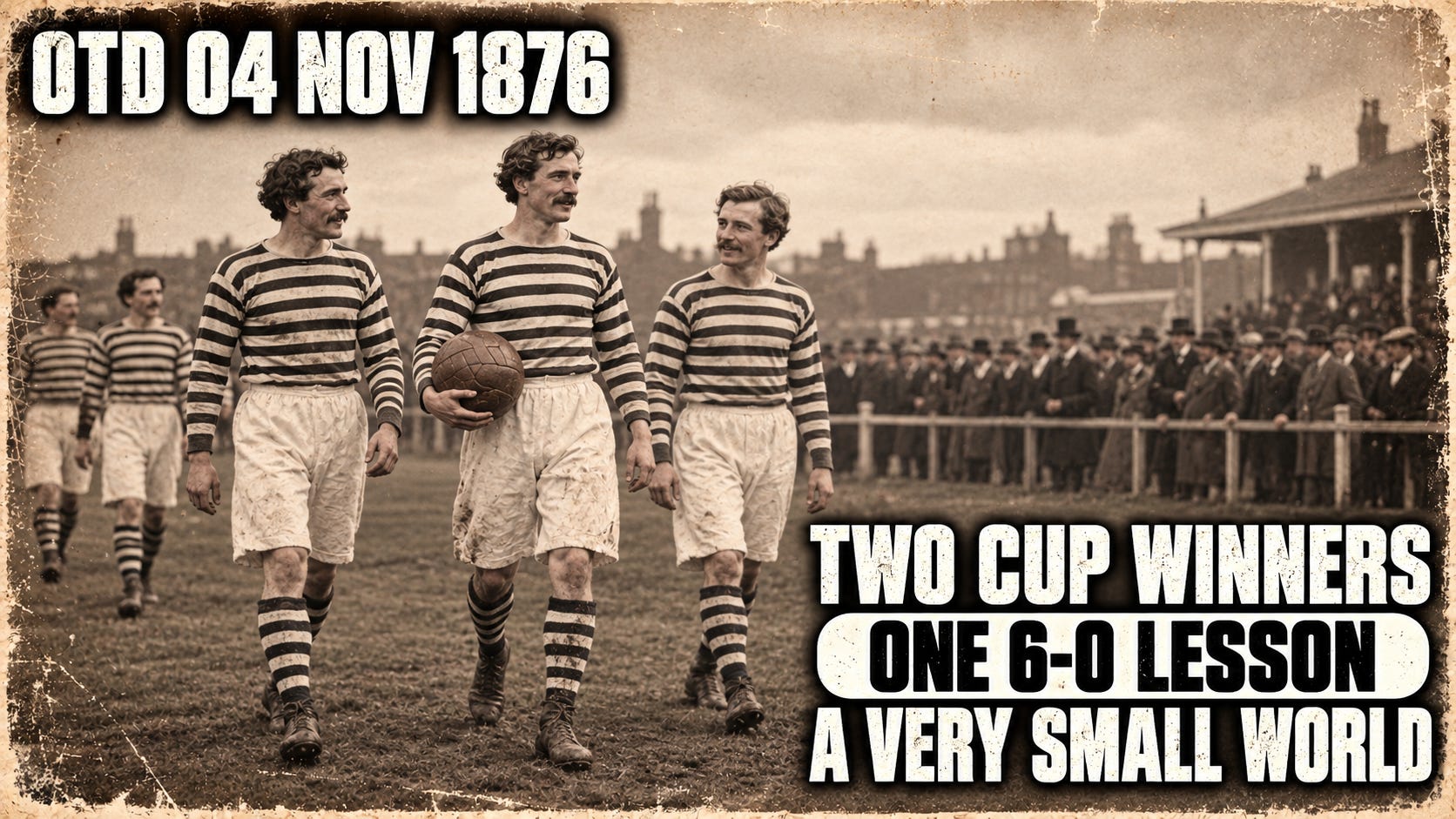
At a quarter to three on 4 November 1876, Joseph Taylor kicked off at the Oval. Queen’s Park had brought an unfinished argument from Glasgow. Nine months earlier, Wanderers had inflicted the first defeat in the Scottish club’s history. Now the two countries’ reigning cup winners were meeting in London, and the visitors intended to restore the proper order.
Within half an hour, Queen’s Park led 3-0. By the finish it was 6-0. The English cup holders had been passed around on their own ground, and the Scots had collected a revenge considerably larger than the original injury.
Football’s world was still small enough for such a meeting to suggest supremacy beyond either country. Yet this was no scheduled world final, with a governing body, qualification regulations and a trophy awaiting its champions. It was an independently arranged challenge between leading clubs, one of the encounters from which the language of a world championship would grow.
That makes the 150th anniversary more revealing. Before football could organize the world, it had to persuade two clubs to agree on a train fare.
How Did We Get Here?
England’s Football Association was thirteen years old. Its Challenge Cup had begun in 1871; Scotland’s association and cup followed in 1873. Neither country had a national league, and neither permitted professional players. The two cup competitions supplied the clearest available answer to the question of which clubs mattered most. The first World Cup, in Uruguay in 1930, was still fifty-four years away.
Wanderers had won the English trophy in 1872, 1873 and 1876. Their strength came from an educated amateur network, drawing players from public schools and universities. Queen’s Park, founded in Glasgow in 1867, had won all three Scottish Cups contested so far. They were simultaneously a football team and an institution through which Scottish football organized itself.
In November 1872, Queen’s Park had supplied Scotland’s entire side for the first official international against England. The 0-0 at Hamilton Crescent established a rivalry already capable of attracting thousands. Wales played its first international against Scotland in March 1876. Beyond Britain, association football existed, but nothing yet approached England and Scotland’s combination of clubs, cups and representative matches.
The methods were different too. The English amateur tradition celebrated dribbling: a gifted runner carrying the ball, teammates following to support or recover it. Queen’s Park made combination a collective habit. A teammate could become the next stage of an attack rather than merely the witness to somebody else’s run.
The distinction was never absolute. English teams could pass, and the Royal Engineers had developed combination of their own. Scottish players could dribble brilliantly. But Queen’s Park’s repeated exchanges, anticipation and coordinated movement offered a particularly persuasive demonstration of what a team could do together.
The relationship with Wanderers began well before both held cups. Charles W. Alcock, secretary of both Wanderers and the FA, wrote on 25 November 1870 proposing a meeting with eleven Scots living north of the Tweed. Queen’s Park’s president, H. N. Smith, pursued the correspondence. Smith and William Wotherspoon were subsequently authorized to arrange a club challenge in northern England.
Carlisle and Newcastle were proposed. So were dates in September or October 1871, and either an eleven-guinea trophy or eleven medals worth a guinea apiece. The match never materialized. The ambition was already larger than the organization.
Instead, the clubs met in the first FA Cup semifinal in March 1872. Queen’s Park held Wanderers 0-0 but could not finance another London journey for the replay. Wanderers advanced and won the inaugural final. Cross-border football had already discovered that sporting equality did not guarantee equal access to the next match.
In October 1875, Wanderers finally visited Glasgow and lost 5-0. Their February 1876 return victory, 2-0 at the Oval, therefore carried exceptional weight. Queen’s Park’s long unbeaten record had ended against the very club they had so recently overwhelmed.
On 26 July, the Queen’s Park committee instructed its match secretary, Andrew Hillcoat, to arrange another home-and-home exchange, beginning in London. On the English side, Jarvis Kenrick had succeeded Alcock as secretary. The practical negotiation consumed the months before November: when to play, whether Wanderers would travel north, and how much that journey should cost the hosts.
Queen’s Park offered £60 toward Wanderers’ Glasgow expenses. Wanderers wanted £100. The Scots rejected the demand and resented it. They nevertheless accepted the London date, leaving the return unresolved. William MacKinnon proposed economy for their own journey: third class by the Midland route, at £2 1s. 3d. a head.
The fixture emerged through club correspondence and committee decisions, not a joint association proclamation establishing a world title. Revenge provided the urgency; prestige and a return gate supplied the attraction; money threatened to prevent the arrangement altogether.
The setting was Surrey’s cricket ground at Kennington, an expanse adapted for winter football rather than an enclosed modern football theater. Spectators gathered around a playing area whose grass was rather long. There were no floodlights to rescue the afternoon once daylight disappeared, no net to hold a scored ball and no penalty area drawn across the turf.
November supplied the season, but the match supplied its own discomforts. Wanderers were badly depleted. They began with nine men, and although Charles Wollaston arrived during the first half, they never had more than ten. Queen’s Park also used replacements, including Senior and Cochrane. The comparison between national styles would be played through an unequal contest, not a controlled experiment.
Wanderers won the toss and chose the eastern goal. Taylor started the game for Queen’s Park, and the visitors immediately drove the ball toward the English backs. A corner first brought only a near miss, the ball passing behind. The next sustained pressure brought Senior’s opening goal.
Otter briefly relieved Wanderers with a dribble. Otherwise, Queen’s Park kept finding one another. The ball traveled through the English lines again, and MacKinnon finished the second within the opening quarter-hour. He added another from a good run and shot. The halftime score was 3-0.
There were moments when Wanderers threatened to turn resistance into something more. Kenrick and Smith combined in a rush; a corner created uncertainty near the Scottish line; shots and dribbles occasionally carried the home side away from its own goal. But Queen’s Park’s support gave their attacks continuity. A move could survive the stopping of its first runner.
After the interval, Weir scored the fourth following another sequence of passing. Wanderers then enjoyed their best sustained spell, pressing hard without scoring. Queen’s Park’s defending absorbed it, and Weir supplied the fifth.
Even the mechanics of danger were different. A handling offense near goal did not produce a penalty: the penalty kick had not yet been introduced. A free kick awarded to Queen’s Park created another anxious clearance without adding to the score.
Late on, Campbell and MacKinnon combined through two or three opponents. Smith, Heron, Kenrick and Wollaston continued trying to construct an English reply; one coordinated move ended with Wollaston putting the ball just outside the post. Queen’s Park’s backs and goalkeeper John Dickson kept the goal intact.
Near the finish, a shot from the side, a pass forward and Weir’s close-range touch completed the rout. Weir had three, MacKinnon two and Senior one. Queen’s Park had won 6-0 without needing to convert every chance they created.
The most important spectacle had been repetition. Again and again, a Scottish player had somewhere useful to send the ball.
So What?
The Glasgow Herald’s judgment was emphatic: Queen’s Park were superior in the difficult business of playing together. Their passing and support had made the difference visible. The same report acknowledged Wanderers’ diminished strength and expected a better contest when the clubs next met.
The Scotsman likewise praised the winners’ play and singled out Weir near goal. Scottish satisfaction was entirely understandable. The club whose February defeat had wounded its standing had returned to London and scored six without reply.
It was a startling score, but a national revolution cannot be dated to its conclusion. England did not discover passing for the first time that afternoon, and the defeated club did not immediately become irrelevant. Wanderers retained the FA Cup in 1877 and won it again in 1878. Their 6-0 defeat sat inside a sequence of three consecutive cup triumphs.
Nor did Queen’s Park’s revenge secure permanent Scottish superiority. Before the year ended, Vale of Leven beat them 2-1 in the Scottish Cup. The side that had seemed overwhelming in London could still lose at home. Football was acquiring enough strong opponents to make invincibility an increasingly fragile identity.
The promised Wanderers return, penciled in for 17 March 1877, never happened. Letters pursued it; the expense disagreement persisted. Kenrick also relayed a rumor that Queen’s Park’s defeat by Vale reflected internal divisions. The Scots denied it and pressed for the visit. No rematch followed. Their magnificent demonstration had not settled the administrative argument.
The wider transformation came through movement. Scottish players carried combination south, where ambitious clubs offered employment and, increasingly, payment. England legalized professionalism in 1885; Scotland followed in 1893. The football England absorbed was partly Scottish, even when the institutions employing its practitioners were English.
The good was the spread of skill and opportunity. The ugly was the hypocrisy of an amateur system in which a wealthy man’s freedom to play could be treated as purer than a working man’s need to earn. Scotland could celebrate its methods while losing men who wanted compensation for using them.
The championship idea developed unevenly alongside that change. These were occasional challenges, not an annual competition with an unbroken roll of champions. In 1878, Vale of Leven beat Wanderers 3-1 at the Oval. The Greenock Advertiser treated the meeting of the cup holders as effectively deciding the United Kingdom’s championship.
Vale also beat Old Etonians 5-2 in 1879. Queen’s Park defeated Clapham Rovers in 1880 and 1881, then overwhelmed Old Carthusians 8-0 in 1882. Cup-winning status made a powerful advertisement, but the arrangements remained individual fixtures.
In 1883, Dumbarton beat Blackburn Olympic 6-1 with Scottish FA president Thomas Lawrie refereeing. English objections included disputed offside goals, and the Sheffield Daily Telegraph challenged the inflation of a club result into a national championship. The argument over what these games actually proved existed at the time.
The title could become still more elastic. Aston Villa beat fellow cup holders Hibernian 3-0 in April 1887. That August, Hibs beat Preston North End 2-1 in a match advertised as a world championship decider. Preston had not won the FA Cup. Selection and publicity were already pulling in different directions.
The clearest Victorian world-title occasion came in May 1888. Scottish Cup winners Renton beat FA Cup winners West Bromwich Albion 4-1 at second Hampden, through atrocious weather. Irish international Jack Sinclair refereed. Renton commissioned a commemorative trophy and made “Champions of the World” part of the club’s identity.
In 1889, Scottish Cup winners Third Lanark drew 3-3 with Preston North End, who had just won the first Football League title and the FA Cup without losing in either competition. A meeting with the Invincibles could produce a draw rather than a coronation. There was no permanent machinery to settle every claim.
The changing balance produced a delicious reversal in 1895. Sunderland, champions of England, beat Scottish champions Hearts 5-3 in Edinburgh. Sunderland’s eleven were Scots. A national rivalry had become a showcase for the export of Scottish footballers.
These claims were provincial, but their ambition was not uniquely ridiculous. Baseball’s World Series would also attach a global title to a geographically restricted contest. A championship’s name can reveal the limits of its organizers’ horizon as clearly as the strength of its winners.
The FA Cup itself once offered a less tidy geography than the label “English Cup” suggests. Queen’s Park reached its final in 1884 and 1885, losing both to Blackburn Rovers. Rangers reached the semifinals in 1887, the last season of Scottish participation. Irish entrants included Kildare, Cliftonville, Distillery and Linfield Athletic. National boundaries were being negotiated through entries, travel bills and association decisions.
There was no single cancellation notice ending the world challenges. Leagues began in England in 1888 and Scotland in 1890, filling calendars and multiplying the possible champions. Later meetings continued, including Bury’s two 2-1 wins over Rangers in December 1903 and January 1904. But there was no permanent organization to defend a place in the schedule, and an exclusively British claim grew harder to sustain as football spread.
Other cross-border experiments answered different needs. The 1902 British League Cup raised money after the Ibrox disaster. Later came the Empire Exhibition and Coronation tournaments, the Texaco Cup and the Anglo-Scottish Cup. Nottingham Forest’s 1976 triumph in the latter became an early marker of Brian Clough and Peter Taylor’s rise. Declining interest helped end Scottish participation in 1981.
The Charity Shield followed a separate institutional line. Its immediate predecessor was the Sheriff of London Shield, introduced in 1898 to match leading professionals and amateurs for charity. The FA’s version began in 1908. It was not simply the 1876 challenge reborn.
World club competition eventually required a much wider map: the Intercontinental Cup from 1960, FIFA’s first Club World Championship in 2000, and the expanded 32-team Club World Cup in 2025. Chelsea beat Paris Saint-Germain 3-0 in that final. On this 150th anniversary, a genuinely international structure exists around the old ambition.
Three Things to Take Away
1. Queen’s Park beat Wanderers 6-0 on 4 November 1876, with both clubs holding their national cups. The fixture belongs to the prehistory of club world championships, rather than an established annual world competition.
2. Passing and support made Queen’s Park’s superiority unmistakable, but Wanderers’ missing players matter. The result demonstrated a method; it did not single-handedly transform English football.
3. Scottish influence traveled farther than Scottish dominance. Players, ideas and competition formats crossed borders until football needed a much larger definition of the world.
On This Day
On 4 November 1876, Queen’s Park arrived at the Oval with an old defeat to avenge and left with a 6-0 victory. Their journey had required months of letters and an economical railway fare. The ball had completed its own journey rather more easily, passing from one striped shirt to the next.
Have a football memory, a correction or a story that belongs here? Write to otd@17lawsguy.com.
Yesterday: Eleven Against Eight - 03 November 1976.