

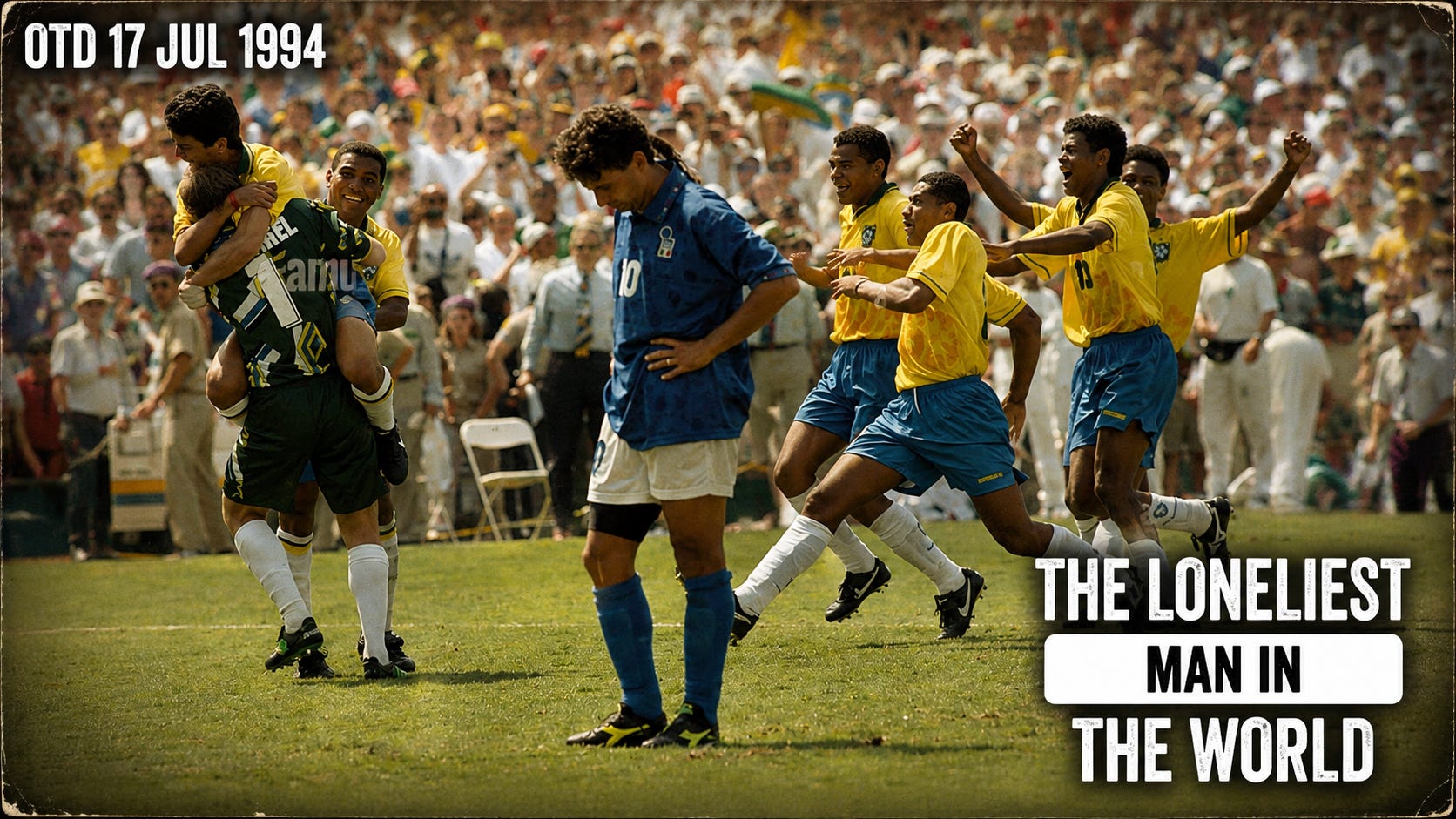
It is July 17, 1994. Pasadena. The Rose Bowl, 12:30 in the afternoon, hot and bright, almost cruel for a final. Brazil against Italy, the two most successful World Cup nations on Earth at that moment, three titles each. And after 120 minutes, the score is still 0-0.
So the World Cup final goes somewhere it has never gone before. Penalties.
USA 94 was a World Cup many people had doubted. A soccer World Cup in the United States? In giant American football stadiums, in summer heat? They came. The tournament broke the all-time average attendance record, 68,991 per match, more than 3.5 million in total across only 52 matches. Even after the expanded 2026 tournament broke the total attendance record, 1994’s average remains the benchmark.
Brazil arrive carrying 24 years without a title, which for Brazil is not a drought but a national argument. The beautiful wound of 1982, the frustration of 1986, the dullness of 1990. So Carlos Alberto Parreira builds something different: less romantic, more compact. Taffarel in goal, Aldair and Márcio Santos, Jorginho and Branco, Mauro Silva and Dunga, and up front the tournament’s decisive partnership, Romário and Bebeto.
Italy arrive on their nerves. They survive the group as one of the best third-placed teams, and then Roberto Baggio drags them through the knockout rounds almost alone: a late rescue against Nigeria, the winner against Spain, two against Bulgaria in the semi-final. Franco Baresi tears his meniscus in the group stage, has surgery mid-tournament, and somehow starts the final weeks later.
The final itself is careful and tense. Romário heads straight at Pagliuca. Massaro has Italy’s huge chance, and Taffarel saves. Jorginho goes off injured early, and a young Cafu comes on, a substitution that quietly matters for the next decade of Brazilian World Cups. Baggio, who has carried Italy for two weeks, looks empty. Baresi, days removed from a knee operation, is somehow still defending everything. Extra time comes and goes; Romário misses from close range. For the first time, a World Cup final is scoreless.
Then the shootout. Baresi, first for Italy, sends it over. Pagliuca saves from Márcio Santos. Albertini scores. Romário scores, in off the post. Evani scores. Branco scores. Massaro walks up, and Taffarel saves. Dunga scores: Brazil 3, Italy 2. Now Baggio, the best player of the tournament, has to score to keep Italy alive.
Over the bar.
Brazil are world champions, and the first World Cup final decided by penalties ends with one of the loneliest images in football: Baggio standing still, head down, while Brazil explode behind him. Dunga, the symbol of the supposedly un-Brazilian Brazil, lifts the trophy, and the title is dedicated in part to Ayrton Senna, the Formula 1 driver who had died at Imola months earlier.
Brazil’s fourth star is respected more than adored. People compare it to 1982 and ask where the poetry went, which is too simple. Romário was genius, Bebeto was class, Taffarel was decisive, and Dunga and Mauro Silva gave Brazil the platform its fantasy teams sometimes lacked. This was Brazil learning that beauty is not the only form of national truth, and in 2002 Ronaldo, Rivaldo, and Ronaldinho added the fifth star.
Italy lose a World Cup final without conceding a goal, which is almost unbearable. Baresi’s tears, Massaro’s miss, Baggio’s ponytail and penalty. But the story does not end in Pasadena. In 2006, in Berlin, Italy score all five in the second shootout final ever played and become world champions.
And 2022 gives penalties the ending 1994 did not: a 3-3 masterpiece, Messi against Mbappé, extra-time chaos, and still, at the end, the same ritual. A single walk from halfway. One player alone with the ball. A country holding its breath. The whole world reduced to twelve yards.
🎙️ THE PODCAST GOES DEEPER. The full episode has the shootout kick by kick, penalties’ pre-1994 history, and how Italy’s spot-kick story turned in 2006. That’s the 10-minute version.
---
🎧 Listen on Spotify, Apple Podcasts, Amazon Music, Overcast, iHeart, and YouTube.
📩 Got an episode idea? otd@17lawsguy.com
Yesterday: 16 July 1950, the Maracanazo.
Tomorrow: 18 July 1930, Uruguay against Peru, and the inauguration of the Estadio Centenario.
Oh, the memories. Great final!
Small detail I love about USA '94: first World Cup with player names on the shirts and first the 3p-for-a-win. So much of the modern tournament's presentation in essence starts that summer, in the country so many said didn't care about the sport. In my opinion, it blazed the trail for MLS two years later.