

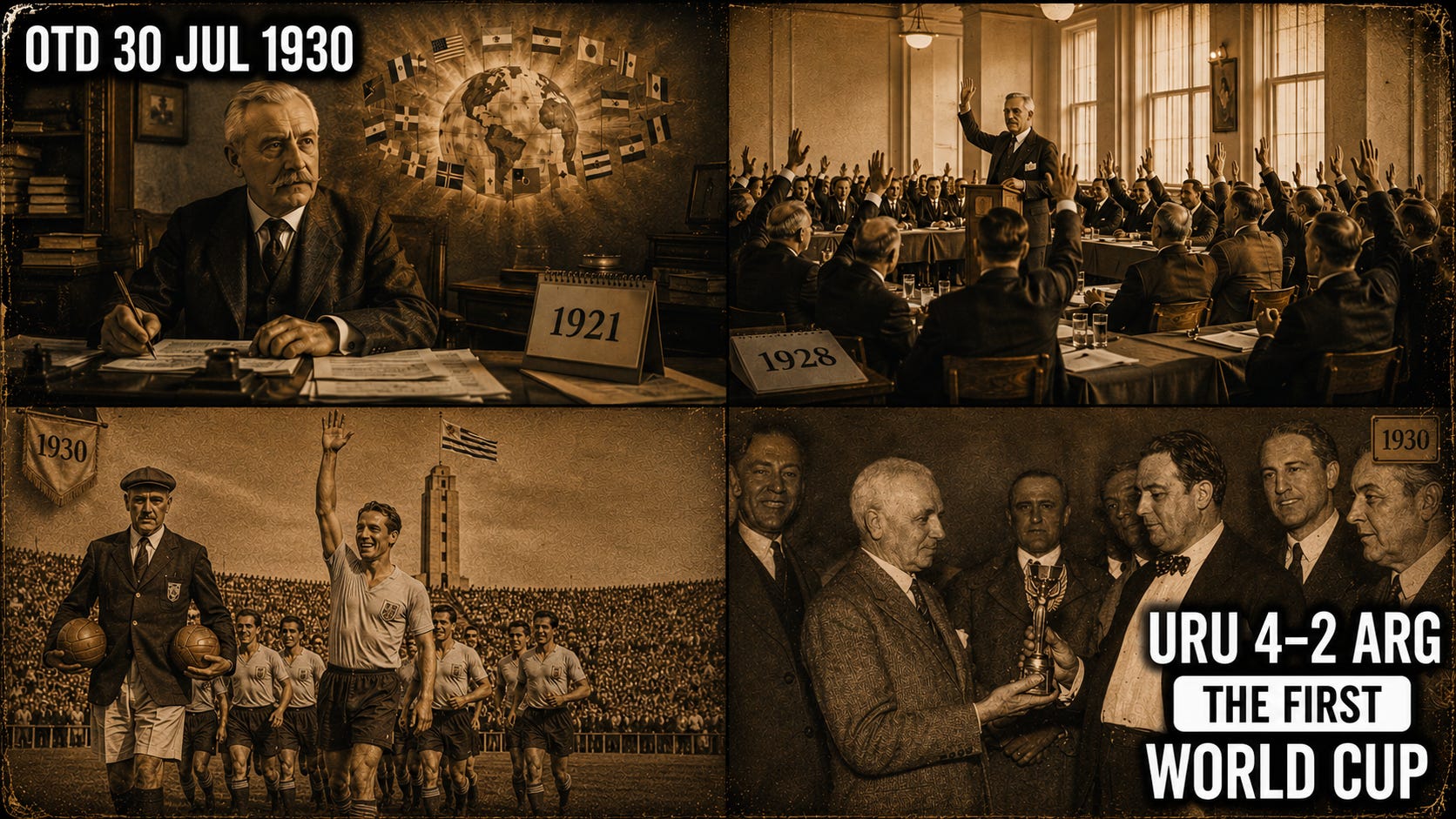
It is July 30, 1930. Montevideo. Estadio Centenario. Uruguay against Argentina. The first World Cup final, a repeat of the 1928 Olympic final, the Río de la Plata rivalry, two teams, two match balls, one Belgian referee, and a trophy ceremony stranger than the plan. Argentina lead 2-1 at half-time. Then Uruguay come back. Uruguay 4, Argentina 2. The first world champions.
International football existed long before this. England and Scotland played in 1872. The Olympics gave the game a public stage in 1908 and 1912. But there was no world championship owned by football itself. FIFA, founded in Paris in 1904, was fragile at first, the Home Nations partly outside it, fights over amateurism everywhere. Then Jules Rimet became president in 1921 and began turning a weak federation into a global program. His problem was the Olympics: prestigious, but owned by the Olympic movement, which meant amateurism, and football was moving beyond amateurism.
Then Uruguay changed everything. Paris 1924: Europe discovered that South American football was not decorative but elite, and Uruguay won gold. Amsterdam 1928: gold again, this time beating Argentina in a replayed final. Now FIFA had its proof. At the 1928 Amsterdam Congress it approved its own world championship, and in 1929 chose Uruguay to host, Olympic champions in their centenary year, offering a modern stadium and help with travel costs.
The tournament was improvised. The ideal was sixteen teams; thirteen came. Europe hesitated: no England, no Italy, no Spain, no Germany, no Austria. Only France, Belgium, Romania, and Yugoslavia crossed the Atlantic. Egypt intended to come but weather delayed them and the ship left without them. On July 13 the tournament began, France beat Mexico 4-1 at Pocitos, and Lucien Laurent scored the first goal in World Cup history. Argentina beat France with the referee blowing six minutes early, then Mexico 6-3 and Chile 3-1. Uruguay waited for the Centenario, then beat Peru and Romania. And the semi-finals produced perfect symmetry: Argentina 6 United States 1, Uruguay 6 Yugoslavia 1. The final would be Uruguay against Argentina. Again.
John Langenus of Belgium refereed, formal in shirt, tie, and knickerbockers, with an escape plan ready should the tension boil over. Montevideo was full, and thousands of Argentines had crossed the river, not all of them able to reach the ground. Before kickoff there was an argument about the ball: Argentina wanted theirs, Uruguay wanted theirs, and Langenus compromised, Argentina’s ball in the first half, Uruguay’s in the second. The first World Cup final could not agree on the object at the center of the sport.
Twelfth minute: Pablo Dorado scored for Uruguay. But Argentina were not guests. Carlos Peucelle equalized, and in the thirty-eighth minute Guillermo Stábile, the tournament’s great scorer, made it 2-1. At half-time the Olympic champions were behind, the hosts trailing, the new tournament leaning toward Buenos Aires.
Then Uruguay became Uruguay. Pedro Cea equalized in the fifty-eighth minute. Santos Iriarte made it 3-2 in the sixty-eighth. Argentina protested and pushed, Luis Monti playing inside real menace after receiving threats before the match. Then, in the eighty-ninth minute, Héctor Castro, El Manco, the one-armed forward who had scored the first goal in the Centenario’s history, scored again. Uruguay 4, Argentina 2. World champions.
Then came a small mystery. The planned ceremony was elegant: teams to the Tribuna Olímpica, flag raised, anthem played, Rimet presenting the trophy. Instead, Uruguay’s players stayed on the pitch, watched the flag rise, and ran a lap of honor carrying a silver cup that was not clearly the World Cup trophy. Film shows it. A photograph shows Dorado holding it. Possibly an old Río de la Plata trophy, possibly something else. Football had created a world championship before it had learned to stage the ritual.
José Nasazzi, El Gran Mariscal, captained the champions, as he had in 1924 and 1928: Uruguay’s first global football age had a captain, not just a player. The World Cup had worked. Not perfectly, not with a full European field, but it had a champion, a final, photographs, and a scoreboard. Uruguay 4, Argentina 2. That is what made the idea irreversible.
🎙️ THE PODCAST GOES DEEPER. The full episode has the two-ball compromise, the mystery silver cup, and Monti playing under threats. That’s the 10-minute version.
---
🎧 Listen on Spotify, Apple Podcasts, Amazon Music, Overcast, iHeart, and YouTube.
📩 Got an episode idea? otd@17lawsguy.com
Yesterday: 29 July 1911, Mohun Bagan and the IFA Shield.