

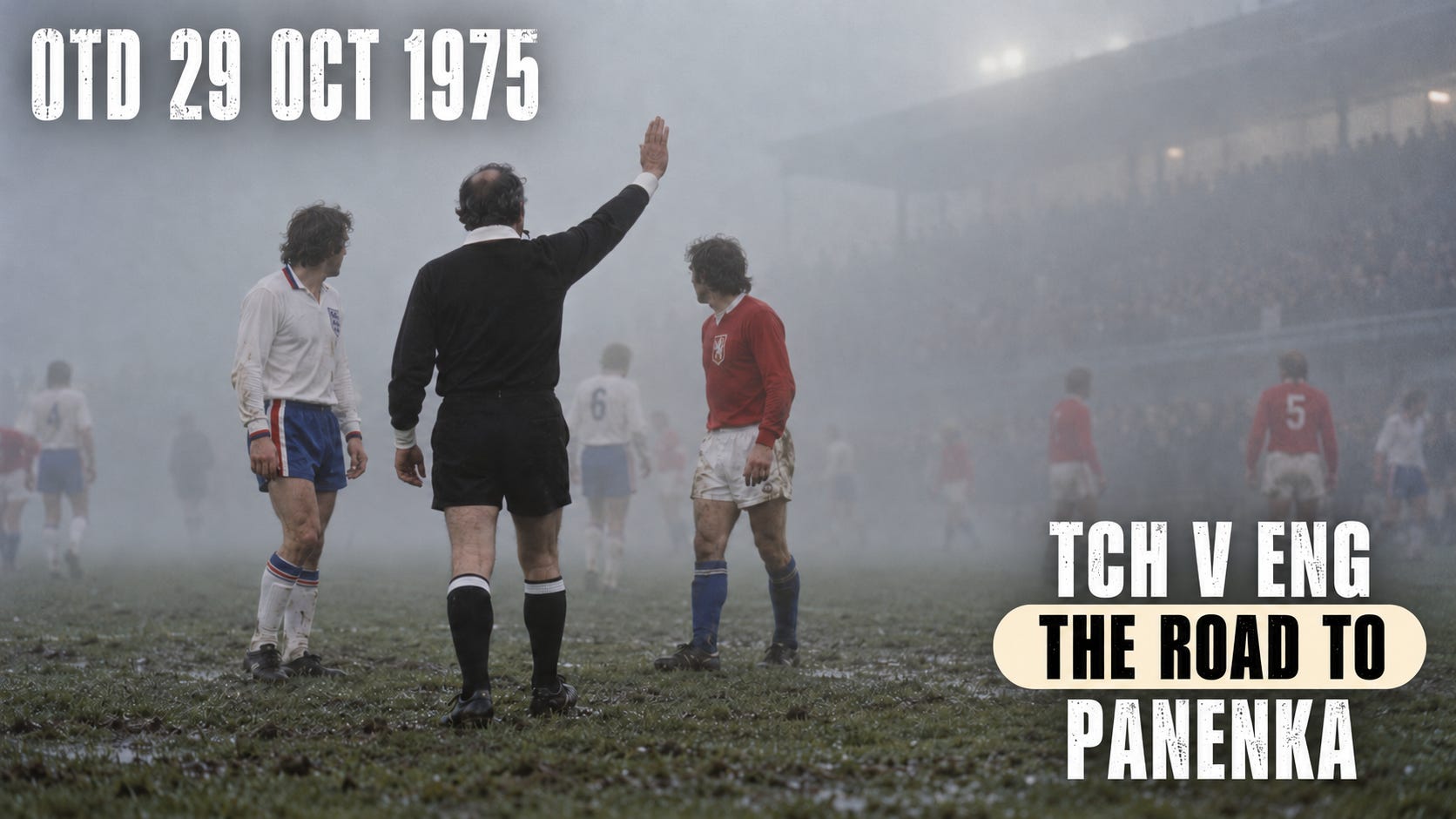
There are matches that live because of what happened in them. This one lives because, at first, almost nobody could see anything at all.
On 29 October 1975, Czechoslovakia and England began a European Championship qualifier in Bratislava before a crowd so large that the city had treated the occasion as an event in its own right. Tehelné Pole was full, England had arrived with Don Revie and a side containing Kevin Keegan, Colin Bell and Ray Clemence, and the home team knew that victory would bring a route to the 1976 finals into focus.
Then fog settled over the stadium. Thick, white, stubborn fog. Players disappeared beyond a few yards. Karol Polák, the Slovak commentator, produced the line that survived the evening: the fog was so thick that even the birds were walking. Malcolm Macdonald had a goal ruled out after nine minutes, but the match could not continue. The Italian referee Alberto Michelotti stopped it after 17 minutes. Nothing officially remained: no score, no caps, no points.
The next afternoon, with the fog gone, Czechoslovakia beat England 2-1.
That result did not make Antonín Panenka chip a penalty down the middle of a goal in Belgrade eight months later. He had been quietly perfecting the idea with Bohemians Praha goalkeeper Zdeněk Hruška, wagering beer and chocolate after training. But it created the sporting road on which Panenka reached the final, Czechoslovakia reached West Germany, and the most famous penalty in football acquired a name.
How Did We Get Here?
The 1976 European Championship was a much smaller tournament than the modern Euro. Thirty-two teams were divided into eight qualifying groups. Only the eight group winners progressed, and they then played home-and-away quarter-finals for the four places at the finals in Yugoslavia. There was no safety net of a round of 16, no expanded field and no generous route for a second-place side. A difficult group could end a country’s tournament long before summer.
England had learned that lesson painfully. Alf Ramsey’s World Cup holders had not reached Euro 1972. England then failed to qualify for the 1974 World Cup, losing the decisive qualifier to Poland at Wembley. Revie, the great Leeds United manager, took over in 1974 with the task of restoring the national side’s authority. His early record was excellent. England beat Czechoslovakia 3-0 at Wembley in October 1974, with Colin Bell scoring twice after Mick Channon had opened the scoring. On paper, that should have put England in command of Group 1.
But Czechoslovakia were not a side designed to remain in anyone’s shadow. The country had reached the 1962 World Cup final and supplied European club football with a formidable Slovak tradition. Slovan Bratislava had beaten Barcelona to win the 1969 Cup Winners’ Cup. Spartak Trnava had reached the European Cup semi-finals the same season. The 1970 World Cup team had disappointed, but the talent and the football culture remained. In Václav Ježek, assisted by Jozef Vengloš, the national team had an exacting coach and an unusually balanced Czech-Slovak group.
Its spine made that balance visible. Ivo Viktor, the Dukla Praha goalkeeper, was already one of Europe’s best. Anton Ondruš captained from sweeper, while Ján Pivarník, Ladislav Jurkemik, Marián Masný, Zdeněk Nehoda and others gave the Slovak half of the country a profound presence. Panenka, the Bohemians playmaker from Prague, was not yet football’s universal noun. He was a clever, unfashionable-looking midfielder with a left foot, a sense of tempo and a private solution to a problem he had encountered in training.
The 3-0 loss at Wembley therefore became a beginning, not a verdict. Czechoslovakia responded by beating Cyprus 4-0 and Portugal 5-0 in Prague. Panenka scored a hat-trick against Cyprus, including a penalty, though not the chip that would later carry his name. By autumn 1975, the group had reversed its emotional current. England had won in Cyprus and drawn in Portugal, but the return match in Bratislava had become the hinge.
It was also a national occasion. Contemporary accounts put demand for tickets far beyond the stadium’s capacity. More than 50,000 people came to Tehelné Pole. The weather was the cruellest possible antagonist. Fog does not make for a clean television image or a neat tactical story. It erases the geometry on which football depends. A winger cannot see the far touchline. A goalkeeper cannot judge the flight of a cross. A referee cannot be certain what has happened at the other end of the pitch.
England actually began the abandoned match with purpose. Macdonald, the powerful Newcastle United striker, had the ball in the net after nine minutes, only for the attempt to be disallowed for offside. The conditions then became decisive. Sources differ slightly on whether 17 or 19 minutes had elapsed, but the contemporaneous record agrees on the essential fact: Michelotti ended the contest before it could become a match. It was not an abandonment that awarded anyone a result. The teams would begin again from 0-0 the following afternoon.
That distinction mattered. England did not merely have to preserve an advantage through bad visibility. They had to wake up, return to the same city, and play the most important match of Revie’s first year as manager against a home side with 50,000 people behind it. Czechoslovakia did not have to live with an unfinished evening. It had another full chance to turn the group upside down.
Revie made England look familiar and formidable: Clemence in goal; Madeley, Gillard, McFarland and Todd in defense; Gerry Francis as captain; Keegan, Bell, Channon, Macdonald and Allan Clarke in the forward positions. Ježek’s side had Viktor, Pivarník, Ondruš, Jurkemik, Masný, Galis and Nehoda. This was not an experimental friendly distorted by substitutions. It was a collision between two international teams whose qualification prospects were visible in every decision.
England struck first again. In the 26th minute, Channon ran on to the opportunity and lifted the ball over Viktor. For a short time the previous day seemed irrelevant. England had the lead, and the great crowd had something to fear.
Then Czechoslovakia answered in the last minute of the first half. Nehoda headed in the equalizer. Two minutes after the interval, Dušan Galis finished a flowing move with a diving header. The score had moved from 0-1 to 2-1 in the narrowest possible corridor of time, and with it the mood of the whole qualification group.
Revie believed his players had been drawn into a brutal, provocative game. Czechoslovakia’s substitute goalkeeper Alexander Vencel was sent off from the bench after arguing with Michelotti. England had chances and territory, but the match did not return to its earlier shape. The home side held their nerve, the crowd finally saw what it had come to see, and the final whistle made the foggy non-match of 29 October feel less like an interruption than a prelude.
So What?
The immediate consequence was not qualification. It was pressure. Czechoslovakia had moved above England, but England still had matches to play and the old two-points-for-a-win arithmetic made every draw consequential. England went to Lisbon in November and drew 1-1 with Portugal. Czechoslovakia drew 1-1 in Porto. The final table was cruelly compact: Czechoslovakia finished with nine points, England with eight, Portugal with seven. One point separated Revie’s side from the next stage.
England’s failure mattered because it confirmed that the post-1966 problem was not a single bad night at Wembley against Poland. A country that had won the World Cup, reached the Euro 1968 semi-finals and possessed celebrated club players missed the 1974 World Cup and then the 1976 European Championship. Revie had not lost before Bratislava. His first defeat came in precisely the match where an international manager’s early optimism is tested: away from home, in a hostile atmosphere, with qualification tightening around him. The fog was not an excuse. It did, however, make the story unforgettable. England had been handed a second start and still could not control the second day.
It also gave the fixture an odd double identity in the record books. The abandoned match belongs to 29 October, which is why it belongs on this date. The competitive result, the caps, goals and final table belong to 30 October. It is tempting to collapse the two into one glamorous “fog match,” but that loses the human tension. Some supporters had travelled and waited through one evening only to be asked to return. Players had prepared, started and then had to manage their adrenaline for another 24 hours. Revie had to choose whether to alter a side that had begun assertively in the mist. Ježek could turn the interruption into a reset for a home team that had been unable to establish a rhythm. The replay was not a continuation with the clock restarted. It was a fresh psychological contest, played in the long shadow of an evening that had disappeared.
For Czechoslovakia, the win supplied more than points. It changed the team’s sense of scale. They won the group, then met the Soviet Union in the quarter-finals. A 2-0 home win in Bratislava, followed by a 2-2 draw in Kyiv, took them to Yugoslavia. In Zagreb they beat the Netherlands 3-1 after extra time despite Jaroslav Pollák’s dismissal. In Belgrade, they led West Germany 2-0, were pulled back to 2-2, and entered a shoot-out unlike any international final had previously required.
That is where Panenka becomes both the destination and the caution. The famous penalty was not born in the fog. It was born in repetition: after Bohemians training, Panenka and Hruška competed from the spot, often for a beer or a bar of chocolate. Panenka found that goalkeepers committed early. He began to lift the ball down the middle. His teammates knew the trick; much of the wider football world did not.
On 20 June 1976, after Uli Hoeneß missed West Germany’s fourth penalty, Panenka had the chance to win Czechoslovakia’s first major international title. Sepp Maier dived left. Panenka did not drive the ball into a corner. He caressed it into the center of the net. The penalty did three things at once: decided the final, gave a country its greatest footballing night, and supplied the global game with a word that now describes an idea as much as a kick.
The route matters because Panenka’s moment is often detached from its team. The chip looks individual, playful and almost outside history. Yet it belonged to a disciplined collective that had survived the brutal compression of 1976 qualifying. Viktor was in the team of the tournament. Ondruš scored in the semi-final. Nehoda scored throughout the campaign. Ježek and Vengloš had made a side that could defend, endure and, when necessary, take a risk. Panenka’s audacity was the final expression of a team that had earned the right to be audacious.
The fog also speaks to an older version of international football. Modern qualifying is administered through weather protocols, broadcast infrastructure, substitute benches, communication systems and contingency plans unimaginable in 1975. A thick fog can still postpone a match, but it is less likely to leave a full stadium and a watching country in the strange limbo of 17 minutes that count for nothing. In Bratislava, there was no practical way to force visibility into existence. The referee had to accept that the match was not playable, and both countries had to accept a second day.
There is a broader European lesson in that. Football history often turns the great event into an inevitability after the fact. Panenka, Belgrade and the first shoot-out in a major international final now seem to belong together naturally. They did not. Czechoslovakia had to recover from the Wembley defeat, beat Portugal by five, replay England, survive the Soviet Union, outlast the Netherlands and finally withstand West Germany. Remove any one link and the famous chip is still a training-ground idea rather than a permanent entry in football’s vocabulary.
England’s side of the story is equally human. Bell won his final cap in Bratislava. Gillard’s England career also ended there. Clemence, Keegan and the others went back to clubs where their reputations remained intact, but international football was beginning to teach England an unforgiving truth: talent assembled from big clubs did not automatically become a tournament team. It would be another six years before England returned to a World Cup, and another 21 before the country reached a European Championship semi-final.
The fog did not send Panenka to Belgrade by itself. It did something more useful for a historian: it preserved the moment when a future legend’s road could still have disappeared. On 29 October, the ball vanished in the white air above Tehelné Pole. On 30 October, Czechoslovakia found it again.
Three Things to Take Away
1. Czechoslovakia vs. England began on 29 October 1975 but was abandoned after 17 minutes because of fog. The full replayed match on 30 October ended Czechoslovakia 2-1 England.
2. The victory was the hinge of Group 1. Czechoslovakia finished first on nine points, one ahead of England, then defeated the Soviet Union in the quarter-finals and reached the four-team finals in Yugoslavia.
3. Panenka’s chip was developed before Bratislava, not caused by the fog. But the fog-delayed win belongs on the route that put Panenka, Czechoslovakia and Sepp Maier in the decisive shoot-out at Euro 1976.
On This Day
On 29 October 1975, Czechoslovakia vs. England was abandoned in Bratislava after 17 minutes of fog. The teams began again the next afternoon. Czechoslovakia won 2-1, England’s Euro hopes weakened, and the road to Panenka opened.
Have a football memory, a correction or a story that belongs here? Write to otd@17lawsguy.com.
Yesterday: *Two European Champions. One Third-Tier Club.* — Eintracht Trier 2-1 Borussia Dortmund, 28 October 1997.