

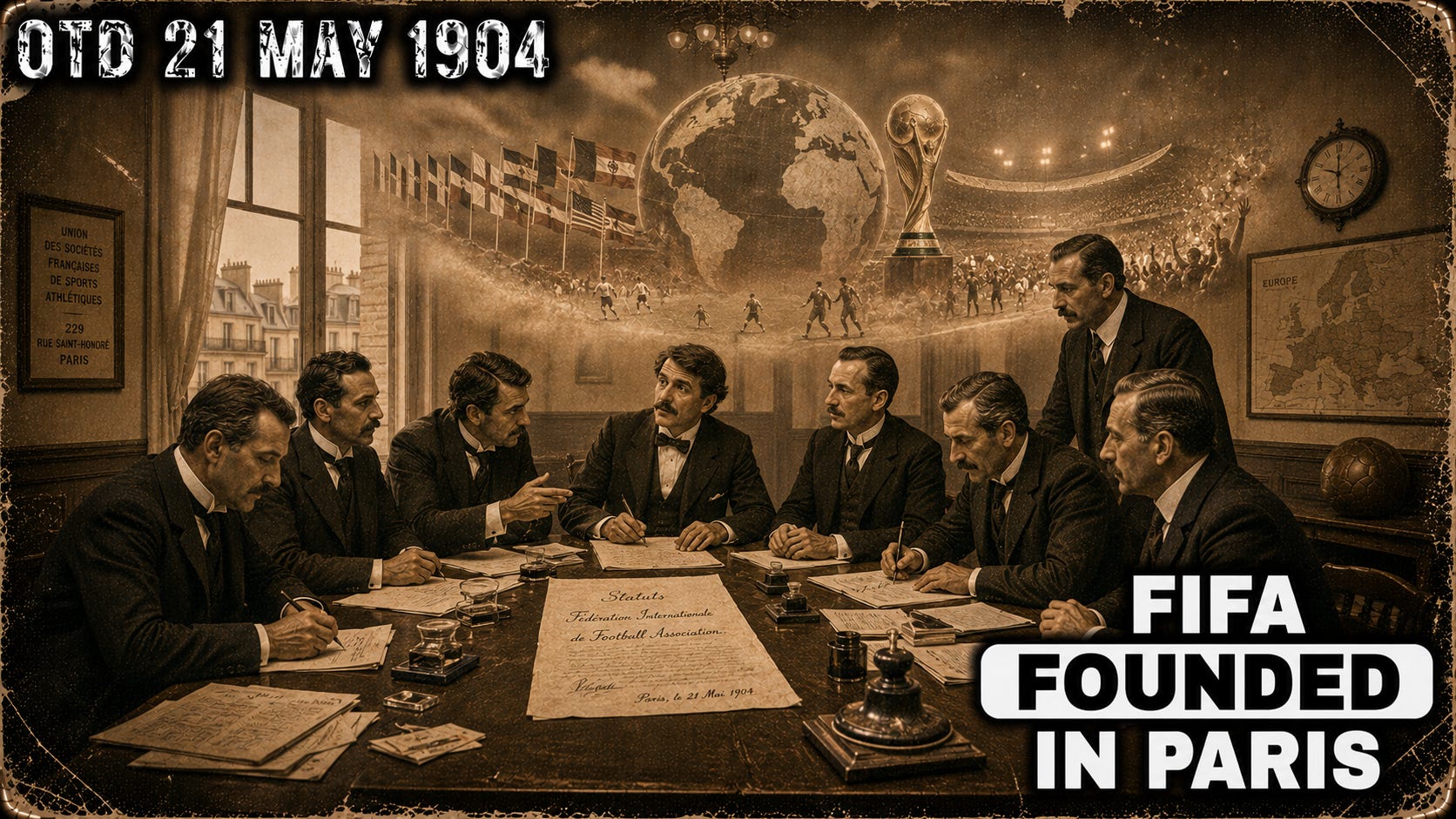
It is 21 May 1904. Paris. 229 Rue Saint-Honoré.
In the offices of the Union des Sociétés Françaises de Sports Athlétiques, a handful of football organizers gather for a meeting that looks small enough to miss.
No television. No sponsors. No World Cup. No Champions League. No continental confederations. No global headquarters in Zurich.
Just delegates, correspondence, draft statutes, and a problem: football has spread faster than anyone can govern it.
Three days later, they will have a president.
But on this day, they create the body that will become FIFA.
And from that small Paris meeting comes the institution that will give football its world championship, its global calendar, its national-team pyramid, its controversies, its scandals, its development programmes, and its claim to be the most universal sport on earth.
Association football had become organized first in England, with the Football Association in 1863. Scotland followed in 1873. Wales in 1876. Ireland in 1880. The international game began before FIFA existed: England and Scotland in 1872 at Hamilton Crescent, the Home Nations creating their own universe.
They also created something essential: the International Football Association Board in 1886, to guard the Laws of the Game.
So by the end of the nineteenth century, Britain already had rules, cups, internationals, professionalism in England, and the Football League.
But outside Britain, football was spreading quickly. Denmark and the Netherlands formed national associations in 1889. Argentina organized in 1893. Belgium and Switzerland in 1895. Uruguay in 1900. Clubs were travelling. National sides were emerging. International matches were becoming more frequent.
But there was no central authority.
Who decides if a player can appear for two clubs in different countries? Who authorizes matches between clubs under different associations? Who handles fines? Who recognizes a national association? What happens in border regions? What about associations that exist politically inside empires, like the Czechs inside Austria-Hungary?
Football was no longer just a game. It was becoming a system. And systems need rules.
Enter the man football remembers as Robert Guérin. The archival story is wonderfully strange. His full birth name was Clément Auguste Maurice Robert, and “Robert Guérin” was, in effect, the professional name by which he became known in football. He was a journalist with Le Matin, active in French sport, and secretary of the football section of the USFSA.
And he saw the future. Years later, Guérin recalled that by 1903 it was not difficult to foresee that football would become more popular all over the world. He expected England to lead the international effort. After all, England had invented the organized game. But when he went to London, the Football Association listened politely and did not move.
So Guérin moved.
He wrote. He networked. He pressed other football organizers. And he called a congress in Paris for May 1904.
Think about the practical commitment. Ludvig Sylow coming from Denmark was not booking a two-hour flight. This was rail, ferry, timetables, borders, overnight travel, papers, and real inconvenience. Germany’s planned representation showed exactly how fragile it all was: Dr Gustav Manning was supposed to come, then Philipp Heineken was nominated to replace him, and still no German delegate reached Paris.
Yet the meeting opened at 2:30 in the afternoon on Saturday, 21 May.
Present were Cornelis Hirschman from the Netherlands, Victor Schneider from Switzerland, Ludvig Sylow from Denmark, Robert Guérin and André Espir from France, and Louis Muhlinghaus and Max Kahn from Belgium.
Spain was represented by proxy through Espir, after Madrid Football Club — the early Real Madrid — sent a letter of apology. Sweden was represented by proxy through Sylow. England wrote to apologize for not attending and said a congress would be held in London in 1905.
And that is why the founding members are remembered as seven: France, Belgium, Denmark, the Netherlands, Spain, Sweden and Switzerland.
The meeting was not just ceremonial. They discussed a draft treaty. They debated articles. They raised specific legal and football problems. Hirschman wanted the international committee to authorize matches involving clubs from federations that had not signed the treaty. There was discussion of players returning from abroad, fines, border clubs, and the Czech association.
On the second day, they approved the first six articles unanimously. On the third day, 23 May, they noted the German telegram. They approved the remaining articles and administrative regulations. Then they elected the first committee.
President: Robert Guérin of France. First vice-president: Schneider of Switzerland. Second vice-president: Hirschman of the Netherlands. Secretary: Muhlinghaus of Belgium. Deputy secretary: Sylow of Denmark.
The treaty and statutes were adopted unanimously on second reading and signed.
That was the birth of FIFA. There were no fireworks. Only meeting minutes.
At first, that center was tiny. FIFA did not instantly control the world. The Home Nations were still aloof. The IFAB still guarded the Laws. Professionalism and amateurism were unresolved.
But the idea was now alive.
England joined in 1905. Daniel Burley Woolfall, an English administrator, became president in 1906 and helped give FIFA credibility with the British game. The 1908 Olympic football tournament in London gave FIFA one of its first major international stages.
Then came crisis. World War I shattered international football. Woolfall died in 1918. FIFA almost disappeared. Then came Jules Rimet, who became FIFA president in 1921 and turned a fragile federation into a global programme. In 1930, Uruguay hosted and won the first World Cup.
The British associations were out again by then, after arguments over amateur payments. They missed the first three World Cups and only returned after the Second World War. That tension is part of FIFA’s story too: the inventors of organized football never quite owned the global football future.
And FIFA expanded. CONMEBOL in 1916. UEFA and the AFC in 1954. CAF in 1957. CONCACAF in 1961. Oceania in 1966.
Presidents reshaped the machine. Rimet gave FIFA the World Cup. Stanley Rous guarded the old administrative order. João Havelange commercialized the global game. Sepp Blatter presided over enormous growth and the corruption culture that erupted in 2015. Gianni Infantino expanded again: 211 member associations, a 48-team World Cup, more development money.
That is the paradox. FIFA is indispensable and flawed. It has standardized, organized and globalized football. It has also been opaque, political, commercial, self-protective and repeatedly damaged by corruption.
But the world game still needs a world structure.
Without FIFA, football might still have become popular. But would it have become this universal? Would Uzbekistan, Uruguay, Zambia, Japan, Morocco, New Zealand, Brazil, Denmark, Haiti and England all live inside one recognizable competitive architecture?
That is the achievement of 21 May 1904. Seven founding members. One room in Paris. And a sport that was becoming too big for bilateral arrangements.
🎙️ The full episode (linked above) has more — including the short-lived rival body UIAFA, Carl Hirschman keeping FIFA institutional memory alive during WWI, the British associations’ complicated relationship with FIFA including their post-WWII return, women’s football, futsal, FIFAe, beach soccer, VAR, the corruption arrests of 2015, and the modern Infantino expansion. The whole arc is in the audio.
---
🎧 Also available on Apple Podcasts, Amazon Music, Overcast, iHeart, and YouTube.
📩 Got an episode idea? otd@17lawsguy.com
Yesterday: 20 May 1993 — The VA-OM Affair.
Tomorrow: 22 May 1963 — catenaccio first wins the European Cup.