

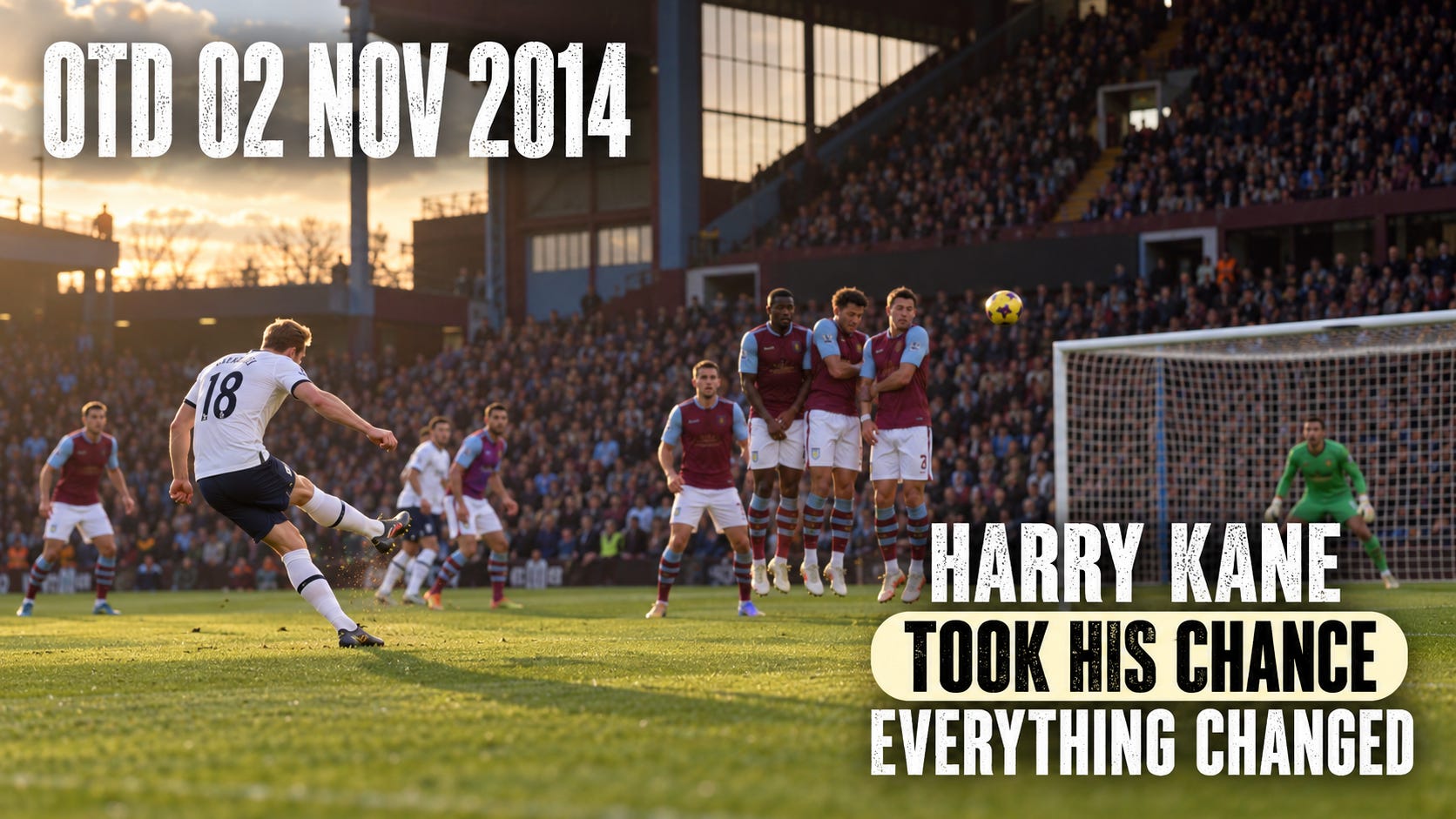
On 2 November 2014, Tottenham Hotspur were losing at Aston Villa. Harry Kane was on the bench again.
That small word matters. Again. Kane was 21, a Spurs academy product with loan spells at Leyton Orient, Millwall, Norwich City and Leicester City behind him. He had scored in cup competitions early in Mauricio Pochettino’s first season, enough for supporters to ask why he was not getting a Premier League chance. But when Tottenham needed goals at Villa Park, the starting forwards were Roberto Soldado and Emmanuel Adebayor. Kane entered in the 58th minute, not as the obvious answer but as the third option.
Villa had led through Andreas Weimann since the 16th minute. Christian Benteke had been sent off, but 10-man Villa still appeared to be holding on. Nacer Chadli equalized in the 84th. Then, in the 90th, Tottenham won a free kick 25 yards from goal. Erik Lamela was standing over it. Kane took it instead.
The shot struck Nathan Baker, wrong-footed Brad Guzan and went in. Kane ran towards the away end and launched into an exuberant dive. Tottenham had won 2-1. A year that had looked like another season of waiting suddenly had a different shape.
No goal can honestly be said to create a player by itself. Kane had the technique, appetite and resilience before Villa Park, and he would still have had to prove them after it. But football careers turn on access as much as ability. One deflected free kick made Pochettino’s next decision harder to avoid. A week later Kane made his first Premier League start of the season, against Stoke City. By May he had scored 31 goals in all competitions. The door had opened, and he had made it impossible to close.
How Did We Get Here?
Kane’s early career was not a smooth march from academy prospect to superstardom. Arsenal released him as a child. Tottenham initially passed after a trial too, and Kane spent time at Watford; a strong performance against Spurs persuaded the club to bring him back. That small sequence matters. The eventual Tottenham icon had already been rejected twice by the two London clubs that would define much of his adult football.
Tottenham took him into their academy, but a promising young forward in a large London club does not automatically become a Premier League striker. He made his Spurs debut in August 2011, then did the unglamorous work of going out on loan.
At Leyton Orient in 2011, he made his Football League debut and learned the rhythms of senior football. At Millwall in 2012, he scored nine goals in 27 appearances in a hard, physical Championship season and was named the club’s Young Player of the Year. That was the first loan that made people take him seriously. Yet it did not settle his path. Norwich brought a Premier League loan, but also a broken metatarsal and very little continuity. Leicester City gave him another Championship spell, mostly from the bench, ending in a play-off defeat to Watford.
That sequence is easy to rewrite after the fact. It is tempting to say that every stop was an essential chapter in the making of an inevitable great. It was not inevitable. Kane had shown good things, but good things are not enough in a squad containing established internationals and expensive strikers. He did not have the electric, immediately marketable profile of a teenage prodigy. He was regarded as a talented centre-forward, a useful youth international, perhaps a future Premier League player. There was no consensus that he would become Harry Kane.
The unflattering shorthand was that he was a little too ordinary-looking for the modern cult of the teenage wonderkid: not especially fast, not visibly flamboyant and not yet physically imposing. It missed the qualities that would define him: anticipation, balance, repeated finishing practice and an unusually mature willingness to learn. Academy coaches noticed his ability to read where a loose ball would fall and to shape his body before receiving it. Those qualities take longer to reveal themselves than a spectacular dribble. The loans taught Kane how to play when the pitch was poor, the service sparse and a defender wanted to make every touch uncomfortable. They also taught him how easily an opportunity can disappear.
Even his first Tottenham breakthrough had come in fragments. Tim Sherwood gave him a Premier League start against Sunderland in April 2014. Kane scored in a 5-1 win, then scored in his next two league appearances. But Sherwood left at the end of the season and Pochettino arrived with his own ideas, his own pressing demands and Soldado and Adebayor already in the building. The hierarchy reset. Kane had to prove himself all over again.
Pochettino did see something. Kane was serious, receptive and willing to work at the parts of his game that turn a striker into a complete forward: pressing, repeated running, receiving with his back to goal and linking play. Yet the manager did not initially make him a Premier League starter. Kane’s route in autumn 2014 was through the Europa League and League Cup. He scored freely there, including a hat-trick against Asteras Tripolis, while the league line continued to form without him.
There was another contingency behind the contingency. Pochettino later recalled that Tottenham had tried to sign Danny Welbeck from Manchester United in the summer of 2014. Arsenal, needing cover after Olivier Giroud’s injury, made the stronger offer and got him. Had Welbeck joined Spurs, Pochettino said, there might not have been the same space for Kane. It is a striking admission because it describes football development honestly: a young player needs ability, but also a vacancy, an advocate and a moment when the team needs exactly what he can offer.
Villa Park supplied the moment. Tottenham had begun the afternoon with Soldado and Adebayor together, a clear indication of the pecking order. Kane came on after 58 minutes. Villa’s Weimann had scored from Charles N’Zogbia’s low cross, and the home team’s resistance had become more complicated when Benteke was dismissed. Still, an equalizer was not a transformation. Chadli’s 84th-minute goal merely made a draw possible.
Then Kane took responsibility for the free kick. That is one of the reasons the goal deserves more than a place in a highlights reel. This was not a tap-in supplied by a settled system designed around him. He was the substitute who took the ball when Lamela was also available, then accepted the uncertain reward of a deflection. The finish was not beautiful in the conventional sense. It was decisive, assertive and perfectly timed.
Pochettino’s response was practical. Kane started against Stoke seven days later. Tottenham lost 2-1, but the selection itself mattered: the manager had revised the order. Kane kept his place at Hull, scored in another 2-1 win, then found goals against Swansea, Burnley and Leicester during December. The evidence accumulated so quickly that the old debate disappeared. By the end of 2014-15, he had 21 Premier League goals in 34 appearances and 31 in 51 across all competitions. He was the first Spur to score 30 in a season since Gary Lineker in 1991-92.
Villa Park was therefore not Kane’s first senior goal, his first Tottenham goal or even his first Premier League goal. It was something more useful for a football story: the moment at which promise became selection. Before it, he was the young striker scoring in the cups. After it, he was the striker Pochettino had to start.
So What?
The counterfactual should be handled with care. If Kane had missed the free kick, it does not follow that he would have become a nobody. His work ethic and output suggested that another chance could have arrived. But elite careers are crowded with players who were talented enough to deserve a chance and never received the right sequence of one. The significant question is not whether Kane contained greatness in some abstract sense. It is whether Tottenham would have built their attack around him at exactly that time, with the same manager and the same confidence, had Villa Park passed without a goal.
That is why “sliding doors” fits. Kane’s opportunity was real but narrow. Spurs had senior strikers ahead of him and had nearly brought in another. Pochettino was a new manager under immediate pressure. The Villa winner changed the temperature around both player and club. It bought Kane another start, then a run, then the stage on which his scoring made the argument permanent.
From there, the scale is extraordinary. Kane became Tottenham’s all-time leading scorer with his 267th goal for the club, passing Jimmy Greaves’ record of 266. His final total for Spurs was 280. He became England’s all-time leading scorer, passed Wayne Rooney, captained his country at major tournaments and, in October 2026, matched Peter Shilton’s 125-cap men’s appearance record. He has now scored 91 England goals, a total that has changed the national team’s record book beyond recognition.
His move to Bayern Munich in 2023 added another kind of test. Kane had spent years being judged through the absence of a major team trophy, an unfairly blunt measure but one that follows great players relentlessly. His first Bayern season was individually spectacular but collided with Xabi Alonso’s Bayer Leverkusen, who ended Bayern’s run of Bundesliga titles. The delay sharpened the old joke. Then Bayern reclaimed the championship in 2024-25, confirmed when Leverkusen drew 2-2 at Freiburg. Kane’s first major honour arrived not with a final whistle at his own game but with a result elsewhere. It did not make the achievement less sweet. He said so himself: it was the first trophy of his career, and that made it special.
The following season confirmed that he had not gone to Germany to fade politely into a winning machine. He continued scoring at an extraordinary rate, winning the Bundesliga’s top-scorer prize in each of his first two seasons and becoming the first player to do so in his first two Bundesliga campaigns. Then, on 26 October 2026, he won the men’s Ballon d’Or. The award, presented in London, recognised a 2025-26 campaign in which he scored 73 goals for club and country, won another Bundesliga title with Bayern and finished with 14 Champions League goals as Bayern reached the semi-finals. It is the cleanest recent answer to the old question of whether Kane belonged among the very greatest forwards of his time. At Bayern, alongside creators and scorers such as Michael Olise and Luis Díaz, he has shown the full version of his game: not only the penalty-box finisher, but the forward who drops into midfield, passes through pressure and makes room for runners around him.
That matters when placing him beside the era’s other great scorers. Cristiano Ronaldo and Lionel Messi reset the outer limits of career accumulation. Robert Lewandowski supplied the modern centre-forward benchmark in Germany and Europe. Kylian Mbappé represents a different path: acclaim came early, a World Cup arrived at 19 and the expectation of greatness was public before he had learned the ordinary frustrations Kane knew on loan. Kane belongs in that company by production and by the range of his forward play, but his route is distinctive. He did not arrive as a coronation. He arrived as a substitute who kept making himself impossible to omit.
Football has many such doors, though few open onto a career this large. Jamie Vardy’s move from non-League football to Leicester and the opportunity created by Nigel Pearson’s faith transformed a late developer into a Premier League champion. Mohamed Salah’s unsuccessful Chelsea spell might have become a verdict had Fiorentina and Roma not offered him a route back into prominence. Didier Drogba’s late rise through Le Mans, Guingamp and Marseille before Chelsea demonstrates that elite forwards do not all emerge on the youth-tournament timetable. And Lewandowski’s career took its own decisive turn when Dortmund chose him from Lech Poznań and gave him a platform that soon became impossible to contain.
Those comparisons do not diminish Kane’s individual responsibility. A sliding door is not magic. It opens into a room in which the player still has to perform. Vardy had to score in the Premier League. Salah had to reinvent himself in Italy and England. Lewandowski had to turn opportunity into goals. Kane had to follow the Villa strike with the next start, the next month and then season after season of exceptional output.
There is also a lesson for clubs. Tottenham’s academy deserves credit for Kane’s development, but the story is not simply a triumph of foresight. The club loaned him out repeatedly, almost signed a striker who would have narrowed his route, and only gradually let performance override hierarchy. The best youth pathway is not a slogan about trusting academy players. It is a structure that recognises evidence quickly enough when a player has outgrown the place assigned to him.
Kane gave that evidence at Villa Park in the clearest possible form. A substitute came on in a difficult away game, took a 90th-minute free kick and won it. The goal was deflected; the consequence was not. Tottenham had found the player around whom a generation of its football would be built.
Three Things to Take Away
1. Kane came on in the 58th minute at Villa Park on 2 November 2014 and scored Tottenham’s deflected 90th-minute winner in a 2-1 comeback over Aston Villa.
2. The goal did not make Kane inevitable, but it changed his opportunity. He made his first Premier League start of 2014-15 a week later and finished the season with 31 goals in all competitions.
3. Kane went from the substitute behind Spurs’ established forwards to Tottenham’s record scorer, England’s record scorer and joint-most capped England man. Bayern’s 2024-25 Bundesliga title brought his first major trophy; the 2026 Ballon d’Or recognised his highest individual peak.
On This Day
On 2 November 2014, Harry Kane came off Tottenham’s bench at Aston Villa and scored a 90th-minute winner. It was the free kick that changed his place in the team -- and helped launch one of the defining scoring careers of his era.
Have a football memory, a correction or a story that belongs here? Write to otd@17lawsguy.com.
Yesterday: The Cup Tie Stuttgart Could Not Lose - 01 November 2000.
Kane and Vardy were both on the Leicester bench v Watford that fateful day.