

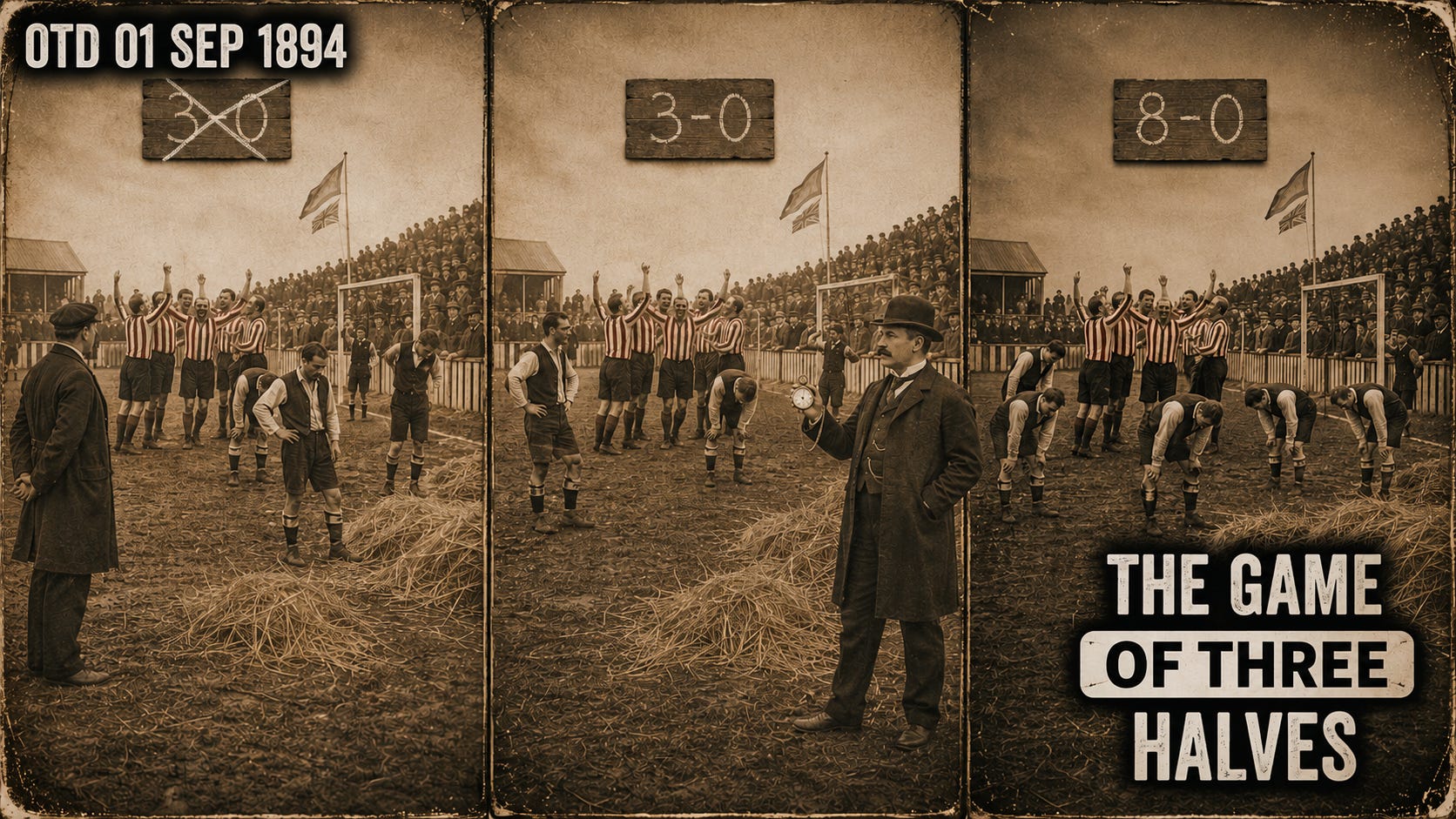
It is September 1, 1894, at Newcastle Road, and Sunderland are about to beat Derby County 8-0 on the opening day of the English First Division. That alone would be a story. But the official 8-0 hides something stranger. Sunderland actually score eleven goals, and Derby spend the afternoon playing 135 minutes of football, three separate periods of forty-five minutes each. Three halves, which is not, mathematically, how halves are meant to work.
To feel how odd this is, you have to know that these were not mismatched sides. The Football League was only six years old, but Sunderland were already one of its great powers. Under their manager Tom Watson, their passing and combination play had earned them a nickname, the Team of All Talents, and back-to-back championships in 1891-92 and 1892-93. The previous season they had finished second, behind Aston Villa. Third that season had been Derby County, who arrived at Newcastle Road with real footballers of their own: John Goodall, once part of Preston’s original Invincibles, his brother Archie, and above all a twenty-year-old forward named Steve Bloomer, already the club’s leading scorer and, in time, its record marksman with 332 goals. This was second against third, not champions against a punchbag.
The trouble began before kickoff. The appointed referee, a Mr Kirkham from Darwen, was somewhere on the railway, having missed his connection at York. He telegraphed ahead that he would not reach Sunderland until close to five o’clock, which left several thousand people standing at Newcastle Road with no referee and no way of being told what was happening. There was no fourth official waiting, and, more importantly, nobody was sure the Football League would even recognize a match refereed by a stand-in. So both clubs lodged formal protests, then agreed to start anyway. A local official from Southwick took charge, a man whose name deserves recording: John Conqueror.
The match kicked off about twenty minutes late. Derby began the better side, forcing corners and threatening through Bloomer, before the Team of All Talents woke up. Johnny Campbell opened the scoring, Jimmy Hannah made it two, and Tommy Hyslop added a third shortly before the interval. Forty-five minutes played, Sunderland 3, Derby 0. Everyone walked off for half-time.
And then the afternoon folded in on itself. Kirkham finally arrived during the interval and ordered the match to be replayed from the start. The first forty-five minutes, and all three Sunderland goals, were wiped away. The score was no longer 3-0. It was 0-0, and everyone began again. Imagine being Derby: you have just been beaten 3-0, and the real referee turns up to tell you, in effect, that none of it counted.
The reprieve lasted about four minutes. Jimmy Hannah scored, then Sunderland scored again, and again, and by the second half-time of the day the score was, with a certain grim comedy, Sunderland 3, Derby 0. The reporters who had already wired the first half-time score around the country now found that the teams had considerately recreated it. But there were still forty-five official minutes to play, and now Derby had a problem beyond the scoreline. They had already run ninety minutes, there were no substitutes to freshen tired legs, and contemporary reports describe the visitors flagging while Sunderland kept coming. A fourth goal arrived, then two more from Hyslop, one from Jimmy Millar, and finally one from James Gillespie near the end. The third final whistle of the afternoon settled it. Officially, Sunderland 8, Derby County 0. Football played, 135 minutes. Sunderland goals scored, eleven. Sunderland goals recognized, eight.
Why did Kirkham restart it at all? The familiar version has him kindly offering the losing side another go, but the truth looks more procedural. The clubs had worried before kickoff that the League might not accept a match run by a replacement, which is exactly why they protested in the first place. The cleanest way to produce an unarguably valid League fixture was to play the required ninety minutes under the appointed referee, which turned the opening forty-five into unofficial football. It was an administrative tangle, not a whim, and the game has since removed the tangle. Today, Law 6 requires competition rules to state in advance who replaces a match official who cannot start or continue, a fourth official, a senior assistant, whoever the competition designates. You do not play forty-five minutes and then delete them because the appointed referee was on a delayed train.
There is a final irony. On paper the restart rescued Derby from 3-0 down. In reality it condemned them to another ninety minutes against one of the fittest teams in England. The season bore out the gap. Sunderland went on to win the title, their third in four years, unbeaten at home, while Derby collapsed to fifteenth and survived only through a Test Match against Notts County. That 8-0 remains the joint-heaviest league defeat in Derby’s history. So the most remarkable thing about the afternoon is not that Sunderland scored eleven. It is that Derby were given permission to forget three of them.
---
🎧 Listen on Spotify, Apple Podcasts, Amazon Music, Overcast, iHeart, and YouTube.
📩 Got an episode idea? otd@17lawsguy.com
Yesterday: 31 August 1998, the match nobody wanted to win.
Tomorrow: 2 September 1920, an Olympic final decided after 39 minutes and a walkout.