

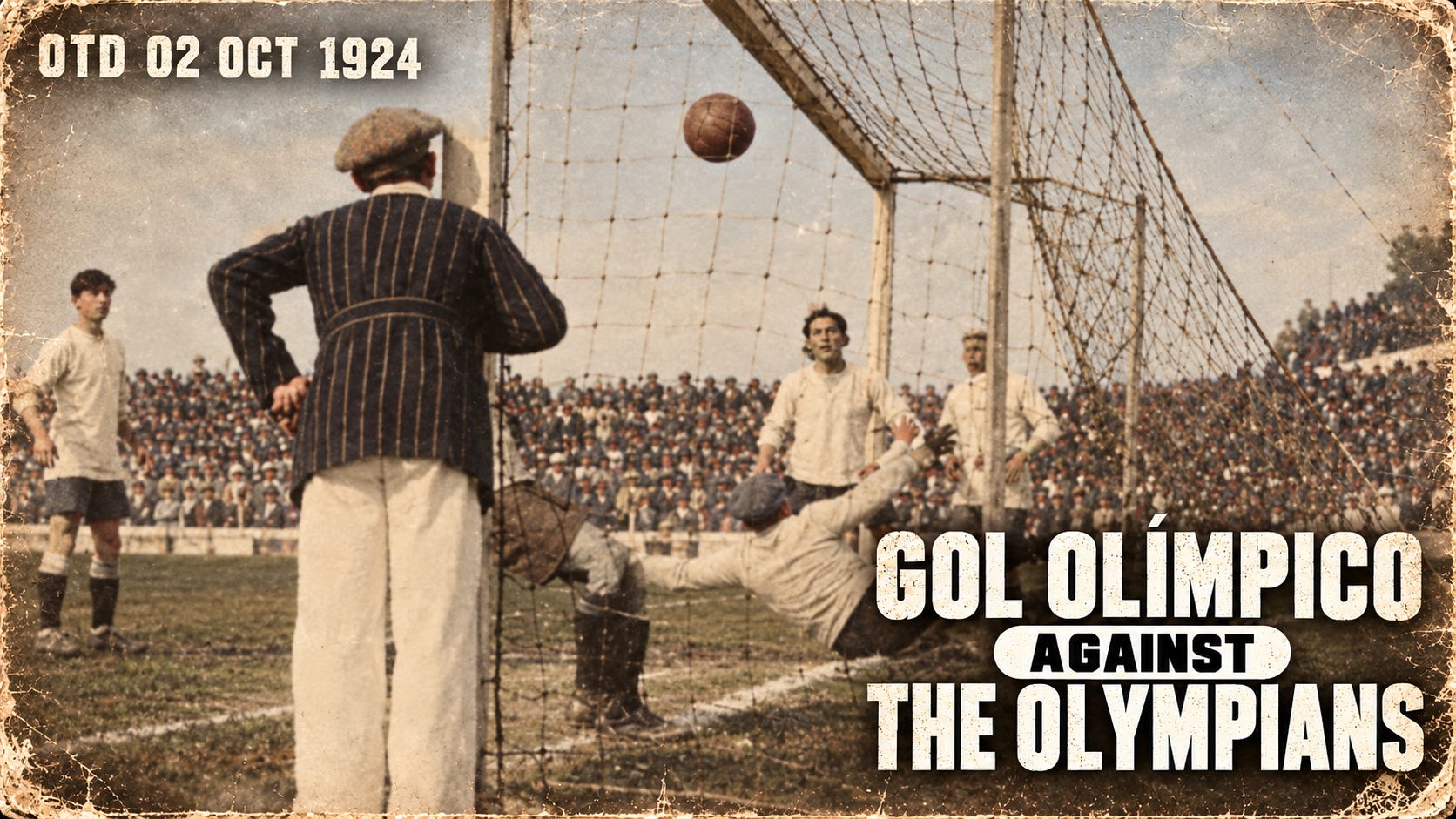
The corner comes in from Argentina’s left. Cesáreo Onzari of Huracán strikes it with his right foot, and the ball bends inward toward Uruguay goalkeeper Andrés Mazali. Nobody touches it. Mazali cannot reach it. It crosses the line.
Today the goal has a name across much of the football world: a gol olímpico. But on October 2, 1924, it was something almost nobody in the stadium had ever seen, and something that, four months earlier, the Laws of the Game did not even permit. It was scored against Uruguay, freshly home from Paris as Olympic champions, so at first it was known simply as the goal against los olímpicos, the Olympians. In time the phrase contracted. Argentina beat Uruguay 2-1 that afternoon, and football gained a new word.
How did we get here?
Three threads meet at the Sportivo Barracas ground in Buenos Aires that day. One is the oldest international rivalry outside the British Isles. One is the rise of Olympic football from an improvised sideshow into the closest thing the sport had to a world championship. And one is football’s plumbing: the Laws that quietly decide what a player is allowed to attempt.
Argentina and Uruguay first met in 1901, and which of the earliest matches counts as official remains an argument to this day, which feels fitting, since almost everything in this rivalry eventually becomes one. The two countries sat across the Río de la Plata from each other, bound by migration, trade and football, their national sides meeting in tournaments like the Copa Lipton and Copa Newton as much as in friendlies. When the first South American Championship was staged in Buenos Aires in 1916, Uruguay took it by holding Argentina to a scoreless draw in the deciding match. Uruguay were South America’s first great national team, but Argentina were always close enough to challenge them, and proud enough to resent finishing second.
Olympic football, meanwhile, had begun uncertainly. Paris in 1900 saw the sport appear inside a vast, chaotic World’s Fair program with no real national-team tournament and medals assigned only retrospectively by later historians. London in 1908 finally gave the Olympics a recognizable national-team competition, won by Great Britain both then and again in 1912, though the Olympic ideal of amateurism sat awkwardly beside a sport quietly turning professional. At Antwerp in 1920 the tournament nearly collapsed into farce, Czechoslovakia walking off during the final against Belgium in protest at the officiating and the crowd, disqualified, leaving Belgium with gold and the competition’s authority looking fragile. Behind the scenes, football’s own governing body and the Olympic movement were still arguing over a basic question: who counted as an amateur, and who actually controlled the international game.
Paris in 1924 did not settle that argument, but it transformed the tournament’s standing, bringing together European sides and teams from beyond the continent. Uruguay arrived as the only South American entrant and a near-total mystery to European crowds, and did not stay mysterious long. They beat Yugoslavia 7-0, the United States 3-0 and France 5-1, saw off the Netherlands in the semifinal, then beat Switzerland 3-0 in the final. José Nasazzi marshaled the defense, Héctor Scarone and Pedro Petrone supplied the goals, and José Leandro Andrade became the tournament’s genuine celebrity, graceful and athletic in a way that startled European audiences who thought they knew what South American football looked like, exchanging short passes and swapping positions with a composure nobody watching had expected. Uruguay crossed the Atlantic as outsiders and came home as champions of the world in everything but the name, an achievement still marked by two of the four stars above their crest.
Argentina had not gone to Paris, partly because its football was still split between rival associations, and that absence left an opening: Uruguay had conquered Europe, certainly, but had they proven themselves against their neighbors? So the two countries arranged a pair of celebration matches. The first, in Montevideo on September 21, finished 1-1. The return was set for Sportivo Barracas in Buenos Aires a week later, though calling what followed a match is generous. More than 50,000 people may have tried to get in, tickets were reportedly resold outside for the extraordinary price of five pesos, and spectators pressed against the field with nothing but a low chain to hold them back. Rain fell, disorder spread, and after roughly four minutes the Uruguayan referee Ricardo Villarino stopped play entirely. The Uruguayans sheltered in the dressing room, the Argentines slipped out a rear entrance, and the crowd waited for hours for a restart that never came. Uruguay’s officials refused to return without a proper barrier, Argentina agreed, and a wire fence went up around the field, remembered in Argentine football folklore as the alambrado olímpico, the Olympic fence, built specifically for the reigning Olympic champions. The match was rearranged for Thursday, October 2.
That set up the third thread. The corner kick had existed in football’s laws since the 1870s, but for decades it was an indirect restart: a player could send the ball into the goalmouth, but somebody else had to touch it before a goal counted. That remained true through June 13, 1924. The next day, the International Football Association Board took up a proposal from the Scottish Football Association and amended the scoring law to allow a goal scored directly from a corner. There was no way to broadcast that change instantly to every referee on earth; it had to travel through associations, committees and printed rulebooks, and legal adoption did not arrive everywhere on the same day. One day after the law changed, Luis Rimassa of Gimnasia reportedly scored directly from a corner against Estudiantes in a La Plata derby, and the referee disallowed it, correctly applying the law as he still understood it, since news of the amendment had not yet reached Argentina. Rimassa may therefore be the first man ever to perform the newly legal act and still not receive the goal. Britain has its own disputed claimants from later that same August, though closer scrutiny of the match reports leaves neither an uncontested first. What can be said with confidence is that Onzari’s goal, three and a half months later, was the first widely documented direct corner in international football, and the one that gave the act its lasting name.
The match
Almost 37,000 spectators returned to Sportivo Barracas for the rearranged fixture. The new fence kept them off the field, but it could not soften the hostility. The match began violently: in an early challenge, Uruguay’s Pedro Cea broke the leg of Argentina’s Adolfo Celli. Substitutions were not yet formally part of international football, but Uruguay agreed, in what contemporary accounts called an act of sportsmanship, to let Ludovico Bidoglio replace him. It mattered beyond the day itself: Bidoglio grew into one of Argentina’s finest defenders and played in the 1928 Olympic final.
Close to a quarter of an hour in, Argentina won a corner on the left. Onzari was twenty-one, a quick, skillful left winger known for dribbling with the ball tight to his feet and simply getting back up whenever a defender kicked him down. He struck the corner right-footed, and the ball curled toward Mazali’s goal untouched. Uruguay protested furiously, some claiming Argentina’s Manuel Seoane had blocked or shoved Mazali, others insisting Onzari never meant to shoot and the wind alone had carried it in. Villarino knew the amended law, and he gave the goal. Onzari maintained the strike was deliberate, though he admitted he never managed to repeat it, and called it the best goal of his life for the astonishment it created.
Cea equalized for Uruguay soon after. Domingo Tarasconi restored Argentina’s lead. Then the match soured again: Andrade fouled Onzari, the already furious crowd began throwing bottles and stones onto the field, and with about four minutes left the Uruguayans walked off. Argentina were awarded the 2-1 win. Contemporary accounts also credit the match as Argentina’s first live radio broadcast of a football game, called from the roof of the visitors’ dressing room by a commentator who did not know every player by sight, which is why newspapers had printed a diagram dividing the pitch into sectors so listeners could follow the ball. Officials were scarce enough that Boca Juniors winger Pedro Calomino, later credited with popularizing the step-over, reportedly ran the line in a borrowed shirt. A newly legal goal, a newly built fence, a gentlemanly substitution and an improvised broadcast all arrived inside the same ninety minutes.
So what?
The name did not arrive in one clean headline the next morning. People first described the strike as Onzari’s goal against the Olympians, a clumsy phrase that shortened as the feat was repeated elsewhere. By April 1925, Argentine reports were already using Olympic goal as a category, applying it to another direct corner scored by Héctor Rivas for Argentinos Juniors. The phrase had escaped its original match, traveling through Spanish-speaking football and into Portuguese as gol olímpico, while English generally stuck to describing the mechanics rather than the history: scored directly from a corner.
For Onzari, the goal was a gift and a trap. It made him immortal and compressed an excellent career into a single kick. He had already won Argentine titles with Huracán in 1921 and 1922, and won two more in 1925 and 1928; in between, Boca Juniors borrowed him for their pioneering 1925 European tour, in which the visitors won fifteen of nineteen matches and came home treated as national ambassadors. He played on with Huracán into the professional era, retired in 1932 with a damaged knee, and finished with 212 appearances and 67 goals for the club that made him. El Gráfico later remembered him as an unshowy, complete sportsman who never sought the spotlight, even though one afternoon guaranteed he would never quite escape it. He died in 1964, aged sixty.
The goal began a lineage that keeps stretching. Aberdeen’s Alex Cheyne scored directly from a late corner to beat England for Scotland at Hampden Park in 1929, in front of a roar so loud it is remembered as the birth of the Hampden Roar itself. A young David Beckham did it too, on loan from Manchester United at Preston North End, curling one in against Doncaster Rovers in March 1995, in the Football League itself. At the 1962 World Cup, Colombia’s Marcos Coll did it against the Soviet Union and the great Lev Yashin, helping Colombia claw back from 4-1 down to a 4-4 draw; more than sixty years and several World Cups later, it remains the only direct corner ever scored in a men’s World Cup finals match. Megan Rapinoe returned the trick to its original Olympic setting, scoring directly from a corner against Canada in an extraordinary 2012 Olympic semifinal and again against Australia in the Tokyo bronze-medal match, the only player to score two Olympic goals at the Olympic Games themselves. Thierry Henry managed one for New York Red Bulls, each looking faintly mischievous, almost illegal, which may be part of why the original still fascinates.
Sportivo Barracas itself did not last much longer than Onzari’s playing career. The club left the Argentine Football Association in 1937, and its ground, which had also staged the 1921 and 1925 South American championships, was demolished that same year, an ordinary erasure the goal scored there outlived by a century and counting.
Behind all of it sits the law. A handful of administrators altered one short sentence, and that sentence changed what a corner taker was allowed to imagine trying. A year later, a separate amendment cut the required defenders between an attacker and the goal line from three to two, and goals multiplied. Small clauses can produce enormous football. The corner amendment never transformed scoring to that degree, and direct goals stay rare even now, but it created a possibility that has outlasted everyone who argued over it in June 1924.
Three things to take away
Onzari did not score the world’s undisputed first direct corner. Earlier claims exist, and Luis Rimassa may even have done it in Argentina one day after the law changed, only to have the goal disallowed because nobody in the stadium yet knew the rule had moved.
Onzari’s real distinction is stronger than any disputed first. He scored the first widely documented direct corner in international football, against the reigning Olympic champions, in front of a crowd that had never imagined such a thing was legal.
A gol olímpico is more than a description of flight and spin. The name carries Uruguay’s 1924 triumph, Argentina’s determination to answer it, and a rivalry that helped shape international football, inside a single compressed word.
On October 2, 1924, Argentina beat Uruguay 2-1 at Sportivo Barracas. Cesáreo Onzari scored directly from a corner. A new law became a goal, the goal became a phrase, and the phrase became part of football’s permanent vocabulary.
---
📩 Got an idea to an OTD story? otd@17lawsguy.com
Yesterday: 01 October 1977, Pelé played his final match, one half for the New York Cosmos and one for Santos, in front of a rain-soaked Giants Stadium.