

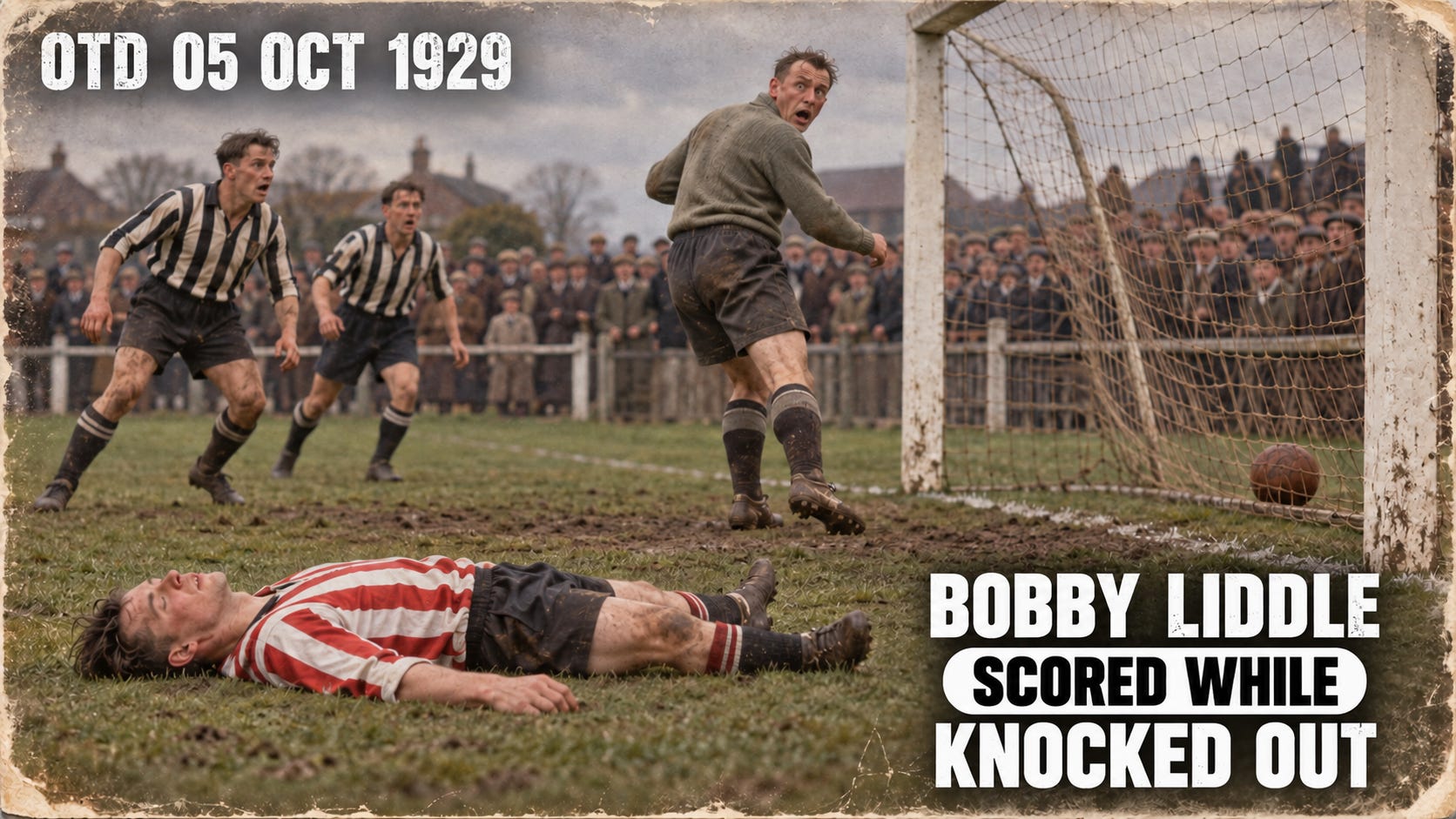
On October 5, 1929, James Ferguson stood six foot two in Notts County’s goal, the ball cradled safely in his hands, and did what goalkeepers had done a thousand times that autumn: he looked downfield and kicked it away. Bobby Liddle, five foot six and closing fast, got there first. The boot caught him flush in the face. Liddle dropped where he stood, and the ball, deflected off the one part of him built to stop nothing, spun backward over Ferguson’s head and into his own net. Stoke’s smallest forward had just scored the goal that leveled the match, with no idea he had done it.
How did we get here?
Robert Liddle was born in Gateshead on April 11, 1908, and grew up in the pit villages of the industrial northeast, working as a miner at Washington Colliery while turning out for its football team on weekends. It is easy to wave at “colliery football” as a vague breeding ground and move on, but Washington’s own side is worth pausing on: within a few years of Liddle’s time there it also produced Ronnie Starling, who would captain Sheffield Wednesday to the 1935 FA Cup, and Jimmy Hagan, an England international who later managed Benfica to three straight Portuguese titles alongside Eusébio. A muddy colliery pitch in County Durham, built to keep miners fit between shifts, fed one journeyman and two genuinely era-defining careers inside a decade. Scouts came because colliery football reliably produced players who were hardened, two-footed and unlikely to be frightened by anything a professional defender could do to them.
Liddle himself was small and quick rather than imposing, and Stoke signed him in January 1928 alongside his Washington teammate Joe Mawson, a proper center-forward where Liddle was harder to label: a forward who could operate across the whole front line and arrive late in the box rather than simply hug the touchline waiting for a cross. He scored on his Football League debut, a five-one win over Nottingham Forest, but spent the rest of that first season as back-up, making just twelve appearances. His real season came next. Stoke were beginning their tenth consecutive year outside the top flight, a club with ambition and almost no money, relying on manager Tom Mather to unearth players nobody else wanted in places like Washington Colliery. Mather’s patchwork side could score for fun and leak goals just as freely: a four-four draw at Charlton, a five-one defeat at Preston, a six-two win over Bristol City, and by October, somewhat improbably, second place in the table after twelve matches.
On September 30, Stoke beat Wolverhampton Wanderers 3-0 at home, and Liddle was hurt badly enough in the second half that he had to leave the field. Nobody replaced him, because nobody could. Football League rules in 1929 allowed no substitutes at all: eleven players took the field, and whatever happened to any of them, those were the eleven Stoke had for the rest of the match. An injury that left a man barely able to stand usually meant a reshuffle to the wing rather than an early night. Clubs framed this as grit. It also happened to suit their finances. The maximum wage, fixed at eight pounds a week during the season since 1922 and frozen there until 1947, meant a player who pulled himself out of a lineup risked both his place and his bonuses, and a club that voluntarily withdrew an injured man got nothing back for the trouble. Toughness and economics pointed the same direction, which made it easy to mistake one for the other.
Five days after that knock, Liddle was picked again, away to Notts County at Meadow Lane, across the River Trent from Nottingham Forest’s City Ground since 1910. County had finished fifth in the Second Division only months earlier, with Harold Andrews scoring twenty-one league goals, but the 1929-30 season was quietly coming apart underneath them, on the way to a bottom-place finish nobody saw coming in August. In goal stood James Stirling Ferguson, a Scot who had come through St Roch’s and Brentford and would make more than 220 Football League appearances before finishing at Ayr United; at six foot two, he towered over the man about to beat him with a goal neither of them intended. Roughly seven thousand people turned out that afternoon, in line with everything else the ground drew that autumn.
The clearance
County led almost immediately, Andrews scoring after two minutes, and extended it again just before halftime after Charlie Wilson had pulled Stoke level in between. Three minutes into the second half, Tom Fenner headed in a third, and against a Stoke defense that had already shipped five at Preston and four at Charlton, 3-1 looked like enough. Then Liddle went to work. In the fifty-first minute he headed in from a Harry Sellars free kick to make it 3-2. Four minutes later, Sellars sent another free kick toward goal, Ferguson gathered it cleanly, and nothing about the next few seconds should have been remarkable at all.
A contemporary Sunday paper described it in the breathless prose match reports allowed themselves then: “Stoke drew level soon afterward with an amazing goal, Ferguson saving well from the free kick but, to the crowd’s astonishment, kicking the clearance straight into Liddle’s face, the ball banging back into the net; Liddle was knocked out by the blow but soon recovered”. Strip away the period color and the mechanics are plain enough. Ferguson had the ball under complete control, began an ordinary downfield clearance, and Liddle, closing him down from close range exactly as he was supposed to, took the full force of the kick in the face before the ball cannoned backward past a startled goalkeeper and over the line. 3-3. For one disorienting moment, Ferguson had done everything right and still somehow beaten himself: ball gathered, clearance struck cleanly, and then, impossibly, his own net bulging while the forward who caused it lay motionless on the turf.
Nothing in the laws required Liddle to touch the ball on purpose. He had used no hand, committed no foul, and Ferguson had voluntarily let go of the ball while it remained in play; Liddle’s face simply happened to be the last thing it struck before crossing the line, leaving the referee no grounds to chalk it off. The same principle holds today. An attacker is still entitled to close down a goalkeeper’s clearance the instant it leaves his hands, and Liverpool’s Darwin Núñez produced a near-exact replica against Sheffield United in 2024, closing down Ivo Grbić and watching the ball cannon in off him. Núñez stayed on his feet throughout, fully aware of what he had just done. That single difference, conscious or not, is what separates a freakish party trick from something considerably darker.
Even the phrase “scored while unconscious” deserves a small caveat, since nobody at Meadow Lane owned a camera capable of timing the exact instant Liddle’s lights went out; what the record actually supports is that the same impact scored the goal and ended his awareness of it, whichever came a fraction of a second first. What the newspaper’s “soon recovered” meant in practice, in 1929, was narrow: Liddle opened his eyes, answered the trainer, got back on his feet, and looked willing to carry on, treated with little beyond water, a sponge and smelling salts. There was no assessment protocol, no mandatory withdrawal for a loss of consciousness, and crucially no one to replace him even if Stoke had wanted to take him off. He played the rest of the match. It finished 3-3, a result that fed into Stoke’s eventual slide from second place after twelve games down to an eleventh-place finish, as injuries, especially a long one to captain Bob McGrory, cost them the run they had started so well. For Notts County, it was one of fifteen draws in a season that ended in relegation, seven points adrift of the Stoke side they had so nearly beaten outright.
So what?
Nobody can honestly claim Liddle was the first player ever to score unconscious. Newspapers before 1929 are full of players described as “knocked out,” “stunned” or “rendered insensible,” but those reports almost always describe collisions away from the moment of scoring, or players who came round and later returned to the game without the goal itself being tangled up in the blow; England’s Syd Puddefoot was knocked unconscious heading the ball against Scotland in 1926 and scored nothing at all. What makes Liddle’s case unusual is not that it is provably first, but that it is unusually early, detailed and contemporaneously documented, with the exact contact that caused the unconsciousness also putting the ball in the net. The closest later parallel became one of the most celebrated goals in English history. On May 25, 1952, with England drawing 2-2 against Austria in Vienna, Nat Lofthouse ran through on goal, was elbowed, tackled from behind and finally flattened by goalkeeper Josef Musil in the act of poking the ball past him, knocked unconscious scoring what proved England’s winner in a 3-2 victory that earned him the nickname the Lion of Vienna. The unconsciousness did not diminish that goal in the retelling; it became the whole point, treated as proof of courage rather than cause for concern, and that instinct outlived the 1950s by decades. In 2007, Bochum’s Stanislav Šesták took a blow to the head against Karlsruhe, played on, scored, admitted at halftime he could not remember doing it, and was left on anyway, scoring again after the break, his ability to score twice treated as proof he could function rather than proof that performance says nothing about brain health. In 2013, Everton’s Romelu Lukaku was knocked briefly unconscious heading in the winning cross on his debut against West Ham and had to be told afterward, once he came round, that he had actually scored. At the 2022 Africa Cup of Nations, Sadio Mané collided violently with Cape Verde’s goalkeeper Vozinha, who was sent off and helped from the pitch barely able to stand; Mané stayed on despite appearing to lose consciousness himself, scored six minutes later, then finally lay down on the halfway line and had to be removed, a sequence brain-injury campaigners condemned outright, since a concussed player wanting to continue proves nothing when concussion itself is what damages judgment.
Substitutions did not reach English league football until 1965, and even then only for genuine injuries, Keith Peacock becoming the first when he replaced injured Charlton goalkeeper Mick Rose away at Bolton. The culture around toughness did not vanish with the rule change; players hid symptoms, and crowds cheered loudest for the ones who refused to leave the pitch. From July 2024, the Laws of the Game have finally allowed one additional permanent concussion substitution per team, with any player withdrawn for actual or suspected concussion barred from returning, removing the exact penalty that once left Stoke a man short in 1929 for doing the sensible thing. Whether that goes far enough is still argued over, some doctors wanting temporary substitutions so a player can be properly assessed, administrators worried teams would exploit a temporary swap for tactical advantage. Underneath it sits the same tension Ferguson and Liddle stumbled into by accident: football still cannot decide whether a head injury is a medical emergency or a competitive inconvenience.
Three things to take away
Liddle’s goal is documented, not legend. A newspaper report from the same week describes Ferguson’s clearance striking him, rebounding into the net, and knocking him senseless, which rules out a story embroidered decades after the fact.
It is the earliest well-documented case, not provably the first. No securely sourced predecessor exists in which the scoring touch and the loss of consciousness were the same moment.
The later examples differ from each other more than they first appear to. Lofthouse and Lukaku were knocked out in the act of scoring; Šesták and Mané scored after concussions and were simply allowed to keep going, and together the four cases trace football’s long habit of treating a player’s ability to carry on as proof that he was fine.
On October 5, 1929, Ferguson picked the ball up, looked for a teammate downfield, and did the one thing every goalkeeper in England did a dozen times a match without thinking about it. It came back off a stranger’s unconscious face and past him into his own net, and by the time the Meadow Lane crowd had worked out what they had just watched, the man credited with the goal was lying flat on the turf, seeing nothing at all.
---
📩 Got an idea to an OTD story? otd@17lawsguy.com