

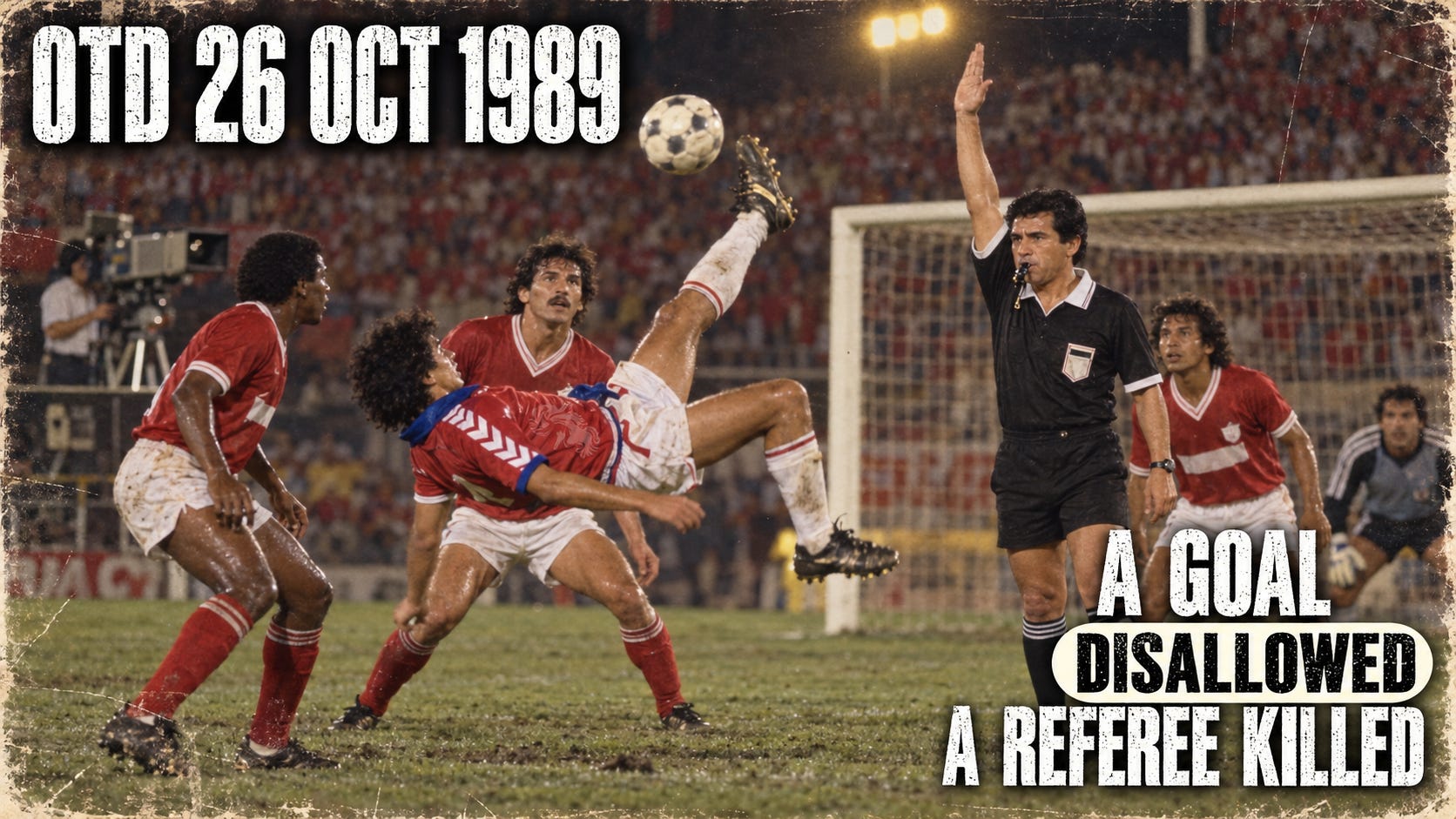
On October 26, 1989, Álvaro Ortega made a fateful decision. Near the end of América de Cali’s 3-2 win over Independiente Medellín at the Pascual Guerrero, the referee disallowed a Medellín goal, judging Carlos Castro’s overhead kick dangerous play. It was the kind of decision that can fill a back page, trigger a radio argument and disappear into a season’s archive.
Three weeks later, Ortega was one of the assistant referees for the return fixture in Medellín. The match ended 0-0. As he and fellow official Jesús Díaz walked near the Hotel Nutibara after it, gunmen shot Ortega dead. He was 32. The Colombian championship was first suspended and then abandoned without a champion, the only completed professional season in the country’s history to end that way.
The temptation is to tell this only as a Pablo Escobar story: a narcotrafficker watched a match, disliked a decision and ordered a killing. That version has become part of Colombian football’s dark mythology, reinforced years later by John Jairo Velásquez, known as Popeye. But the deeper story is more disturbing. Ortega’s death was not a bolt from a blue sky. It came after warnings, a referee kidnapping, open suspicion about betting and club money, and a governing structure that put a threatened official back into the same city without a credible protective plan. His murder made visible what “narcoball” meant when the person applying the Laws of the Game had no protection from the people who believed they owned the result.
How Did We Get Here?
Colombian football had long known that sudden money could be both seduction and danger. In 1949, the break with FIFA rules opened the country to the great, unruly player import boom remembered as El Dorado. It was a dazzling period, full of famous names and packed grounds, but it also demonstrated how quickly a competition can outrun its financial and regulatory foundations. I explored that earlier beginning in El Dorado Begins in Colombia. The late 1980s were not the same story. This time the money came through cocaine trafficking, and with it came the capacity to buy influence, intimidate opponents and make a football disagreement feel like a debt.
That did not make every Colombian club a cartel project, every result fixed or every player compromised. It is important to preserve the football itself. Atlético Nacional’s 1989 Copa Libertadores winners were a remarkable Colombian side: René Higuita, Andrés Escobar, Luis Carlos Perea, Leonel Álvarez, Alexis García, Albeiro Usuriaga and others playing under Francisco Maturana. Their achievement was not fictional merely because the setting was poisoned. As I wrote in Atlético Nacional, Danubio and Narco Terror, the beauty of that team and the terror surrounding the game have to be held together, not used to excuse one another.
By 1989 the contradiction was impossible to miss. Nacional won the Libertadores in May, Colombia qualified for its first World Cup since 1962 in October, and the domestic game appeared to be entering a new age. Yet the country itself was living through bombings, assassinations and the escalating war between the state and the cartels. Football sat inside that national emergency, not outside it. Club ownership, sponsorship, betting, player transfers and local prestige offered both routes for illicit money and places where a gangster’s power could be demonstrated.
The referee was the vulnerable point of contact. A player could be surrounded by teammates and a club president by lawyers, money and bodyguards. A match official was expected to travel, sleep in a hotel, walk to a restaurant and return home as an ordinary professional. In theory CONMEBOL’s international appointments offered a useful safeguard: neutral referees and assistants were selected from outside the competing clubs’ countries, then assigned by the confederation. In practice, neutrality on paper did not protect the Argentine Carlos Espósito and his assistants when they arrived in Medellín for Nacional’s Libertadores semi-final against Danubio in May 1989. Espósito later recalled armed men coming to the officials’ hotel room and making clear that refusal was not a shield.
That episode matters because it strips away a comforting fiction. The official appointment was not the end of the integrity system. It was the beginning of a journey in which the referee had to be collected at the airport, taken to a hotel, protected between hotel and stadium, kept secure during the match, and safely moved out afterward. CONMEBOL could appoint a neutral official; it could not, in that moment, guarantee that the local world around him remained neutral. The same was true domestically, only with fewer layers and less distance.
There had already been a warning close to home. In 1988, the referee Armando Pérez was abducted in Medellín and released with a threat that poorly judged officials would be “erased.” Pérez survived, but the threat was public. Jesús Díaz, one of Colombia’s leading referees, later said the country had reached the point at which the only thing missing was the murder of a referee. The machinery of the season continued.
Ortega did not fit the caricature of an untouchable sporting official. He was from Robles, in Bolívar, worked in and around the Atlantic coast’s refereeing college and had reached Dimayor’s professional matches in 1989. He also ran a small family clothing business with his wife. Díaz knew him as a serious, forceful man. That ordinariness is part of the tragedy. He was not a celebrity insulated from the country’s violence. He was a working official whose professional task placed him between clubs, bettors and men with guns.
The October 26 match gave the threat a focal point. América, then one of Colombia’s strongest and most successful clubs, beat Medellín 3-2 in Cali. The visitors believed Castro’s late bicycle kick had earned them an equalizer. Ortega ruled it out for dangerous play. Díaz was the assistant on that occasion. The precise correctness of the call is almost beside the point now. A referee must be able to make a controversial decision without calculating whether someone has staked a fortune on its reversal.
The reaction in Medellín was furious. It was also a reaction in a city where Pablo Escobar’s name carried a coercive force far beyond an ordinary fan’s anger. Years later, Popeye claimed Escobar watched the match, called the decision robbery and ordered Ortega killed. That is an important allegation, not a court judgment: the homicide investigation failed to secure convictions and later prescribed. Contemporary reporting also carried an anonymous call claiming that powerful gamblers had lost heavily because of Ortega’s decisions. The honest conclusion is not to turn uncertainty into certainty. It is that betting, club rivalry and cartel power created a lethal environment in which several explanations overlapped and the man who made the call was left exposed.
The most painful detail came next. The same teams met again in Medellín on November 15. Ortega was assigned as an assistant referee, alongside Díaz. Accounts from Díaz and later reporting say he tried to persuade the authorities not to include Ortega in the party; Ortega was worried after a telephone call at the hotel that afternoon. Yet the appointment stood. There was a police patrol for the match return, but that was not a security system capable of protecting the officials beyond the stadium.
The return game ended 0-0. The officials were taken toward their hotel, stopped for food, and began walking a short distance when the attackers appeared. Díaz was beside Ortega. The killer told him, in effect, to move aside: this was not for him. Ortega was shot repeatedly. The number of shots varies in retellings; the essential fact does not. A football official was murdered after a match in a country where such a murder had been publicly feared.
So What?
Colombia’s immediate response was grief, shock and, at last, an admission that the competition could not carry on as usual. The football authorities and Dimayor suspended the championship. The government, through Education Minister Manuel Francisco Becerra, then made access to public stadiums conditional on clubs demonstrating that they were not being subjected to criminal pressure and that the game was being cleaned up. The club presidents considered playing on; the state’s refusal to make stadiums available changed the calculation. On November 22, Dimayor unanimously cancelled the 1989 championship. Junior and Millonarios had already reached the final quadrangular, but nobody received the star.
That decision was unusually consequential because the season had been so close to its climax. Players lost matches and wages. Clubs lost gate money. Supporters lost a finish. But a title awarded after Ortega’s murder would have made an intolerable claim: that the game’s normal incentives mattered more than the official who had paid for a decision with his life. Cancellation did not heal the sport, and it did not deliver justice to Ortega’s family. It was a line, belated but necessary, against the idea that football could simply absorb any violence.
The family’s story makes the failure clearer. Ortega left a wife and two young daughters. Díaz carried the memories of the hotel room, the last walk and the gunfire for decades; he visited Ortega’s grave in Barranquilla and spoke of how the shots still returned each November. The case itself did not produce the clarity a family deserved. Prosecutors did not establish a perpetrator in court, no one was captured for the homicide, and the investigation ultimately expired. A sports world that made public statements of condolence could not substitute for accountability.
Nor was the cleanup as decisive as the rhetoric. When league play resumed in 1990, the government had demanded practical measures: criminal-record certifications for club directors, registered player contracts and fuller accounting for the origin of club funds. Those were sensible demands. Their weakness was that rules on paper cannot dismantle a system in which the people to be scrutinized have wealth, local influence and a reason to conceal both. Colombia’s league survived; it did not instantly become transparent.
CONMEBOL’s response showed the same mixture of intervention and limitation. In 1990, threats to officials around Atlético Nacional’s Libertadores tie with Vasco da Gama produced a replay on neutral ground in Santiago and restrictions on Colombian clubs hosting international matches. Nacional, the reigning champions, were forced to live with a punishment created by a security environment they did not fully control. The confederation could annul a game, move a venue and impose sporting consequences. What it had not done in 1989, and what no fixture list itself could do, was make the journey of a match official safe when armed groups could enter the football ecosystem with impunity.
That is why Andrés Escobar’s murder in 1994 should not be treated as a sequel that somehow taught Colombia its lesson. It was another warning that football results, gambling losses and violent power could converge after the death of Pablo Escobar. The details and legal histories differ; one should not force a single explanation onto every killing. But the arc matters. Ortega’s murder was not an isolated aberration safely contained by the cancellation of one season. It revealed a culture in which a result could be monetized, personalized and violently enforced.
The wider history of officials confirms that the risk takes different forms. Sometimes a referee is corrupted, as in major match-fixing cases from Europe to Asia. Sometimes an official is attacked by players or spectators. Sometimes, as with Ortega, the danger comes from organized criminal power treating a decision as a financial loss. These are not interchangeable stories, and Ortega’s is exceptionally grave. But they all expose the same error: treating the referee as a disposable obstacle rather than a protected custodian of a contest.
The contemporary threat has changed shape, not disappeared. It is no longer only a local boss with an entourage near a hotel. Illegal football gambling now operates through transnational networks, online platforms, encrypted communication, mule accounts and cross-border money laundering. INTERPOL’s 2024 operation against illegal football gambling reported more than 5,100 arrests across 28 countries and territories. Asian crime syndicates are part of that global picture, not a synonym for it: the networks reach into Europe, the Americas and elsewhere, and their business is organized crime rather than any nationality.
Football’s modern response is also much stronger than what Ortega was given. FIFA and confederations use integrity officers, betting-market monitoring, reporting mechanisms, education programmes and disciplinary rules that prohibit betting and manipulation. Large competitions can coordinate security, travel and hotel protocols for officials. Those are real advances. They matter because an approach to an official can now be reported, logged and investigated rather than dismissed as dressing-room folklore.
But protection still depends on institutions acting before the harm. If an official reports a threat, the answer cannot be merely to remind him of ethics rules or appoint him again because a schedule needs filling. It has to mean a risk assessment, physical protection, a changed assignment if necessary, independent investigation and consequences for the people who create the threat. Ortega’s case carries that lesson with terrible clarity. He was not killed because football lacked a rule against murder. He was killed because the people responsible for moving him through a known danger did not have, or did not use, the means to keep him safe.
The October 26 decision therefore belongs in history not as a notorious refereeing controversy but as the start of a moral test Colombian football failed. The result was 3-2. The goal was disallowed. The league season had no winner. And a referee who should have been remembered for a difficult call became a measure of what happens when sport allows fear to become part of the officiating.
Three Things to Take Away
1. The October 26, 1989 match was the trigger, not the date of Álvaro Ortega’s death. He disallowed a late Medellín goal in América’s 3-2 win, then was murdered after the return match in Medellín on November 15.
2. Ortega’s killing came after open warnings: referee Armando Pérez had been abducted in 1988, and international officials were threatened around Atlético Nacional’s Libertadores run. Appointing a neutral referee was never enough if no one protected the official’s journey.
3. Colombia cancelled its 1989 championship rather than name a winner, but the murder remained unsolved. Modern integrity systems are stronger, yet illegal betting and organized crime still make official protection a live obligation, not a historical footnote.
On This Day
On October 26, 1989, Álvaro Ortega disallowed a late goal in América de Cali’s 3-2 win over Independiente Medellín. Nineteen days later he was murdered. Colombian football did not merely lose a referee; it learned, too late, what a result can cost when organized crime believes the game belongs to it.
Have a football memory, a correction or a story that belongs here? Write to otd@17lawsguy.com.
Yesterday: *The World Cup Colombia Gave Back* — Colombia withdraws as host of the 1986 World Cup, 25 October 1982.