

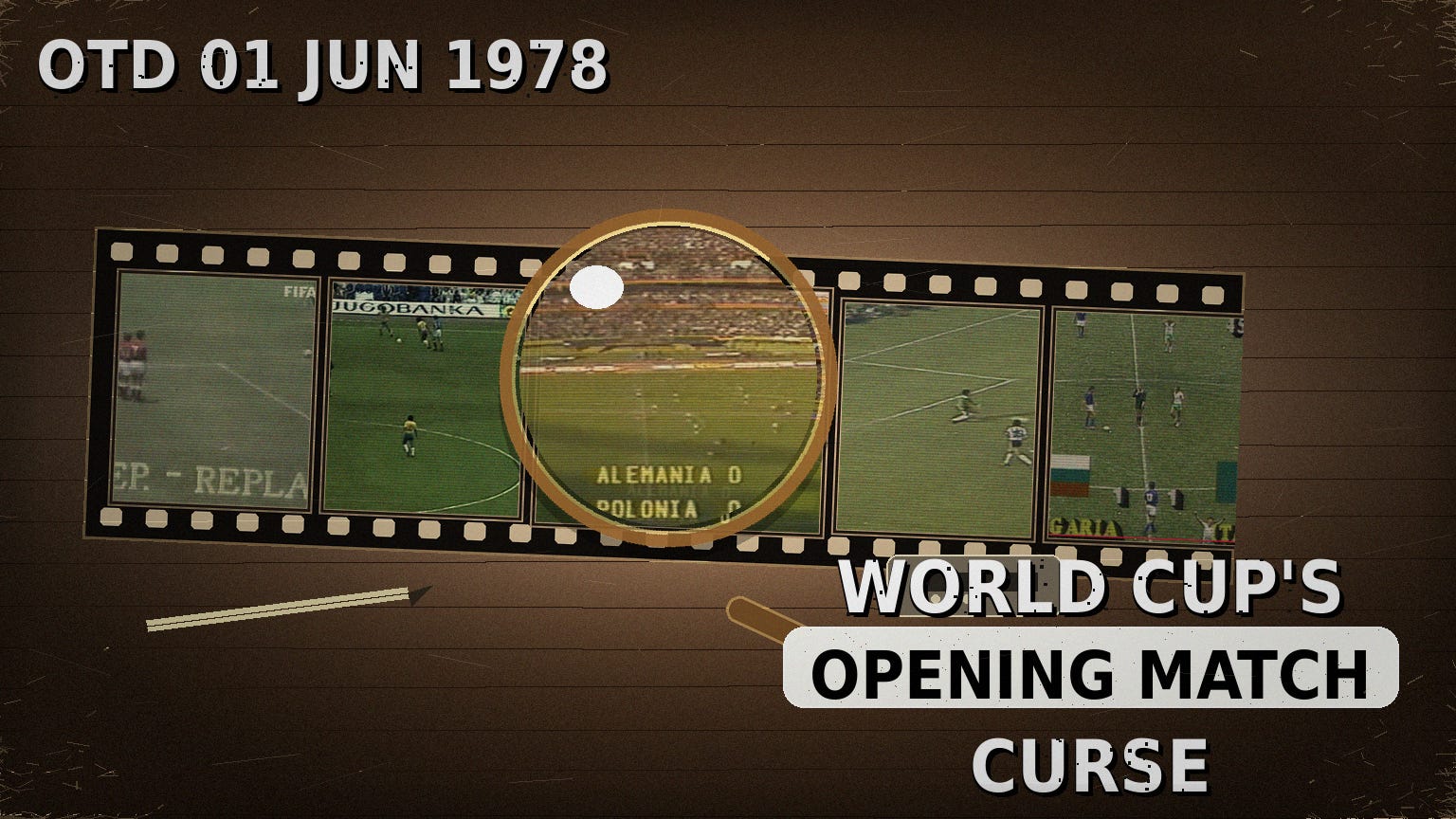
It is 1 June 1978, in Buenos Aires. The Estadio Monumental. The World Cup begins — and it begins with a match that ought to be anything but dull. West Germany, the defending champions, against Poland, third place in 1974 and Olympic silver medalists in 1976. Maier, Vogts, Bonhof, Rummenigge on one side; Deyna, Lato, Szarmach and a young Zbigniew Boniek on the other.
The score? 0-0.
Another World Cup opener with no goals. The curse continues. And with the 2026 World Cup now just ten days away, it’s the perfect moment to ask: why did the tournament’s grandest single fixture spend more than a decade refusing to produce a goal — and how did that change?
First, the curse was real. For a long time the World Cup didn’t really have an “opening match” in the modern sense. In 1930 two games kicked off at once; it was eight in 1934, and the idea of a single symbolic curtain-raiser, watched by the world, only formed gradually.
And once it did, it went cold. The showcase opener produced four straight goalless draws:
1966: England 0-0 Uruguay
1970: Mexico 0-0 USSR
1974: Brazil 0-0 Yugoslavia
1978: West Germany 0-0 Poland
Four tournaments. Four blanks. The biggest stage in football, and nobody could find the net.
But here’s the strange thing: those goalless openers were quietly historic. The 1970 Mexico–USSR snooze gave us the first substitution in World Cup history — Anatoliy Puzach on at half-time — and the dawn of the modern yellow-card era. The opener bored the watching world and changed the laws of the game in the same ninety minutes.
There’s also a pattern worth noting: the opener is a terrible predictor. England drew 0-0 in 1966 yet went on to win the whole thing. In 1978, both West Germany and Poland advanced from the opener — and both were gone before the final, West Germany undone by the famous 3-2 shock against Austria in Córdoba that ended Helmut Schön’s long era. The opener tells you something. It rarely tells you the ending.
Then the curse cracked, and the opener became the opposite of those cautious nil-nils. It became theatre. In 1982, Belgium shocked defending champions Argentina 1-0. In 1990, Cameroon shocked Argentina again, finishing with nine men, Omam-Biyik’s header and Massing’s foul on Caniggia burned into memory. In 1994, the United States gave us full showbiz — Diana Ross missing a staged penalty before Germany beat Bolivia. In 2002, Senegal stunned holders France 1-0 on debut, one of the great opening-day upsets.
After 2002, the format changed: defending champions no longer qualified automatically, so from 2006 the host nation opened the tournament — and the opener grew louder, bigger, more choreographed. Germany 4-2 Costa Rica in 2006, six goals. South Africa 1-1 Mexico in 2010, Tshabalala’s strike and the vuvuzela soundtrack. Russia 5-0 Saudi Arabia in 2018, the biggest opening-match margin ever. Qatar 0-2 Ecuador in 2022 — the first host nation ever to lose its own opener.
From schoolchildren with flags and goalless draws, the opener became mass choreography, celebrity stages, political messaging, sponsors, memes and global watch parties. It stopped being merely the first match. It became the tournament announcing what it wants to be.
And in 2026, it returns to where so much of this history lives: Mexico City. Mexico against South Africa, at the stadium long known as the Azteca — which will become the first ground ever to host three World Cup opening matches, after 1970 and 1986. In 1970 it gave us a goalless opener that secretly rewrote the rules. In 1986 it gave us a draw. In 2026 it opens the biggest World Cup ever — 48 teams, 104 matches.
Maybe that’s the real lesson of the opener. England drew 0-0 and lifted the trophy. France lost and collapsed. Cameroon shocked the world and became a story for the ages. West Germany and Poland produced a star-studded bore and both faded.
The opener is not a prediction. It is a doorway.
🎙️ THE PODCAST GOES DEEPER. The full episode has what this post compresses: every showcase opener from 1966 to 2022 in detail; the 1970 first-substitution and first-yellow-card story; the politics of the 1978 Monumental ceremony under the junta; the Córdoba shock that ended Schön’s reign; and the full ceremony-culture arc from flags to fireworks. That’s the 10-minute version.
---
🎧 Listen on Spotify, Apple Podcasts, Amazon Music, Overcast, iHeart, and YouTube.
📩 Got an episode idea? otd@17lawsguy.com
Yesterday: 31 May 1961 — Benfica End Madrid’s Golden Age.
Tomorrow: 2 June 1886 — who is actually in charge of the 17 Laws of the Game?