

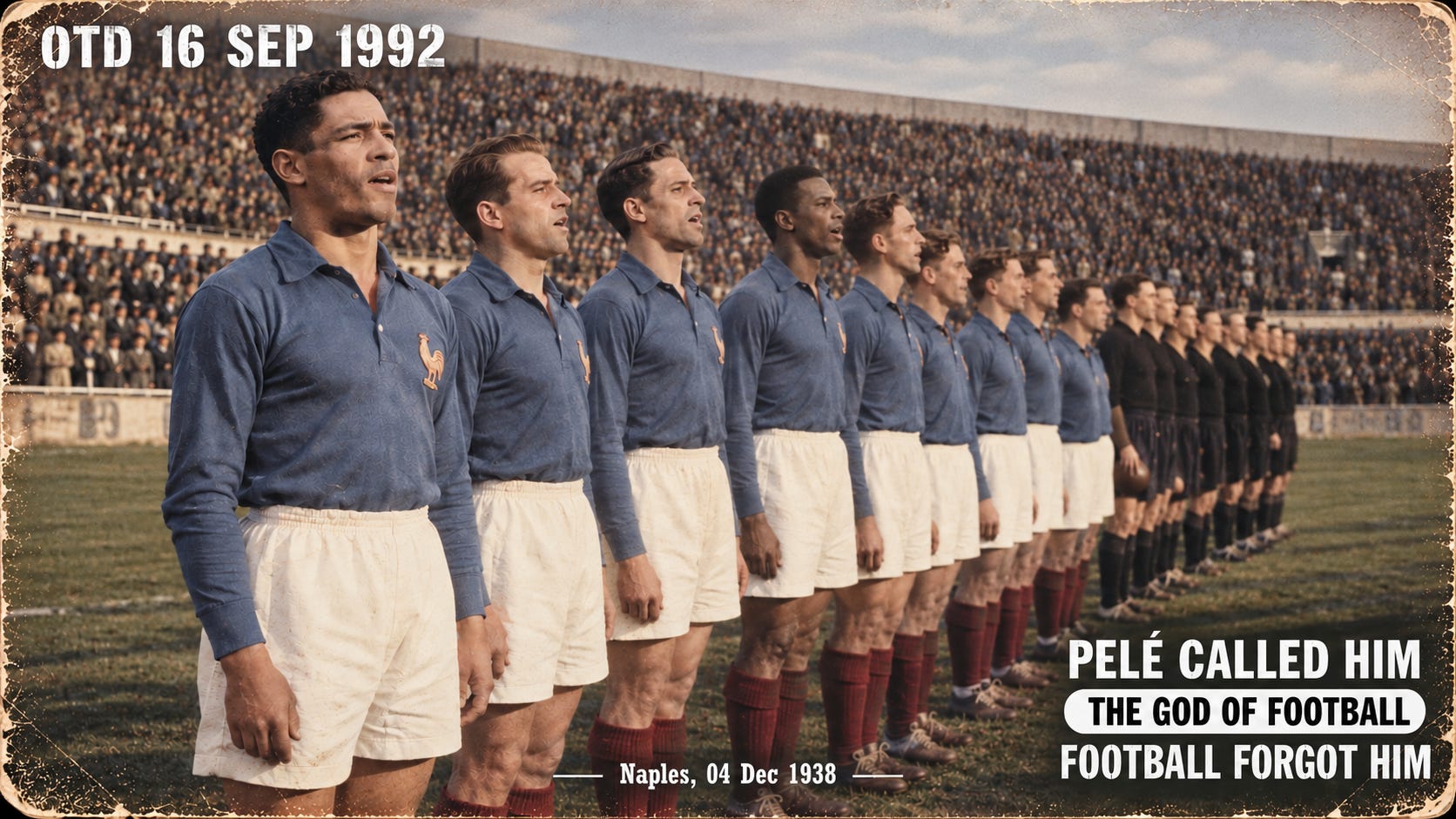
It is September 16, 1992, in Casablanca, and Larbi Benbarek has died alone in his home. Several days pass before his body is found. He had been one of the greatest footballers in the world: a superstar in Morocco, the man who transformed French football, a double champion of Spain with Atlético Madrid, the original Black Pearl. “If I am the King of Football,” Pelé reportedly said, “then Benbarek was its God.” And yet, when the God of Football died, much of the game had already forgotten he existed.
How did we get here?
Even his beginning is uncertain. Some records say Larbi Benbarek was born in Casablanca on June 16, 1914; others say 1917. His name survives in several forms, Larbi Ben Barek, Larbi Benbarek, Abdelkader Larbi Ben Mbarek, and the vagueness is not an accident. He was born a colonial subject in the French protectorate of Morocco, from a poor background, and the early life of such a man was documented far less carefully than the lives of the European players he would eventually surpass. He learned the game in the streets of Casablanca and, by the mid-1930s, was playing for local clubs there. He could operate as a half-back, an inside-forward or a playmaker; he was strong, graceful and technically astonishing, and the ball seemed to belong to him. But the racial assumptions of colonial football held that players like Benbarek could not truly understand the game. North Africans, the supposed experts said, might be athletic and individually skilful, but they lacked the intelligence and discipline for the collective game.
Then, on April 11, 1937, a Moroccan selection met France B in Casablanca and won 4-1, with Benbarek the best player on the field. The French sporting paper L’Auto praised his intelligence, his control and his understanding of the game. It was not an argument against the stereotype. It was a result. Olympique de Marseille understood what they had seen, and Benbarek crossed the Mediterranean to join one of France’s leading clubs. His impact was immediate, and he did not merely become a successful African player in Europe; he became one of the European game’s greatest attractions. His touch, his balance, his passing, the sudden changes of pace, the acceleration through a defence: people came to watch Marseille because Larbi Benbarek was playing. The French press needed a name for him, and in early 1939 L’Auto asked its readers to choose one. The winner was La Perle Noire. The Black Pearl. It was meant as admiration, and yet the coverage around him also exposed the world he played in, exoticizing him, patronizing him, describing him through racial caricature. His brilliance made him famous. It did not make him equal.
Then came France. Morocco was not independent and had no team of its own, but French rules allowed Moroccan and Tunisian colonial subjects to be treated as French for eligibility, and so Benbarek became selectable. On December 4, 1938, he made his France debut against Italy, the world champions, in Naples. The atmosphere was openly hostile, Europe was sliding toward war, and Benbarek and Raoul Diagne, the two Black players in the French side, faced racist abuse from the crowd. During the Marseillaise, Benbarek sang at the top of his voice. France lost 1-0, but French football had found its new central figure. And then, almost as soon as it had begun, war stopped everything.
A career divided
Benbarek had played only four times for France when the Second World War halted international football. He returned to Morocco, and six years that should have been the peak of his career simply vanished. The World Cups of 1942 and 1946 were never played, and by the time the game resumed he may already have been past thirty. And yet his second career was almost as remarkable as his first. In 1945, Stade Français brought him back to a France with grand ambitions, and he became their star, his international career resuming with him. Then, in 1948, Atlético Madrid signed him. Spain was still isolated under Franco’s dictatorship, and Atlético were assembling an extraordinary attacking team, in which Benbarek joined the Swedish Olympic champion Henry Carlsson and the prolific Adrián Escudero in a forward line that became known as the Crystal Attack. The coach was Helenio Herrera, who would later become synonymous with the ferociously organized Internazionale side that won consecutive European Cups, but whose Atlético team was built around attacking talent, with Benbarek as its conductor. Atlético won La Liga in 1949-50 and retained it in 1950-51, and Benbarek scored 58 goals in 114 Spanish league appearances. The supporters gave him another name: the Foot of God. A Moroccan colonial subject had become the creative leader of the best team in Spain.
In 1953 he returned to Marseille, and the circle began to close. In May 1954, Marseille reached the Coupe de France final, where the aging Benbarek faced a 20-year-old Moroccan forward playing for Nice, Just Fontaine. Nice won 2-1, the future quietly replacing the past. But Benbarek was not quite finished. On October 16, 1954, France selected him against the new world champions, West Germany, and he was forced off injured in the first half. It was his seventeenth and final cap. His first had come in December 1938, his last in October 1954: fifteen years and ten months apart, still the longest international career in the history of the France men’s team.
And inside those numbers lies a great emptiness. Seventeen appearances across almost sixteen years, and no World Cup. He became eligible just after the 1938 tournament; war removed 1942 and 1946; France withdrew from the 1950 finals; and by 1954 his last cap came after that summer’s tournament. One of the finest players of his age never appeared on football’s greatest stage. And one of Morocco’s greatest players never represented an independent Morocco, because the protectorate did not end until 1956. He went home, helped develop the new country’s football as a player-coach and later as a coach, but his playing identity had already been claimed by the colonial structure into which he was born. Officially, seventeen appearances for France and three goals. For independent Morocco, none.
So what?
The first thing is that Benbarek changed what an African footballer could be in the European imagination. He was not the first African to play in Europe, Arthur Wharton and Hussein Hegazi came earlier, North Africans like Ali Benouna and Abdelkader Ben Bouali had already succeeded in France, and Raoul Diagne had already played for the national team. But Benbarek became something different: a continental superstar, a player around whom elite teams were built, a Black African footballer presented not as a curiosity or a pioneer but as one of the finest players anywhere. The road that runs to Eusébio, George Weah, Samuel Eto’o, Didier Drogba and Mohamed Salah does not begin with him alone, but it runs unmistakably through him.
The second thing is that his career reveals the deep ambiguity of colonial representation. France could select him, French clubs could employ him, French crowds could celebrate him, and yet, by the BBC’s account, he was never granted French citizenship. His talent was absorbed into French football while his political status stayed unequal. Was he a French international? Undeniably. Was he a Moroccan footballer? Just as undeniably. Modern statistics demand a single flag, and Benbarek’s life refuses to fit beneath one.
The third thing is that his obscurity shows how football memory is actually built. His greatest years came before television. He never played in a World Cup. War split his career, colonial status blurred his national identity, his name is recorded several ways and his birth year is disputed, and there is no archive of colour footage carrying his genius to later generations. So later supporters inherited the players the record happened to preserve, Pelé, Di Stéfano, Puskás, Raymond Kopa, Just Fontaine, the men kept alive by World Cups, European Cups and film. Benbarek survives mainly in testimony, in the words of people who saw him trying to describe what the rest of us missed. And that is what makes Pelé’s line so powerful, because it reverses the usual order. Pelé was not claiming Benbarek as a follower. He was acknowledging a predecessor. If Pelé was the King, Benbarek came before the King.
Then came the ending. After football, Benbarek slowly disappeared from public view, and on September 16, 1992, he died alone in Casablanca, his body undiscovered for several days. Six years later, FIFA posthumously awarded him its Order of Merit. Recognition returned at last, too late for the man receiving it.
Three things to take away
First, Larbi Benbarek was the original Black Pearl. A Moroccan who became a star for Marseille, France and Atlético Madrid before African footballers were accepted as central figures in the European game.
Second, his career was shaped by forces far larger than football. Colonial rule made him eligible for France but denied him the chance to represent an independent Morocco, and the Second World War removed six of his prime years and two World Cups.
Third, his surviving numbers cannot contain his importance. Seventeen France caps, three international goals, two Spanish titles, but almost sixteen years between his first and last appearances, and a reputation so great that Pelé reportedly called him the God of Football.
On this day in 1992, Larbi Benbarek died in Casablanca, alone and largely forgotten. The first African football superstar had helped Europe imagine a kind of player it had been told could not exist, and then football allowed him to vanish from its memory. The King became immortal. It is time we remembered the God who came before him.
---
📩 Got an idea to an OTD story? otd@17lawsguy.com
Yesterday: 15 September 1956, South Korea become the first champions of Asia.
Tomorrow:17 September 1969, Feyenoord thrash Iceland’s KR 12-2 and the age of Dutch dominance begins.
What a coincidence lol. I was reading about him just last night. Sounds like he was a fabulous player. May his soul RIP.