

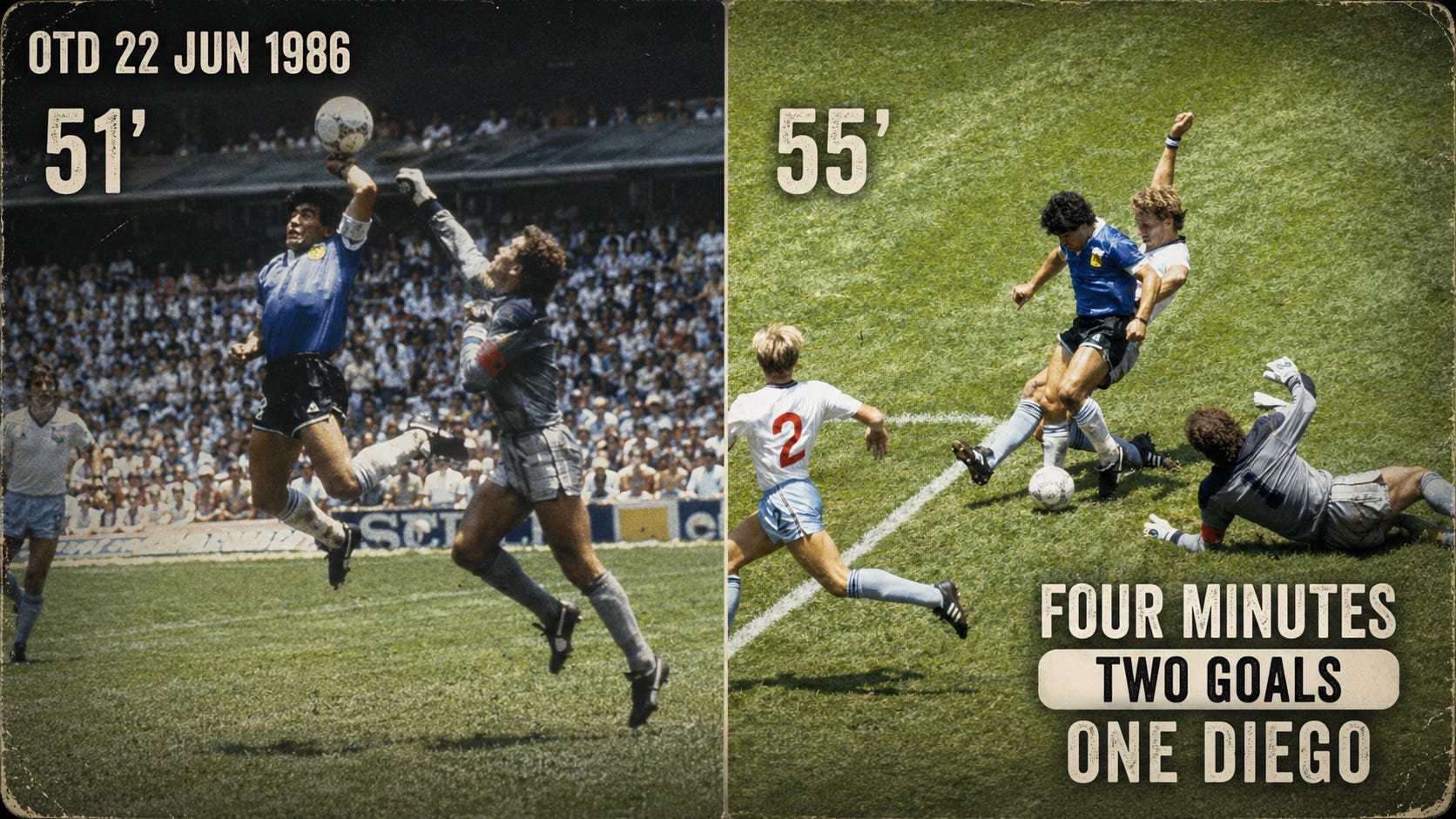
It is 22 June 1986, at the Estadio Azteca in Mexico City. Argentina against England, a World Cup quarter final. And in four minutes, Diego Maradona gives football one of its deepest contradictions. First, the Hand of God. Then, the Goal of the Century. Argentina 2, England 1. One goal illegal, one goal almost impossible, one player literally and figuratively taking the match into his own hands. This is peak Maradona: genius and deceit, beauty and darkness, a poor kid from Villa Fiorito at the centre of world football and of a rivalry already carrying too much history.
How did we get here? Maradona had been left out of Argentina’s 1978 World Cup by Menotti, a wound that stayed with him, and Argentina won at home without him under the dictatorship. But Diego did not vanish: the World Youth Championship in 1979, Boca, then a world-record move to Barcelona, brilliance and conflict and a red card in a cup final, and then, in 1984, Napoli. That is where he became more than a footballer. Naples did not receive him as a star signing but as a savior, the poorer south against the richer north, a city that saw in Diego its own insult and its own revenge. By 1986 he had not yet won the Scudetto (that came in 1987), but he arrived in Mexico as the most gravitational player on earth.
Argentina’s football story was built for someone like him, full of beauty and pain, but also a darker strand of hardness and gamesmanship. In 1966 England had beaten Argentina at Wembley after Antonio Rattín was sent off, and Alf Ramsey called Argentina “animals”. By 1986 the coach was Carlos Bilardo - a doctor and former Estudiantes player shaped by that club’s brutal, clever, effective dynasty - who built Argentina around winning and around Maradona. Good players surrounded him, Valdano, Burruchaga, Ruggeri, but everyone knew the system was Diego.
And there was politics. The Falklands War, the Malvinas War, had ended only four years earlier. Argentina had invaded the islands in April 1982; Britain had retaken them by June; hundreds had died; the dictatorship collapsed soon after. So when Argentina and England met in 1986, it was not formally about the war, but it could not escape it: grievance, pride and memory on one side, suspicion and tension on the other. The first half was tight and goalless, England compact, Maradona kicked and surrounded and still always available.
Then the second half. In the 51st minute Maradona drove toward the England box, the ball ricocheted off Steve Hodge back toward goal, and Maradona kept running. Peter Shilton, six feet tall (183cm), came out. Maradona, five foot five (165cm), jumped, raised his left hand, and punched the ball over Shilton and into the net. The referee gave the goal. England protested. Maradona celebrated just enough, and afterward said it was scored, “un poco con la cabeza de Maradona y otro poco la mano de Dios”, a little with the head of Maradona and a little with the hand of God. It was cheating. Brilliant, instinctive, shameless cheating. And it counted. Argentina 1, England 0.
Four minutes later, the other Diego appeared, or the same Diego with no mask. He collected the ball inside his own half near the right touchline, turned, and accelerated. Beardsley and Reid gone. Butcher gone. Fenwick gone. Butcher again, too late. Shilton, rounded. He kept his balance and slid the ball into the empty net. Argentina 2, England 0. The Goal of the Century. On Argentine radio, Víctor Hugo Morales screamed it into immortality: “barrilete cósmico”, cosmic kite, what planet are you from? The answer, in that moment, was not earth. Lineker pulled one back, England pushed, Argentina survived. 2-1.
The two goals cannot be separated. If Maradona only scores the Hand of God, he is a cheat. If he only scores the Goal of the Century, he is a genius. Because he scores both, four minutes apart, he becomes Maradona in full, and football has never known what to do with that. The sport wants its morality clean. Maradona refuses cleanliness. For many Argentines the Hand of God was understood through politics, class and the Falklands wound, the small man from the poor country outwitting the big English goalkeeper, the hand as revenge and mischief and survival. That does not make it legal. It explains why it was loved. For England it remains theft, a violation, a referee’s failure, and then, cruelly, it was followed by a goal so magnificent that even anger had to share space with awe. The two images argue with each other forever: one says scandal, the other says genius. Together they say Diego.
Argentina went on to win the World Cup, Maradona scoring twice more against Belgium, then finding the pass for Burruchaga’s winner in a 3-2 final against West Germany. He won the Golden Ball not because he was part of the best team, but because he was the tournament’s controlling force. It is, for many, the greatest individual World Cup ever played. And the aftermath did not soften him: two Scudetti at Napoli, then the slow decline. But the England match remains the eternal image, because it captures the whole man in four minutes.
That is why 22 June 1986 matters. Football likes to sort its heroes and villains. Maradona, in four minutes, made that sorting impossible, and that may be the most honest thing about him.
🎙️ THE PODCAST GOES DEEPER. The full episode has more on Maradona’s road through Barcelona to Napoli, the Argentina-England history including 1966, the Falklands context, the two goals in detail, why Argentina loved the handball, the rest of the 1986 run and final, and how the two images came to define him. That is the 10-minute version.
---
🎧 Listen on Spotify, Apple Podcasts, Amazon Music, Overcast, iHeart, and YouTube.
📩 Got an episode idea? otd@17lawsguy.com
Yesterday: 21 June 1970, Brazil, Pelé, and the Greatest Team.