

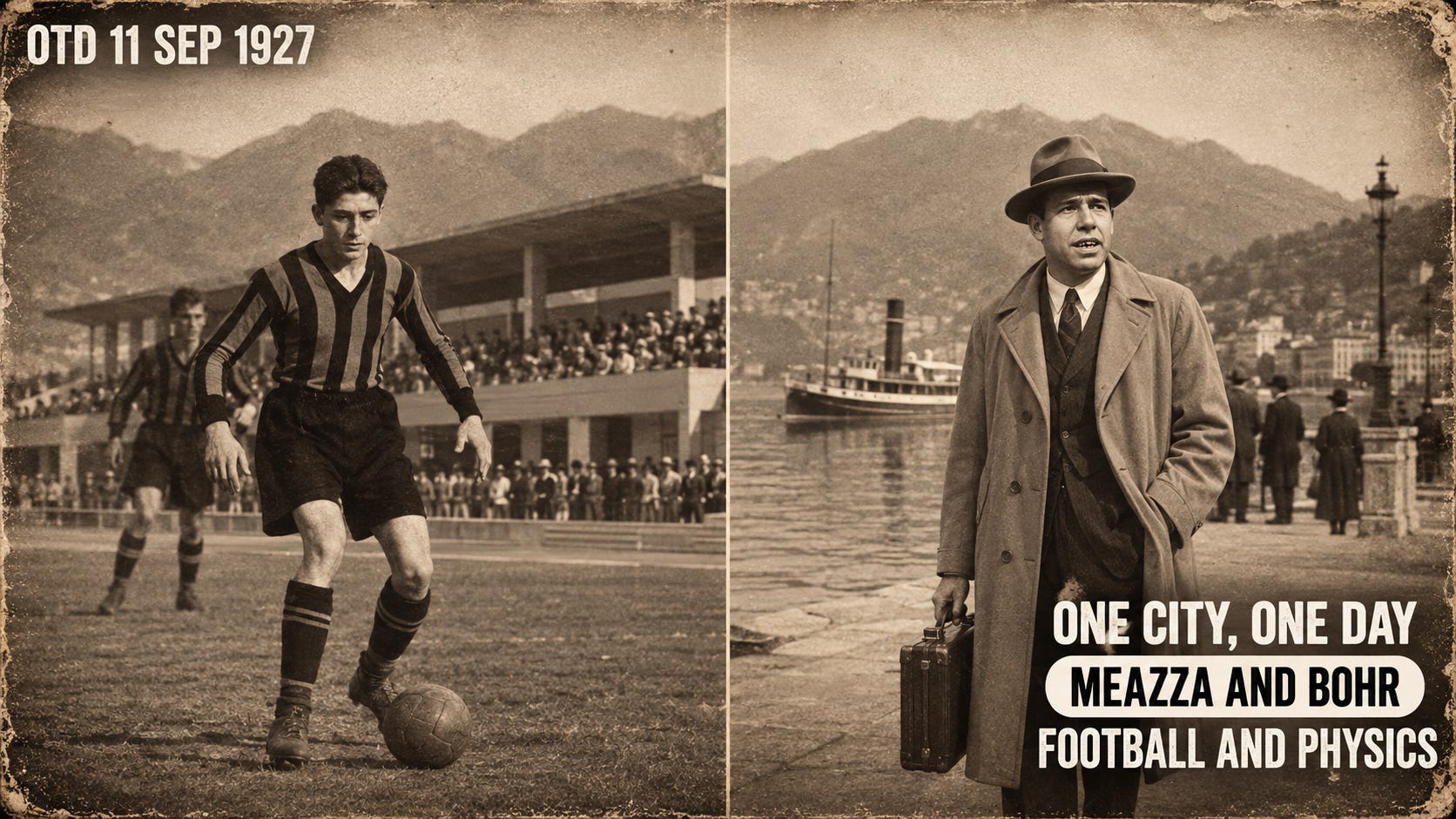
It is September 11, 1927, and the city of Como, in northern Italy, is celebrating one man: not a footballer but a scientist, Alessandro Volta, a hundred years after his death. Among the exhibitions and ceremonies is a small football tournament, the Coppa Alessandro Volta, and one of the four invited clubs is Internazionale, who have had a miserable morning, losing 3-0. So for the meaningless third-place match, the Hungarian coach Árpád Weisz decides to try something different: a seventeen-year-old, small and skinny, barely more than a boy. Then the boy starts to play. Inter score six, and the kid scores twice. His name is Giuseppe Meazza, and Italian football has just met its first superstar.
Meazza had grown up in Milan, born in 1910, his father dead when he was young, raised by his mother Ersilia, who was not at all keen on his football and once hid his shoes, so he played anyway with his feet wrapped and a ball made of rags. Here is the first irony: Meazza supported Milan and wanted to play for Milan, and Milan looked at a boy of about forty kilos, decided he was too frail, and said no thank you. Inter took him instead, which was an expensive scouting error. In their youth system he caught the eye of an established player who kept telling Weisz to look at the boy, and at Como, Weisz finally did.
Now stop the football clock, because this is where the day becomes wonderfully strange. The Coppa Volta was only one part of Como’s huge commemoration, and on the same day another event opened across town: an international congress of physicists, sixty-one of them, including Max Planck, Werner Heisenberg, Wolfgang Pauli, Paul Dirac, Enrico Fermi and Niels Bohr. Quantum mechanics was being rebuilt around Lake Como, and during the congress Bohr gave the first public account of his principle of complementarity. You hear the name Bohr and think of Nobel Prizes, and rightly: Niels won his in 1922, his son Aage in 1975. But this is a football show, so here is the football. Niels Bohr had kept goal for Akademisk Boldklub in Copenhagen, and his younger brother Harald, an eminent mathematician, was a Denmark international who scored twice in Denmark’s first official match, a 9-0 win in 1908, on the way to Olympic silver. There is no evidence the two worlds in Como ever touched that day, which somehow makes it better: quantum mechanics in one hall, a legend beginning on a football pitch across town, on the same afternoon.
Meazza’s rise was absurdly fast. He scored thirty-three goals in twenty-nine league matches in 1928-29, and when the first single-table Serie A arrived in 1929-30, its first great scoring star was Meazza, with thirty-one goals as Inter won the title. Except they were not quite called Inter anymore: in 1928 the Fascist regime had forced the club into a merger and imposed the name Ambrosiana, and the club they were merged with was Unione Sportiva Milanese, the very side Meazza had faced on his debut. Then he became national property. In 1930 Italy went to Budapest and beat a strong Hungary 5-0, Meazza scoring three, and around twenty-five thousand people met his train back in Milan. With no television and no social media, a nineteen-year-old was already a genuine celebrity, known for his clothes, his hair, his nightlife and his goals.
He became the genius of a great Italy side. They won the 1934 World Cup, on home soil and amid unavoidable Fascist propaganda, but with a genuinely outstanding team, and Meazza at its heart. In the 1938 semifinal against Brazil, now Italy’s captain, he stepped up to take a penalty just as the elastic in his shorts broke, so one of the finest players in the world scored a World Cup semifinal penalty while holding his shorts up with one hand. Italy went on to win a second World Cup. In only fifty-three internationals Meazza scored thirty-three goals for Italy, a total only one Italian has ever passed.
But his golden age belonged to one of Europe’s darkest periods, and nobody shows that contradiction more painfully than Árpád Weisz, the Hungarian Jewish coach who had trusted the skinny seventeen-year-old and guided Inter to that first Serie A title. When Italy introduced its racial laws, Weisz had to flee, and he and his family were eventually deported to Auschwitz and murdered. The same regime that used Italian football as a show of national greatness drove out one of the men who had helped build it.
The war ended Meazza’s prime early, after a serious problem with his left foot, and he wound down through Milan, Juventus and others before going home to Inter as player-coach, closing the circle. He finished with 408 Inter appearances and 284 goals, still the club’s record. When he died in 1979, Milan gave him the ultimate monument: San Siro was officially named the Stadio Giuseppe Meazza. The skinny kid Milan had rejected as too fragile ended up with one of football’s cathedrals bearing his name.
---
🎧 Listen on Spotify, Apple Podcasts, Amazon Music, Overcast, iHeart, and YouTube.
📩 Got an episode idea? otd@17lawsguy.com
Yesterday: 10 September 1985, the night Scotland lost Jock Stein.
Tomorrow: 12 September 1885, two Scottish clubs score 36 and 35 in the same afternoon.
Just stumbled upon your page and have to say I absolutely love the stories you’re writing!