

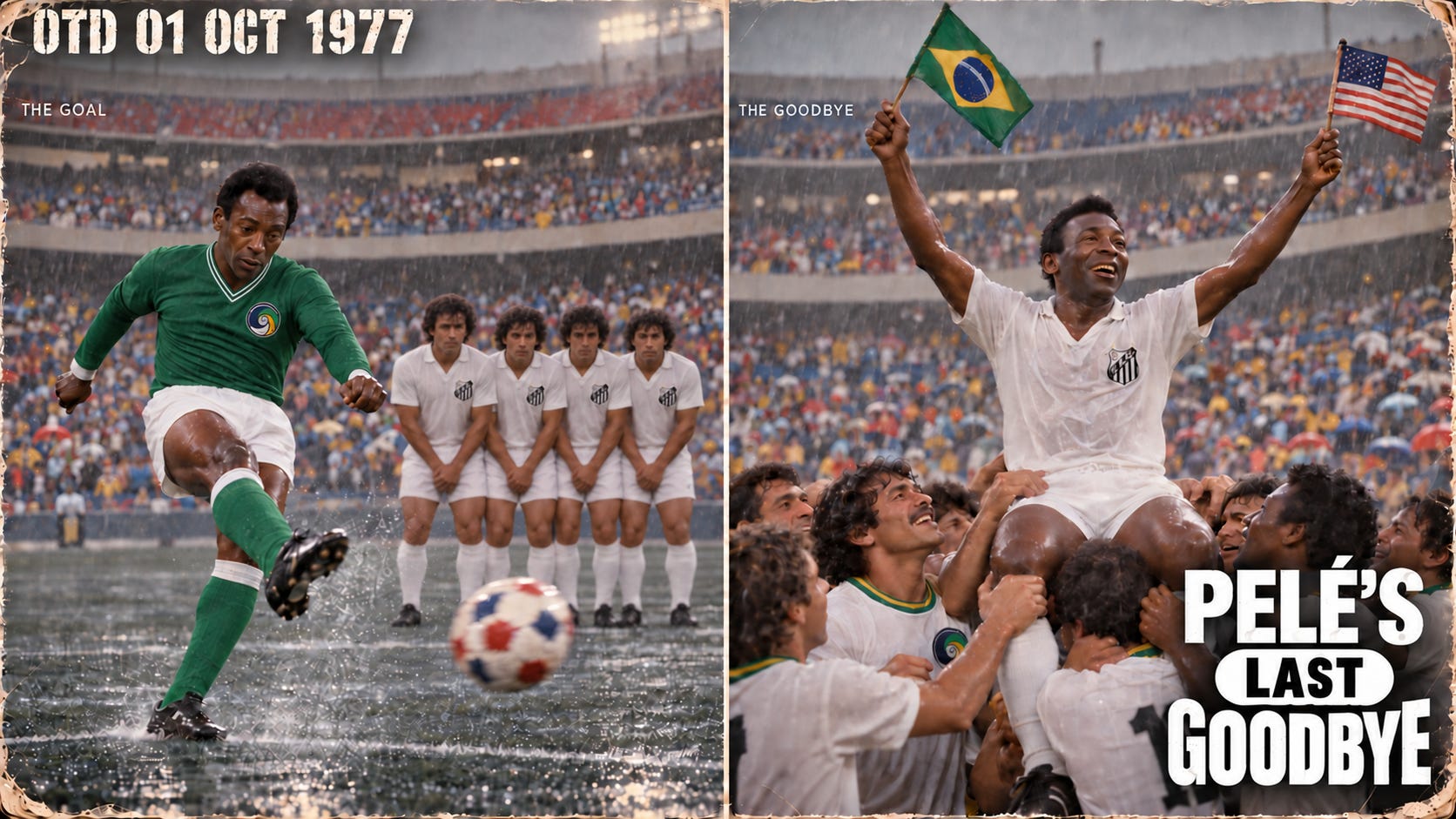
Rain is falling on Giants Stadium in New Jersey, and more than 75,000 people have come out into it anyway. Muhammad Ali is here. So are Bobby Moore, Henry Kissinger, Elton John and a stretch of politicians, musicians and athletes who could otherwise fill a stadium of their own. They have not come for a championship. They have come to say goodbye to one footballer.
The match is New York Cosmos against Santos, and Pelé is playing for both. He will wear the Cosmos shirt for the first half and the white of Santos for the second, closing his career with the club that first made him a king. Before kickoff, with his father and Ali standing beside him, Pelé takes the microphone and asks the crowd to repeat one word three times: love, love, love.
On October 1, 1977, Pelé said goodbye to football. Football, it turned out, was only beginning to say goodbye to him.
How did we get here?
He was born Edson Arantes do Nascimento in Três Corações, in the Brazilian state of Minas Gerais, in October 1940. His father, João Ramos do Nascimento, known as Dondinho, had played football himself, not as a star but well enough to teach his son the game. Money was tight. Young Edson shined shoes and played with whatever would roll, socks stuffed with newspaper, a grapefruit, anything close enough to a ball. The nickname Pelé seems to have grown out of his own childhood mispronunciation of Bilé, a goalkeeper his father had once played alongside. He disliked it. Naturally, that only made his schoolmates use it more.
In Bauru, a coach named Waldemar de Brito saw something in the boy and took the fifteen-year-old to Santos, reportedly telling the club he would become the greatest footballer in the world. It sounds like a line invented after the fact. Pelé spent the next two decades making it sound merely accurate. He debuted for Santos in 1956, before his sixteenth birthday, and scored. The following year he debuted for Brazil against Argentina at sixteen, scoring in a losing effort.
Then came Sweden and the 1958 World Cup, where a teenager carrying an injury and considerable doubt was left out of the opening matches. Once selected, he scored the winner against Wales in the quarterfinal, still the youngest goalscorer in World Cup history nearly seventy years later. He scored a hat trick against France in the semifinal, then two more in the final against Sweden, the first of them an audacious touch that lifted the ball over a defender and volleyed it before it landed. Brazil won 5-2. Pelé was seventeen years and 249 days old, and he wept at the final whistle. Eight years after losing the defining match of Brazilian football at home, this teenager had helped carry an entire football culture out from under that weight. It was also, in a real sense, the birth of the sport’s first global superstar: an athlete whose talent crossed languages and borders as easily as the new medium of television could carry his image.
Back at Santos he anchored one of the great club sides in football history, alongside players like Gilmar, Zito, Pepe and Coutinho. Santos won league titles recognized today as Brazilian championships, captured the Copa Libertadores in 1962 and 1963, then beat Benfica and Milan for consecutive Intercontinental Cups. Against Benfica in Lisbon in 1962, on the European champions’ own ground, Pelé scored a hat trick in a 5-2 win. European giants circled, Real Madrid and Juventus and Manchester United among them, but in 1961 Brazil’s government declared him a national treasure, making a sale practically impossible. So Santos took Pelé to the world instead, touring constantly across Europe, Asia, Africa and the Americas in matches that were officially friendlies but functioned as the club’s commercial engine, played before enormous crowds against opponents eager to test the most famous player alive.
His second World Cup, Chile 1962, brought a stunning solo goal against Mexico before injury ended his tournament early; Garrincha carried Brazil to the title that year, and the trophy belongs as much to him as to Pelé. Four years later in England, opponents kicked him out of the tournament almost literally, and Brazil went home after the group stage. Pelé said he would never play another World Cup. He changed his mind. Mexico 1970 became his answer: no longer the dazzling teenager but twenty-nine, stronger, wiser, scoring four goals and setting up teammates like Jairzinho and Rivellino again and again, producing moments that never even became goals, an audacious shot from inside his own half, a dummy that sent a goalkeeper the wrong way while he ran round the other side. In the final against Italy he rose to head Brazil ahead, then teed up Carlos Alberto for arguably the most celebrated team goal the World Cup has ever produced. Brazil won 4-1, and Pelé became the first and still only player to win three men’s World Cups.
His Brazil career ended in 1971, his Santos career in 1974. Then came the dispute over the numbers. Pelé’s own most-cited total is 1,281 goals in 1,363 matches; Santos itself credits him with 1,091 in 1,116 club appearances; modern statisticians, counting only senior competitive fixtures under today’s narrower definitions, generally place the figure closer to 760. None of this exposes a fraud. It exposes a change in what football even counts as a match. Pelé played in an age when a globally touring Santos faced serious opposition outside any modern league structure, and every one of those games mattered to the people who paid to watch them. State the category honestly rather than picking whichever number wins an argument, and the achievement stands regardless: Pelé was wanted everywhere, constantly, because the world wanted to see him play.
Financial trouble helped pull him out of retirement in 1975, when he signed for the New York Cosmos of a struggling young American league. Cosmos executive Clive Toye made the pitch to him plainly: anyone could say they had won championships, but coming to New York meant being able to say he had brought football to an entire country. Pelé’s debut drew over 21,000 fans to a stadium whose patchy grass had reportedly been spray-painted green for television. Crowds once counted in the thousands were soon counted in the tens of thousands. Franz Beckenbauer, Giorgio Chinaglia and Carlos Alberto followed him to the Cosmos, and the club became part football team, part New York nightlife, part travelling spectacle, celebrities filling the stands years before that became a familiar sight at finals. In August 1977 the Cosmos beat the Seattle Sounders in the Soccer Bowl for Pelé’s last competitive victory. The farewell was still to come.
The farewell
Despite the downpour, 75,646 people packed Giants Stadium that afternoon. Pelé played the first half in Cosmos colors, and shortly before the break he struck a free kick from long range through the rain and past the Santos goalkeeper. Of course he scored. At halftime he changed into Santos white for the final 45 minutes of his playing life. Santos equalized through Reynaldo, and the Cosmos won it through Ramón Mifflin, a 2-1 scoreline that had stopped mattering long before the final whistle blew.
Afterward, two goalkeepers, the Cosmos’ Shep Messing and Santos’ Erol Yasin, hoisted Pelé onto their shoulders and carried him on a lap of the drenched field while photographers and former teammates closed in around him. Messing later admitted the weight nearly buckled his knees, and that when he tried to set his passenger down, Pelé asked for one more time around. A Brazilian newspaper summed up the afternoon in a single headline the next morning: even the sky was crying. He had arrived in professional football as a fifteen-year-old from Bauru. He left it in the arms of the sport itself.
So what?
Retirement usually shrinks an athlete. The weekly proof disappears, new names arrive, memory flattens a career into a handful of clips. Pelé somehow grew larger instead. He acted in films, most famously Escape to Victory, recorded music, appeared in advertising and never really stopped travelling. His 1977 autobiography helped popularize calling football the beautiful game, even though he did not coin the phrase himself. He served as a United Nations ambassador for ecology and the environment and as a UNESCO Goodwill Ambassador, then spent three years in the 1990s as Brazil’s Extraordinary Minister for Sport, lending his name to legislation meant to modernize the sport’s administration and loosen clubs’ grip on their players. He received an honorary knighthood and was named Athlete of the Century by the International Olympic Committee. When FIFA split its own Player of the Century vote between a public poll and a panel of experts, Diego Maradona won the public’s vote and Pelé won the panel’s, a fittingly unresolved way to settle an argument that was never going to be settled cleanly. He was not an uncomplicated figure: his relationships with Brazilian politics, including the military dictatorship, and parts of his private and business life drew real criticism. But figures of his size are rarely remembered for being simple. They are remembered because what they meant outgrew the facts of their own biography.
Among the game’s other candidates for greatest ever, each holds a different kind of claim. One built the first great continental club empire. Another may have been the purest improviser the sport has produced. Others have combined scoring, creation and sheer longevity at a level statistics can measure precisely. Pelé’s claim sits apart from all of it: the teenager who announced Brazil’s arrival in 1958, the centerpiece of a Santos side that carried South American club football around the planet, the wounded king of 1966, the complete master of 1970, and finally the missionary who sold the sport’s glamour to a country that had barely noticed it. He connected football before mass television to football as global entertainment, and he did not merely appear in the game’s established capitals. He helped build new ones. When Pelé died in December 2022 at 82, his body lay in state at Santos’s own stadium, and the public filed past him once again, football saying goodbye a second time to the same man. The nickname a child once resented had become a word for greatness itself.
Three things to take away
The farewell was built with real intention. One half in Cosmos colors, one in Santos white, joining the club that made him and the club through which he sold his fame to an entirely new football frontier, on a single symbolic afternoon.
The argument over his goal total is really an argument about football’s eras. Count only recognized competitive fixtures or include Santos’s grueling global tours, and the number changes. The scale of what he achieved does not.
Pelé’s place among the greatest is not like the others’ places. He was a teenage world champion, a three-time World Cup winner, a continental and intercontinental club champion, the sport’s first true global superstar, and afterward perhaps its most recognizable ambassador of all.
On October 1, 1977, in the rain at Giants Stadium, Pelé played his final match, scored for one team, changed shirts, and was carried off by the other. The crowd rose, the sky wept along with the headlines the next morning, and the king left the field in the arms of the sport he had spent two decades reshaping. He never really left it at all.
---
📩 Got an idea to an OTD story? otd@17lawsguy.com
Yesterday: 30 September 1984, Central Español, promoted from Uruguay's second division a year earlier, beat Huracán Buceo to win the Uruguayan championship ahead of Nacional and Peñarol.
Lovely piece. El Rey Pelé.