

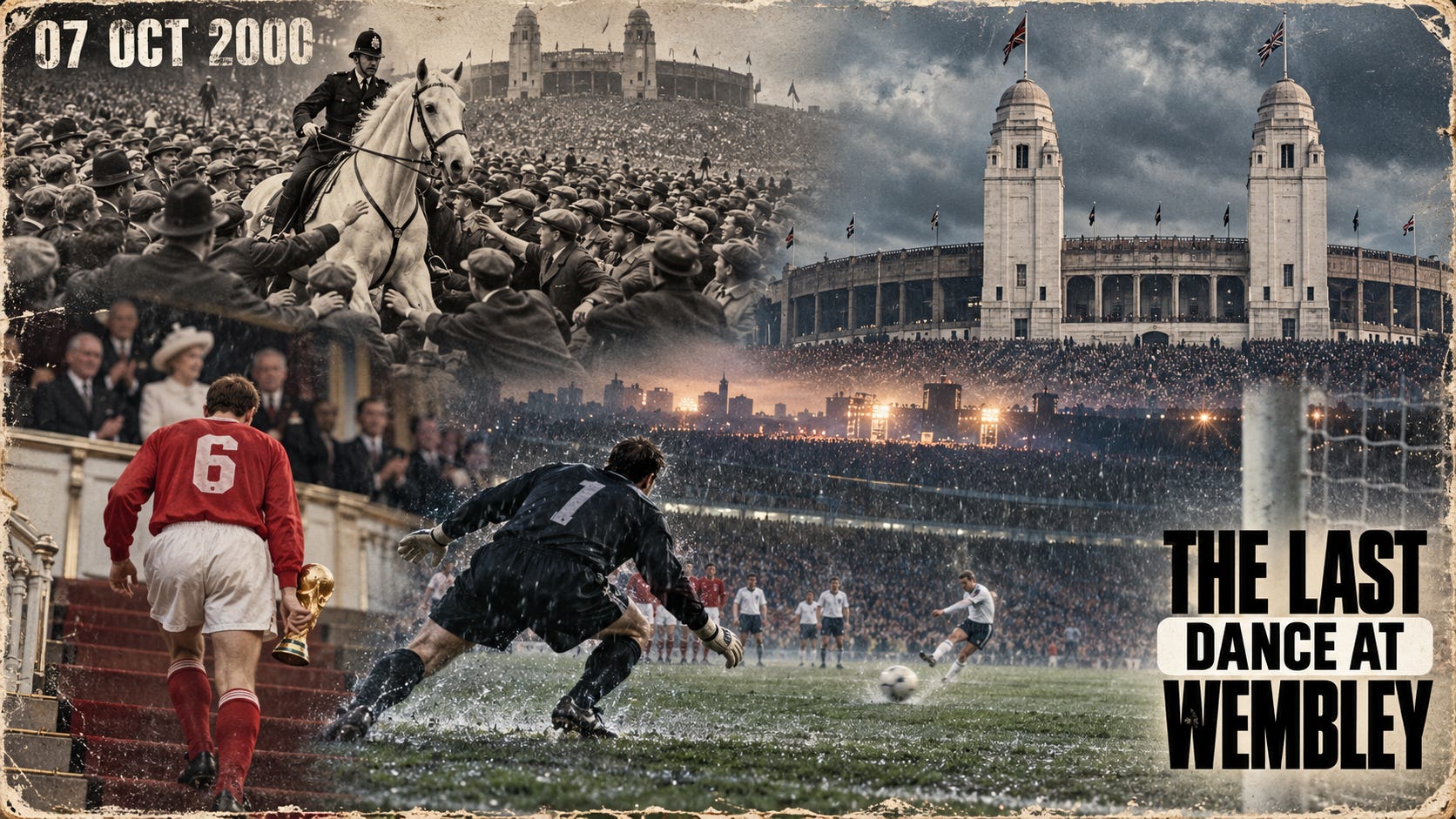
On 07 October 2000, the rain fell through the afternoon. Wembley’s famous turf cut up beneath the players. England wore red, Germany wore white, and after thirteen minutes Dietmar Hamann struck a free kick before England’s wall was properly organized. David Seaman moved late. The ball skidded past him.
It was not a beautiful final goal for a beautiful old stadium. England played poorly. The crowd grumbled. Germany won 1-0. And somewhere inside Wembley, after the final whistle, Kevin Keegan told the Football Association’s acting chief executive, David Davies, that he was resigning as England manager. The conversation took place in a toilet cubicle because privacy was almost impossible to find.
That was Wembley’s last day: dignified ceremony outside, practical chaos behind the curtain. It was strangely appropriate.
For 77 years, the Twin Towers had stood for English football itself. Wembley had staged coronations and collapses; the White Horse Final and the Wembley Wizards; Hungary’s demolition of English certainty; Bobby Moore climbing 39 steps to receive the World Cup; Manchester United healing part of the wound of Munich; England’s failed qualifications; Euro ’96; greyhounds, speedway, boxing, Olympic Games and Live Aid.
And on this date, it closed with England losing to Germany.
How did we get here?
Before Wembley, England did not really have a national football stadium. The national team travelled. It played at cricket grounds and club grounds: the Kennington Oval, Goodison Park, Bramall Lane, Villa Park and elsewhere. The FA Cup final wandered too. The Oval hosted most of the early finals; later came Lillie Bridge, Fallowfield, Goodison, Crystal Palace, Old Trafford and Stamford Bridge.
Crystal Palace became the final’s regular home from 1895 until the First World War. Old Trafford staged the 1915 final, then Stamford Bridge hosted the first three after the war. These were important grounds, but none was a permanent national stage. English football had a governing body, a cup competition and an enormous public following. What it lacked was a theater built to contain all three.
The opportunity arrived through something larger than football. Britain wanted a great exhibition to display the resources, products and supposed unity of its empire. Wembley Park, in north-west London, offered space and railway access. The site already carried the remains of another act of national ambition: the concrete foundations of Sir Edward Watkin’s abandoned attempt to build a London rival to the Eiffel Tower.
The British Empire Exhibition needed a centerpiece. The Empire Stadium would be it.
Architects John Simpson and Maxwell Ayrton designed a reinforced-concrete arena; Sir Robert McAlpine’s company built it in roughly 300 days. Around 250,000 tons of earth were shifted. The cost was approximately £750,000. Its official capacity was 127,000, and its two Mughal-influenced towers made it instantly recognizable. King George V cut the first turf and formally opened the stadium.
It was completed only days before its first great test: the 1923 FA Cup final between Bolton Wanderers and West Ham United. The so-called White Horse Final.
The official capacity became almost irrelevant as perhaps 200,000 people, possibly more, poured toward Wembley. Turnstiles were overwhelmed. Spectators covered the pitch. Mounted police pushed the crowd back, and one pale horse, Billie, ridden by PC George Scorey, became the image through which the day is remembered. Bolton won 2-0, but the greater lesson was administrative: great occasions needed tickets, planning and crowd control, not merely enormous gates.
Wembley had announced itself through near-disaster.
Nor was its future assured. The stadium had been built for the Exhibition of 1924 and 1925 and was originally expected to be demolished afterwards. It survived through a combination of imagination and commerce. Arthur Elvin assembled investors, the stadium was purchased in 1927, and greyhound racing and speedway helped pay the bills. That year also gave Wembley one of its enduring rituals: “Abide with Me” was sung before the FA Cup final.
Football slowly made the building sacred.
England’s first international there came in 1924, a 1-1 draw with Scotland. The idea that Wembley was immediately an impregnable fortress is retrospective mythology. Scotland won 5-1 there in 1928, producing the celebrated “Wembley Wizards”. Indeed, until 1951 Scotland were England’s only international visitors at Wembley. Argentina then became the first team from outside the British Isles to play England there.
The more precise claim is that England remained unbeaten at home by continental opposition until Hungary came in 1953. That distinction matters because Ireland’s 2-0 victory at Goodison Park in 1949 had already given England its first home defeat by a team from outside the Home Nations. Hungary’s 6-3 was different. It happened at Wembley, against the self-appointed teachers of the game, and the lesson was tactical, technical and public. The stadium magnified the defeat.
That was Wembley’s peculiar power. It did not merely stage events. It enlarged them.
The 1938 FA Cup final became the first shown live on television. It also gave us the commentator Thomas Woodrooffe’s rash promise to eat his hat if Preston’s George Mutch scored from the penalty spot in the final minute of extra time. Mutch scored. Woodrooffe later ate a hat-shaped cake. In 1948, Wembley became the heart of the “Austerity Games”, the first Olympics after the Second World War.
Then came 1966.
England played all six of their World Cup matches at Wembley. Argentina captain Antonio Rattín’s refusal to leave the pitch in the quarter-final fed the chain of events that helped produce yellow and red cards. Portugal were beaten in the semi-final. In the final, England defeated West Germany 4-2 after extra time. Before Bobby Moore received the Jules Rimet Trophy from Queen Elizabeth II, he noticed mud on his hands and wiped them on the velvet covering beside the royal box.
It is a tiny action, but it says almost everything about old Wembley: the exhausted footballer, the sovereign, the trophy, the etiquette and those 39 steps joining the pitch to the realm of ceremony.
European club football also came to regard Wembley as a summit. It hosted five European Cup finals. AC Milan beat Benfica there in 1963. Manchester United defeated Benfica 4-1 after extra time in 1968, becoming the first English winners ten years after Munich. Ajax beat Panathinaikos in 1971. Liverpool defeated Club Brugge in 1978. Barcelona won their first European Cup there in 1992, Ronald Koeman’s free kick defeating Sampdoria.
Domestic competitions were changed by appearing there. When Queens Park Rangers came from two goals down to beat West Bromwich Albion in 1967, it was the first League Cup final decided in one match and the first played at Wembley. A competition still searching for status suddenly had a national stage.
But Wembley could punish England as severely as it rewarded them. A 1-1 draw with Poland in October 1973, inspired by goalkeeper Jan Tomaszewski, kept England out of the 1974 World Cup. Allan Simonsen’s penalty gave Denmark a 1-0 victory there in September 1983 and helped prevent England reaching Euro 1984. These were not merely bad results. At Wembley, they became national inquiries.
At other times the stadium recovered its fortress character. England went 24 matches unbeaten there from September 1984 until May 1990. Euro ’96 then supplied a concentrated burst of modern Wembley memory: Paul Gascoigne’s goal against Scotland, the 4-1 dismantling of the Netherlands and, inevitably, a semi-final defeat by Germany on penalties. Germany returned to beat the Czech Republic in the final through Oliver Bierhoff’s golden goal.
Wembley’s importance had never been confined to football. Muhammad Ali - then Cassius Clay - fought Henry Cooper there in 1963. Evel Knievel attempted to jump 13 buses in 1975. Live Aid filled it in 1985, with Queen’s performance becoming part of global popular culture. The stadium hosted the Rolling Stones, Michael Jackson, Madonna and many more. To perform at Wembley meant that an artist had reached the largest available stage, just as reaching an FA Cup final meant the same for a footballer.
By 2000, however, the mythology was in much better condition than the building.
The last match
England against Germany was a World Cup qualifier, not an exhibition arranged as a farewell. That made the day more truthful. Wembley would close while still doing its job.
The attendance was 76,377. Former players paraded. The crowd sang. Old images were summoned. Then the match began and sentiment gave way to England’s familiar uncertainty.
Hamann’s free kick after thirteen minutes proved decisive. Germany were hardly magnificent, but England were labored and created too little. The turf deteriorated in the rain. Supporters jeered. The old towers watched over a team that appeared burdened rather than inspired by its surroundings.
The final whistle ended more than a match. Hamann became the last scorer at old Wembley. Germany became its last winners. Keegan, who had already doubted whether he possessed the tactical expertise the job required, resigned immediately. The following day’s newspapers played mercilessly with the architecture. England’s performance had been as faulty as the towers.
There was one last footballing joke in the sequence. England appointed Sven-Göran Eriksson, their first foreign manager, and eleven months later beat Germany 5-1 in Munich. The old enemy had closed Wembley; England’s answer came away from home.
So what?
Why did Wembley matter so much?
Because repetition turned concrete into ritual. The same route through north-west London. The first glimpse of the Twin Towers. Rosettes, scarves and coaches on Wembley Way. The team introductions. The royal box. “Abide with Me”. The national anthem. The winning captain climbing 39 steps before raising the cup high enough for the entire stadium to see.
Kings and queens, the Queen Mother, Princess Anne and the Duchess of Kent presented trophies and met teams. Politicians, actors and celebrities appeared in the royal box. Yet the occasion belonged just as much to supporters arriving from mining towns, ports, suburbs and industrial cities. Wembley placed monarchy, mass culture and working-class football inside the same enormous bowl.
It also created a vocabulary. To “get to Wembley” was an ambition understood without qualification. The ground’s name could mean a final, a pilgrimage, a career’s climax or England itself. Players who spent their professional lives at modest grounds could have one afternoon beneath the towers and be remembered forever.
That symbolism made demolition painful. But sentiment could not solve the physical problems. Sightlines and facilities were dated. Parts of the stadium were in poor condition. English football, transformed by the Premier League and the Taylor Report era, wanted a modern 90,000-seat national stadium capable of generating modern revenue.
The choice of Wembley was not inevitable. In 1995, proposals were submitted by Birmingham, Bradford, Manchester, Sheffield and Wembley. Wembley and Manchester were shortlisted. After the governing bodies of football, rugby league and athletics expressed their preference, Sport England selected Wembley in December 1996 and offered Lottery funding in principle. The Football Association’s project company acquired the site in 1999.
Preserving the Twin Towers was considered, but the new bowl required a larger footprint and the railway constrained expansion to the south. The stadium would have to move north, through the space occupied by the towers. Their listed status made the dispute more than emotional, but permission was ultimately granted. The old stadium closed in 2000; demolition began in 2002; the towers came down in 2003.
English football therefore needed a temporary home for its great domestic occasions. Cardiff’s Millennium Stadium was the outstanding practical answer: new, covered, capable of holding more than 70,000 people and reachable by rail into the city center. Other venues were discussed, but the FA chose Cardiff. It was an elegant exchange. While the Welsh national stadium had been rebuilt, Wales had staged rugby internationals at old Wembley. Now Wales sheltered English football.
Cardiff hosted six FA Cup finals from 2001 to 2006, as well as League Cup finals, play-offs and Community Shields. It made its own history: Michael Owen’s late rescue of Liverpool against Arsenal in 2001; Steven Gerrard’s extraordinary equaliser against West Ham in the 2006 final. The interregnum proved that traditions could travel. Wembley was powerful, but the competitions did not collapse without it.
The new Wembley took longer and cost more than planned. Its final cost was around £798 million. The Twin Towers were replaced by a 133-meter arch, visible across London and structurally supporting the roof. The capacity was 90,000. The old 39 steps became 107.
Its first official match, in March 2007, was an England Under-21 friendly against Italy. Giampaolo Pazzini scored after 29 seconds and completed a hat-trick in a 3-3 draw. Chelsea then beat Manchester United 1-0 in the first FA Cup final at the new stadium. John Terry became the first senior England player to score there, against Brazil.
Some old rituals resumed immediately. Supporters still walked up Wembley Way. The anthem and “Abide with Me” returned. Captains still climbed to receive the cup, even if the staircase was longer and the royal box belonged to a different building.
New traditions accumulated too. The NFL brought regular-season American football to Wembley in 2007. Women’s FA Cup finals moved there in 2015. The stadium staged Olympic football in 2012, European Championship matches in 2021, England’s painful defeat by Italy in the men’s final and, a year later, the Lionesses’ European triumph before 87,192 spectators. In 2024 it hosted a record eighth European Cup or Champions League final across the old and new stadiums. Concerts, boxing and other spectacles restored Wembley’s role as Britain’s largest secular stage.
The new stadium has not erased the old one. It has inherited an argument with it. Some people miss the towers, the lower roof, the smell and compression of the old bowl. Others remember obstructed views, tired concrete and inadequate facilities. Memory edits buildings just as it edits football matches.
But old Wembley earned the nostalgia. It survived when it was supposed to be temporary. It turned a chaotic cup final into a founding myth. It absorbed royal ceremony, working-class pilgrimage, national triumph, national humiliation and global popular culture. For decades, the stadium’s silhouette was enough to identify English football anywhere in the world.
Three things to take away
First, Wembley was built as temporary exhibition architecture and became permanent through football, commercial reinvention and repeated public ritual. Its meaning was accumulated, not designed.
Second, “Fortress Wembley” was a powerful but selective truth. Scotland won there in 1928; Hungary shattered English certainty in 1953; Poland and Denmark ended qualification campaigns. The defeats mattered so much precisely because Wembley had become the place where England expected history to obey them.
Third, demolishing the stadium did not demolish the institution. Cardiff proved the competitions could travel, while the new Wembley revived old ceremonies and created new ones. The towers disappeared, but “Wembley” remained a destination, an ambition and a word that still means final.
On This Day...
On 07 October 2000, the last goal belonged to Germany. England left beaten, Kevin Keegan resigned in a toilet cubicle, and the Twin Towers looked down on a soaked, deteriorating pitch. Wembley had always held glory and farce together. Its last dance gave England the farce and left the glory to memory.
---
Questions, corrections or story ideas: otd@17lawsguy.com
Yesterday: 06 October 1923 - Sam Wynne scored twice for Oldham Athletic and twice for Manchester United. Oldham won 3-2, but Wynne supplied all four goals.