

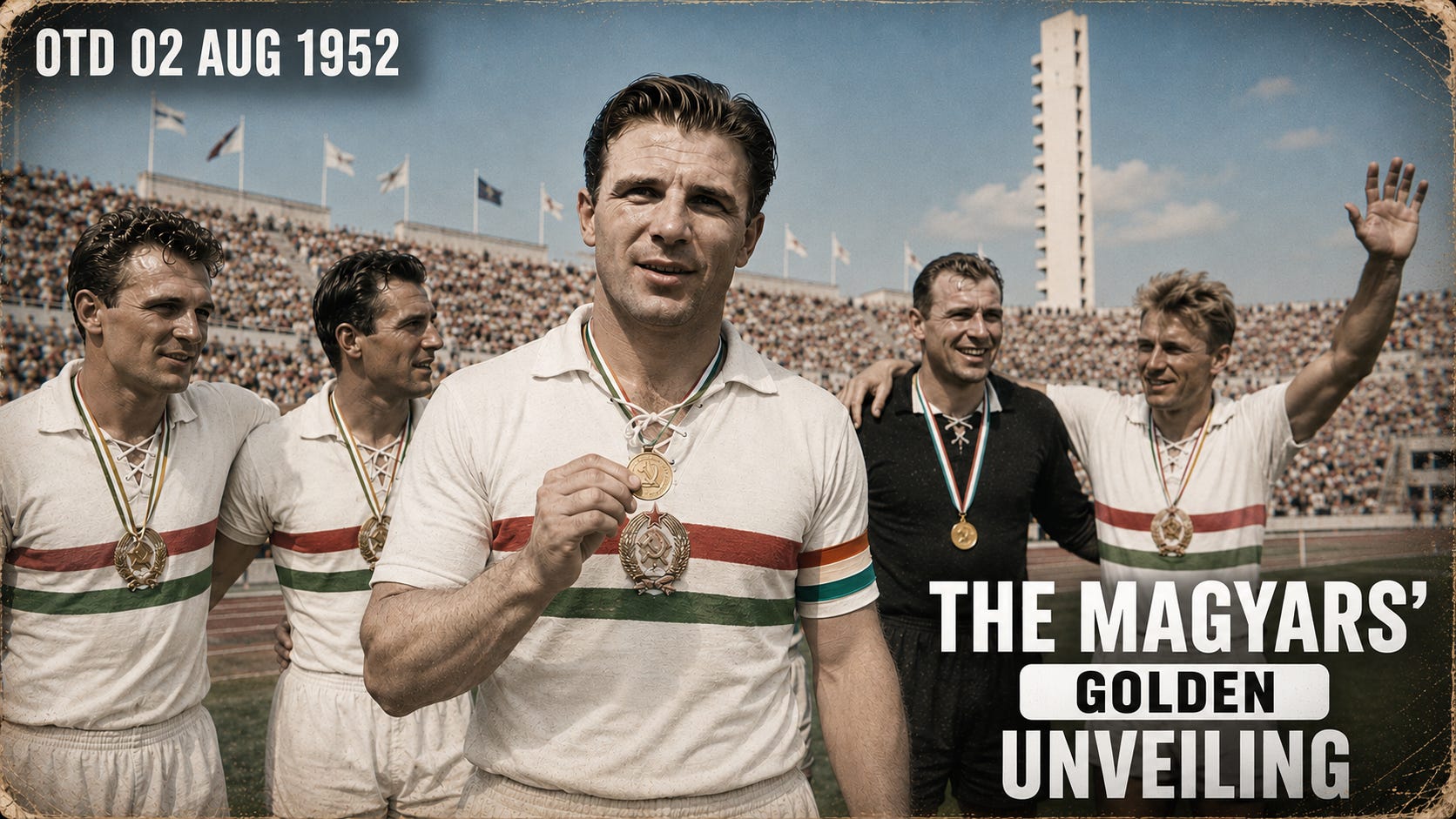
It is August 2, 1952. Helsinki. The Olympiastadion. Hungary against Yugoslavia in the Olympic football final. Seventieth minute: Ferenc Puskás scores. Eighty-eighth minute: Zoltán Czibor scores. Hungary 2, Yugoslavia 0. Olympic gold. And the world now knows what Central Europe already knew. Hungary are not just good. They are different. The Magical Magyars have arrived.
The roots go back before the war, to the Danubian school of Hugo Meisl and Jimmy Hogan, MTK and the Mitropa Cup, coffee-house football, short passing, and the idea that football could be argued into intelligence. That tradition survived the collapse of empires and then the war in altered form. After 1945 Hungary became a communist state, and football became a state project.
This is where Gusztáv Sebes matters. Not just a coach, but a political thinker who called his idea socialist football, not because the ball read theory but because the team moved collectively: everyone attacks, everyone defends, positions are starting points, not prison cells. The structure helped. Kispest became Budapest Honvéd, the army club, and the army could concentrate players, so Puskás, Kocsis, Czibor, and Bozsik became a club spine that was also the national spine. MTK, under state patronage, provided another classroom through Nándor Hidegkuti.
And the style was ahead of its time. Grosics was a goalkeeper who swept. Bozsik was a half-back who dictated. Hidegkuti dropped from the forward line. Puskás was a commander with a left foot. It was almost Total Football before the phrase existed: space unfixed, roles elastic, the ball a trigger for movement.
The results gathered like evidence. After a 5-3 loss to Austria in May 1950, the last defeat before the run, Hungary beat Poland 5-2 and did not stop. Through 1950, 1951, and into 1952, in official internationals, they did not lose. And Olympic football suited them, because the post-war Games were trapped in amateurism. Western professionals were largely excluded, but the communist bloc used state amateurism, players officially soldiers or railwaymen who trained like professionals. So Hungary could bring close to its real national team when the West could not, which is why Olympic football then leaned east.
In Helsinki, Hungary beat Romania 2-1, Italy 3-0, and Turkey 7-1. The semi-final against defending champions Sweden finished 6-0, which was not a semi-final but an announcement. And the final opponent was no background character. Yugoslavia were also socialist and serious, but after Tito’s 1948 break with Stalin they were independent and politically charged, and they had already survived a 5-5 with the Soviet Union and a 3-1 replay win. So this final carried football and ideology at once.
For seventy minutes Yugoslavia held. Then Puskás scored, of course he did, captain, left foot, timing, the man who bends a match toward himself. Near the end Czibor made it two. Hungary 2, Yugoslavia 0. Olympic champions.
Helsinki blew the lid off. People knew Hungary were strong; the gold gave them a world stage. And they kept proving it. On November 25, 1953, at Wembley, where England had never lost at home to a team from outside the British Isles, Hungary won 6-3, the Match of the Century, Hidegkuti dropping deep and England’s defenders frozen between following him and holding shape. In Budapest in 1954 they won 7-1. The old empire had been given a lesson.
Then came the cruelty. Hungary arrived at the 1954 World Cup as the best team in the world, beating South Korea 9-0, West Germany 8-3, Brazil and Uruguay 4-2 each. In the final, against West Germany again, they led 2-0 after eight minutes. Then it fell apart: West Germany won 3-2, das Wunder von Bern. Hungary’s only official defeat in the whole run was the one match that decided the World Cup. And in 1956 the uprising scattered the Golden Team: Puskás to Real Madrid, Kocsis and Czibor to Barcelona. The champions disappeared before they could defend the crown. But the ideas did not. The sweeper-keeper, the false nine, positional rotation, collective movement: every time football asks players to move from roles into relationships, Hungary’s shadow is somewhere nearby.
🎙️ THE PODCAST GOES DEEPER. The full episode has Sebes’s socialist football, the state-amateur advantage, and the tactical line from Hidegkuti to Guardiola. That’s the 10-minute version.
---
🎧 Listen on Spotify, Apple Podcasts, Amazon Music, Overcast, iHeart, and YouTube.
📩 Got an episode idea? otd@17lawsguy.com
Yesterday: 1 August 1943, the first América-Guadalajara match.