

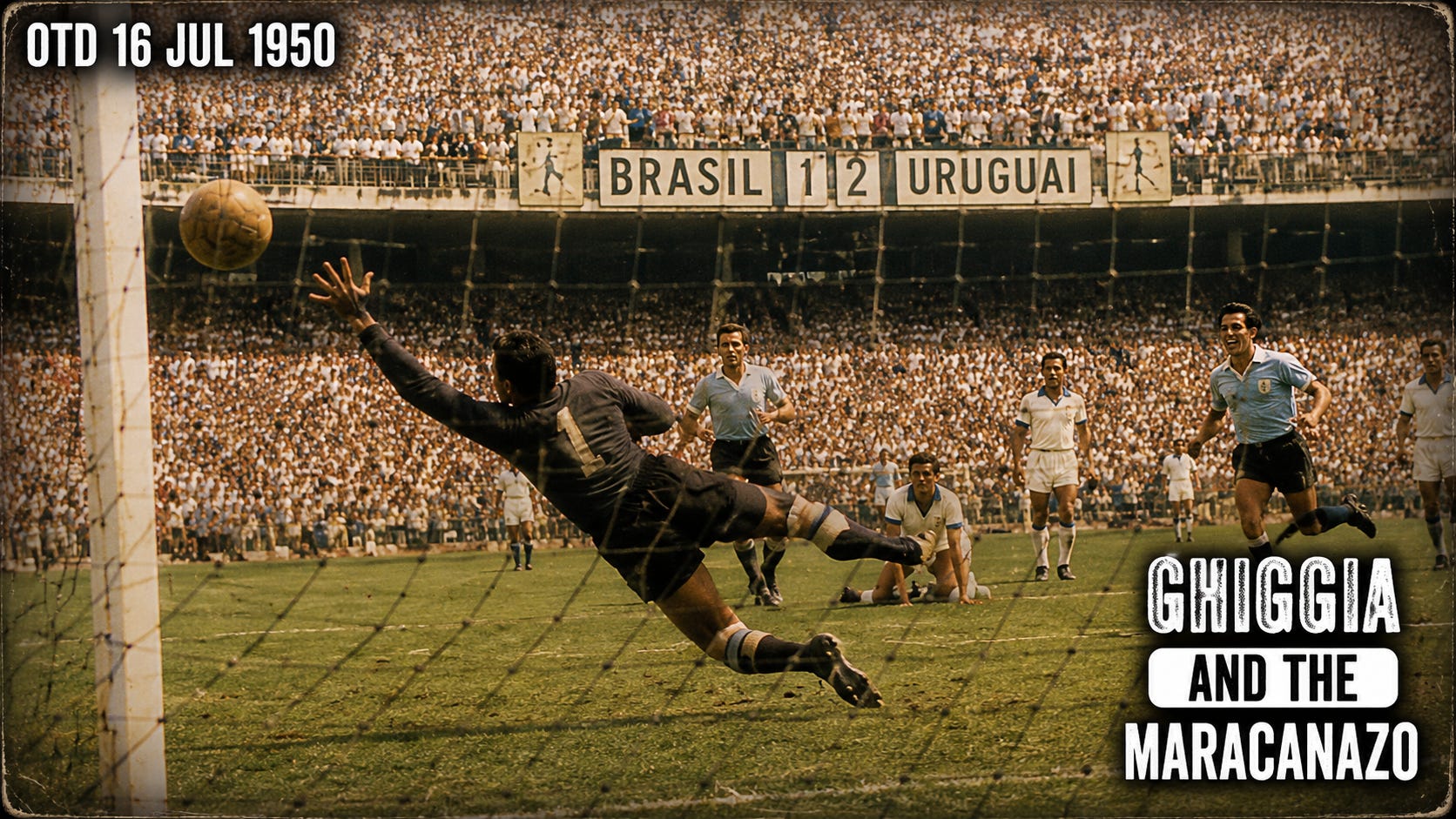
It is July 16, 1950. Rio de Janeiro. The Maracanã. Brazil against Uruguay, the last match of the World Cup’s final group. Not officially a final. But everybody knows what it is.
Brazil need only a draw to become world champions. Uruguay must win. Nearly 174,000 people are officially inside, probably more. The newspapers are ready. The speeches are ready. Jules Rimet is ready with the trophy.
Brazil are spectacular that summer. They have destroyed Sweden 7-1 and Spain 6-1 in the final group. Ademir is the tournament’s top scorer, Zizinho is brilliant, and Jair, Chico, and Friaça make them fast, technical, confident. Uruguay have talent too: Máspoli in goal, Schiaffino, Míguez, Ghiggia, and the captain, Obdulio Varela. But they are not the public’s champions. They are the obstacle at Brazil’s coronation.
Varela knows it. The Brazilian papers have already printed the victory mood, and some stories say he threw the newspapers on the dressing-room floor and told his teammates the people outside were made of wood. Whether every word is exact hardly matters. The meaning survived: do not play the crowd. Play the eleven men.
At 3 p.m., under English referee George Reader, the ball moves. Brazil attack. The Maracanã roars. Uruguay suffer, and survive. Nil-nil at half-time. Then, in the second minute after the break, Ademir slips the ball to Friaça, who shoots across Máspoli. Brazil 1, Uruguay 0. The coronation begins early: in the stands, on the radio, in the dignitaries’ box.
But Varela slows everything down. He walks into the goal, takes the ball, and argues: offside, language, delay, anything. The point is not the argument. The point is the pause. Cool the stadium. Cool the storm.
Sixty-sixth minute. Ghiggia beats Bigode on the right and crosses low; Schiaffino arrives. One-one. Brazil are still champions with this score, but the feeling has changed. The Maracanã is no longer celebrating. It is waiting. And waiting is dangerous.
Seventy-ninth minute. Ghiggia again. Right side again. Bigode chasing again. Barbosa expects the cross. Ghiggia shoots, near post. Goal. Uruguay 2, Brazil 1.
And the Maracanã goes silent. Not quiet. Silent. The line later attributed to Ghiggia is that only three people ever silenced the Maracanã: the Pope, Frank Sinatra, and him. That is folklore, but folklore becomes folklore because it explains what facts cannot. Two hundred thousand people had entered a party. Now they are standing inside a national wound.
Brazil attack without belief. Uruguay defend without panic. Final whistle. Uruguay are world champions, and Rimet finds Varela and hands him the cup almost quietly, the triumphant public script abandoned.
For Uruguay, this is the high-water mark. Varela becomes the country’s moral memory; he later says he could not celebrate while so many Brazilians were crying. Ghiggia becomes the man of the impossible goal, Schiaffino one of the great artists of the era. Uruguay reach World Cup semi-finals in 1954, 1970, and 2010, and beat Brazil 2-1 again to win the 1981 Mundialito. But they never return to a World Cup final.
For Brazil, the depression is enormous, and it needs a scapegoat. It chooses Moacir Barbosa, a great goalkeeper condemned for one near post. He carries it for the rest of his life, saying that Brazil’s maximum prison sentence was thirty years and he had served fifty. The white shirt becomes cursed; a 1953 competition produces the yellow, and the canarinho we think of as eternal is born partly from a defeat Brazil wanted to bury. Pelé, nine years old, sees his father cry. In 1958 he is seventeen, and Brazil win the World Cup. The Maracanazo does not end Brazil. It forces Brazil to become Brazil.
That is why the word survives. Not a match. A category. A home certainty destroyed. A crowd silenced.
🎙️ THE PODCAST GOES DEEPER. The full episode has Varela’s dressing-room legend, Barbosa’s cruel afterlife, and how the yellow shirt was born from the defeat. That’s the 10-minute version.
---
🎧 Listen on Spotify, Apple Podcasts, Amazon Music, Overcast, iHeart, and YouTube.
📩 Got an episode idea? otd@17lawsguy.com
Yesterday: 15 July 1930, Argentina against France, and the whistle that came six minutes early.
Tomorrow: 17 July 1994, Brazil against Italy at the Rose Bowl, and the first World Cup decided on penalties.
Do we actually know how solid the 173,850 figure is? I have seen everything from around that figure to 210,000 claimed over the years. Either way, it’s presumably still the largest crowd ever at a football match, which makes the silence even more astounding.