

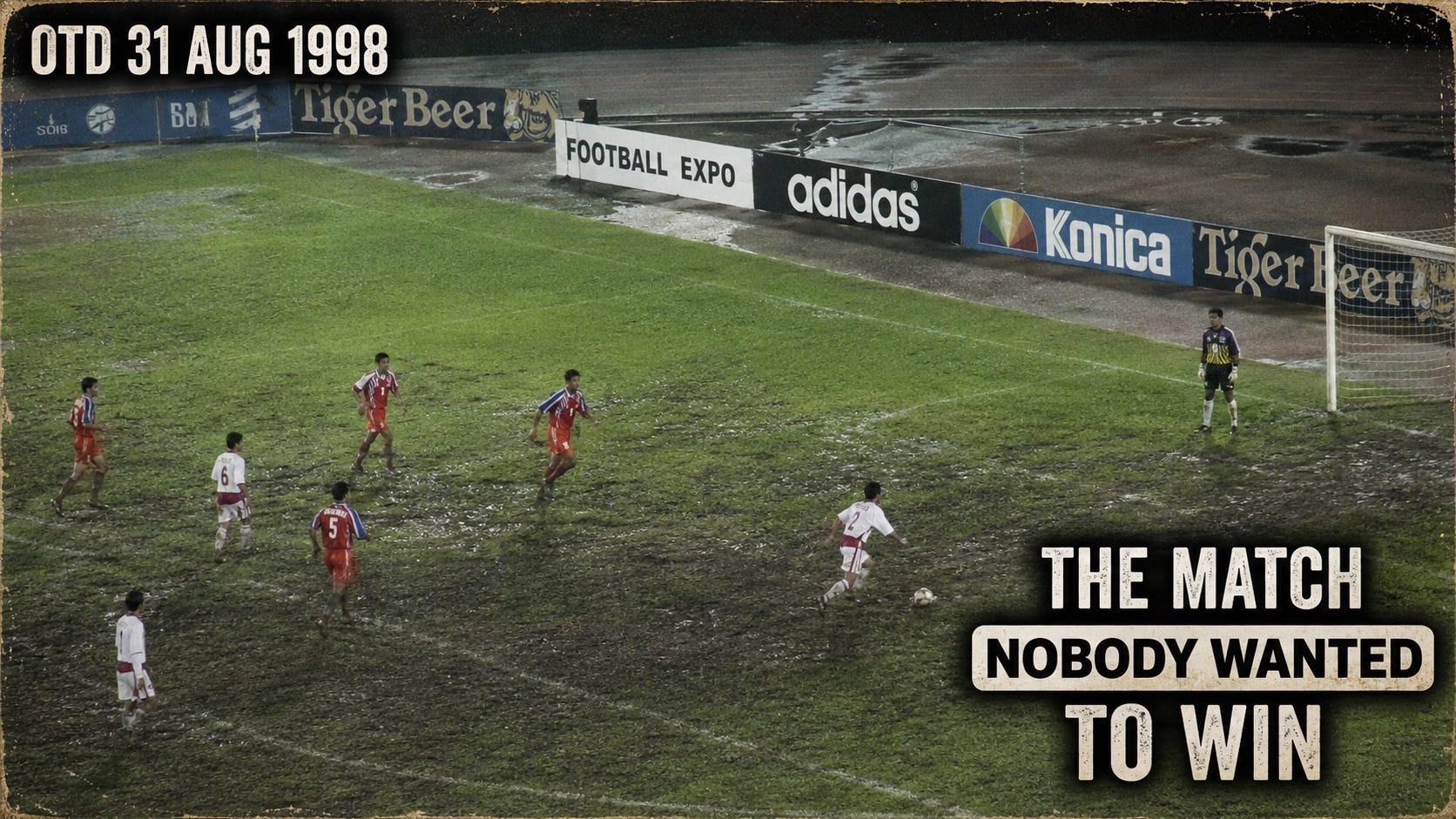
It is August 31, 1998, at the Thống Nhất Stadium in Ho Chi Minh City, and something has gone wrong with the whole idea of a football match. Thailand and Indonesia are playing in the Tiger Cup, and neither team seems to want to win. The reason is a quirk of the tournament. Whoever wins this group must travel north to Hanoi to face the hosts, Vietnam, in the semifinal. Whoever finishes second stays right here in Ho Chi Minh City and gets Singapore, widely thought the softer draw. Finishing first has quietly become a punishment.
For most of the match, the two sides handle this by simply not trying. The first half is goalless and strangely aimless. At one point the Indonesian goalkeeper, Hendro Kartiko, is reportedly wandering upfield to take shots himself, which is not a normal feature of a game anyone wants to win. Then, after the break, it becomes farce. Indonesia score, Thailand equalize, and with only minutes left Aji Santoso puts Indonesia 2-1 ahead, which is the last thing Indonesia want, because a win means first place. Thailand level again through Therdsak Chaiman, and now Indonesia are drifting back toward the group win they are desperate to avoid.
So an Indonesian defender solves the problem himself. Mursyid Effendi collects the ball near his own penalty area, with nobody pressing him, turns toward his own goal, and, as Thai forwards try to stop him, calmly puts it past his own keeper. He even applauds as he jogs back for the restart. It is 3-2 to Thailand, a team that did not want the points, and the whistle goes almost at once. Indonesia have achieved the defeat they were chasing.
Here is the important distinction. This was not match-fixing in the usual sense. Nobody bribed Effendi. There was no betting syndicate. The incentive was entirely sporting: both teams believed that losing improved their chance of winning the tournament. Modern football has a name for exactly this. FIFA’s integrity rules recognize that matches can be manipulated not only for money but for sporting advantage, and they list deliberately losing, intentionally conceding and deliberately underperforming as examples. The principle is simple. Once you walk onto the pitch, you do not get to degrade the contest just because a defeat happens to suit you elsewhere.
But there is a second party in the dock, and it is the tournament itself. Badly designed competitions can make cheating feel rational, because they let a team see exactly what result it needs before it plays. The most infamous case came at the 1982 World Cup, when West Germany and Austria met in Gijón already knowing that a narrow German win would send both of them through at Algeria’s expense. West Germany scored early, and then the two teams effectively stopped competing. The 1-0 that followed was so cynical that FIFA soon made the final round of group games kick off simultaneously, so that nobody would ever again play knowing the precise result they needed. Sixteen years later, the Tiger Cup managed to recreate the same trap from a different angle. The other group had already finished, the semifinal draw was visible, and two teams found themselves fighting for the right to come second.
Football had seen a purer version of the absurdity four years earlier. In the 1994 Caribbean Cup, a bizarre rule counted a golden goal in extra time as two, so Barbados, needing to win by two, deliberately scored an own goal to force extra time, then defended both ends at once. But that was a team exploiting a ridiculous rule exactly as written. Thailand and Indonesia were doing something else: deliberately wrecking the contest to choose their next opponent.
The response was firm. Both associations were fined 40,000 dollars. Indonesia ran its own disciplinary process, suspending the coach, Rusdy Bahalwan, and the team manager, Andrie Amien, from international football for two years, and Effendi for one. Effendi’s punishment then grew into something much larger, a lifetime ban from international football.
But the finest verdict came from the football. Indonesia got the semifinal they wanted, against Singapore, and lost it 2-1. Thailand got the one they dreaded, against Vietnam, and lost it 3-0. And Singapore, the supposedly easy draw everyone had schemed to face, beat Vietnam 1-0 in the final and became champions. Thailand and Indonesia then had to play each other again anyway, in the third-place match, which finished 3-3 before Indonesia won on penalties. Five days after producing a game neither team wanted to win, they finally played one that both of them did.
The lesson sits in three parts. The Tiger Cup was a real and welcome Southeast Asian championship, but its 1998 format built a perverse incentive into the bracket. The two teams manipulated the match for sporting advantage rather than money, which explains the motive without excusing the act. And sometimes the deepest fault lies not in what competitors do, but in what the competition quietly encourages them to do.
---
🎧 Listen on Spotify, Apple Podcasts, Amazon Music, Overcast, iHeart, and YouTube.
📩 Got an episode idea? otd@17lawsguy.com
Yesterday: 30 August 1931, a professional match in Argentina stopped early for inequality.
Tomorrow: 1 September 1894, an English league match somehow contains three halves of football.