

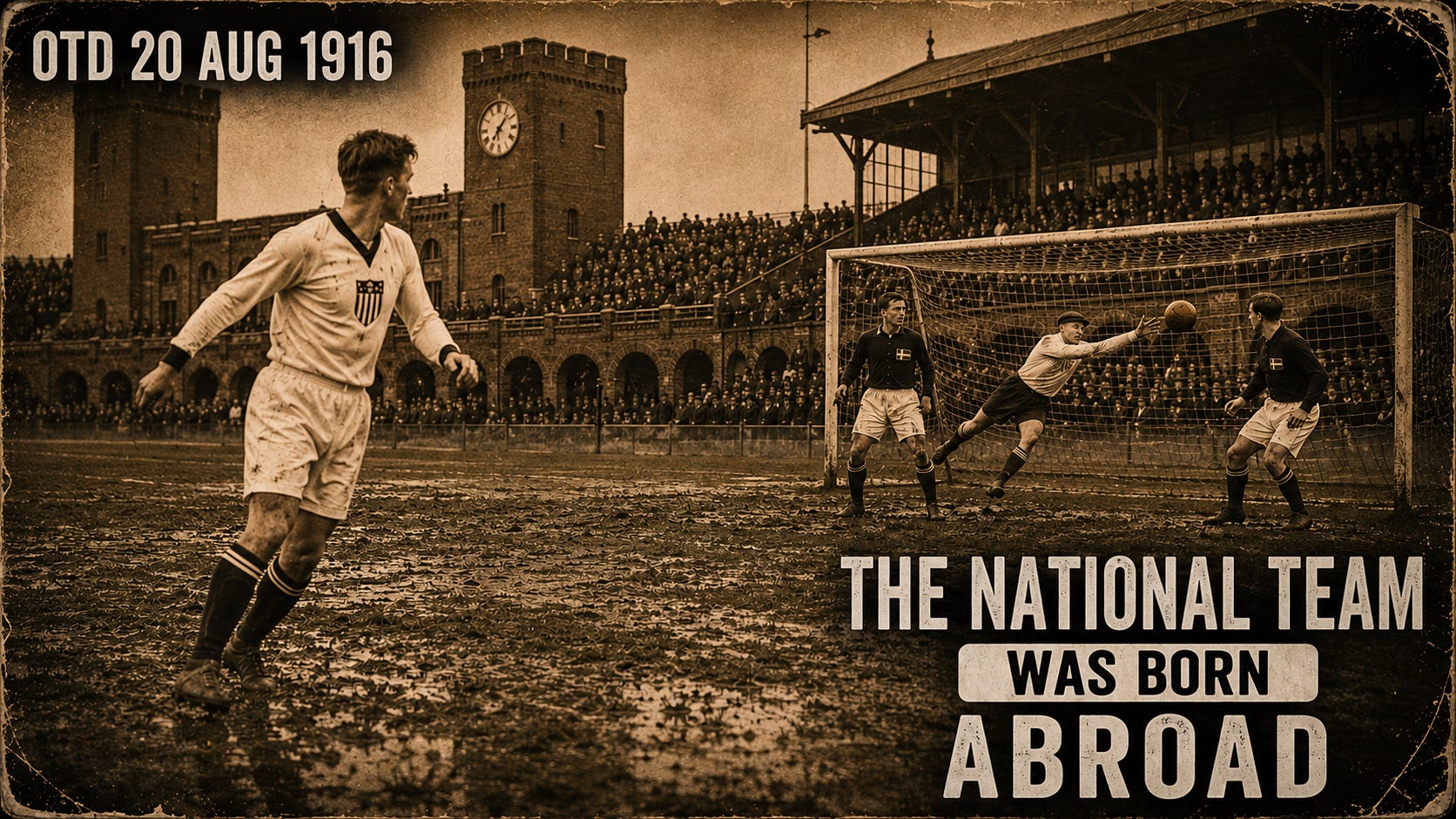
Stockholm, Augst 20, 1916. Around sixteen thousand people fill the Olympic Stadium to watch Sweden play a group of Americans who have crossed the Atlantic in the middle of the First World War. Sweden score after seven minutes. Then Dick Spalding equalizes, Charles Ellis puts the visitors ahead, and Harry Cooper makes it 3-1. Sweden pull one back late, but the final score stands: Sweden 2, United States 3. With that result, quietly, the United States men’s national team is born, on another continent, in the middle of a world war.
American soccer was far older than the American national team, and that gap explains a great deal. Long before there was any countrywide structure, there were soccer towns, where immigration and industry set football communities beside the factories and mills: Kearny, Fall River, St. Louis, Philadelphia, Bethlehem. Scottish textile workers had made West Hudson in northern New Jersey one of the earliest strongholds, and in 1884 the American Football Association was created. It sounded national, but it was really a creature of the Northeast. When a team calling itself the United States played a Canadian selection in 1885 and again in 1886, every American player came from a New Jersey club, and neither match is recognized today as a full international. America had representative football long before it had the machinery to build a national team.
The obstacle was institutional: nobody could agree who governed the sport. Into that vacuum stepped Thomas Cahill, a St. Louis-raised organizer who became one of the central architects of the American game. In 1911 a rival body, the American Amateur Football Association, appeared with Cahill as its secretary, and it made an audacious move almost at once: it applied to FIFA. Cahill crossed the Atlantic in 1912 to press the case in Stockholm, only to be told to go home and come back with a single organization representing the whole game. That is more or less what happened. In April 1913, representatives gathered at New York’s Astor House and created the United States Football Association, the body we now know as U.S. Soccer. FIFA granted provisional recognition that August and full membership in 1914.
That 1912 trip mattered for another reason. In Stockholm, Cahill had built a relationship with a Swedish administrator and FIFA vice-president named Kornerup, and later sent him a copy of the American soccer guide. In early 1916 a letter came back, inviting the Americans to send a team to Scandinavia with a four-thousand-dollar guarantee to finance the trip. The invitation ran in a straight line from that first visit four years earlier.
There was, however, an enormous complication. It was 1916, Europe was at war, and the Berlin Olympics had been cancelled. Sweden, Norway and the United States were all neutral, but the Atlantic was dangerous. Bethlehem Steel, the reigning American champions and apparently Sweden’s preferred guests, flatly refused to risk sending their team across an ocean their own company was helping to arm; a German U-boat had sunk the Lusitania only the year before. So the young federation assembled a national selection instead, fourteen players, twelve American-born, captained by Tommy Swords of Fall River. They sailed from Hoboken on the twenty-sixth of July aboard a ship named for a Danish king, and while they were still at sea, the United States and Denmark signed the treaty to purchase the Danish West Indies, driven partly by fear that Germany might seize those islands for a Caribbean naval base. During the very voyage that created the national team, neutral America was engaging with Scandinavia and worrying about German submarines in the same breath.
The football lived up to the drama. Before the official match, the Americans drew 1-1 with a Stockholm selection, and King Gustav V, watching from the royal box, summoned Cahill at halftime to thank the visitors for making such a journey in wartime. Five days later came the real thing, and Spalding’s equalizer, an awkward high ball that bounced over the goalkeeper, became the first official goal in the national team’s history. Ellis and Cooper finished the job.
And then, almost immediately, it stopped. There were no 1916 Olympics, America entered the war in 1917, and the national team did not play another international until 1924. That stop-start rhythm would define American men’s soccer for the better part of a century: a boom in the 1920s, a World Cup semi-final in 1930, the miracle over England in 1950, then a forty-year absence, the rise and collapse of the North American Soccer League, and finally the more durable era of the 1994 World Cup and Major League Soccer. The United States reached the last sixteen as hosts in 2026 before losing to Belgium. The lesson buried in 1916 is that population was never really the problem. America did not lack footballers. It lacked continuity, the chance to build from one generation to the next instead of starting over, the one thing its pioneers, crossing a wartime ocean to be born abroad, never had.
---
🎧 Listen on Spotify, Apple Podcasts, Amazon Music, Overcast, iHeart, and YouTube.
📩 Got an episode idea? otd@17lawsguy.com
Yesterday: 19 August 1950, the day all 22 players went to jail.
Tomorrow: 21 August 1965, the substitute finally arrives in the English Football League.