

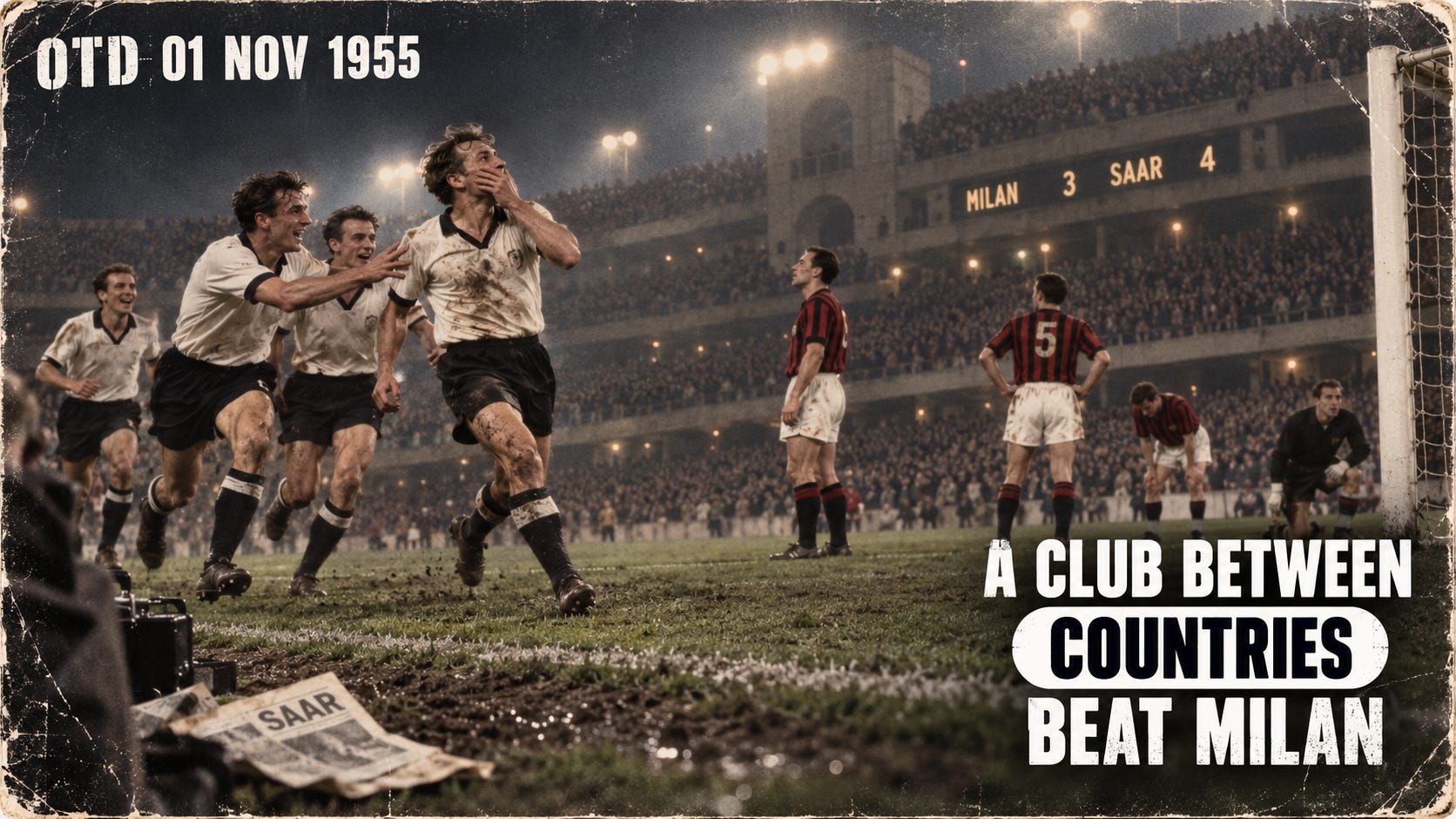
On 01 November 1955, Peter Krieger scored after five minutes at San Siro and gave Europe’s newest club competition a glimpse of its future. The scorer represented 1. FC Saarbrücken, but the initials beside the club’s name did not say West Germany, East Germany or France. They said Saar.
Nine days earlier, the people of the Saar Protectorate had rejected a proposed European statute for their territory. The result pointed the region toward political union with West Germany, although that would not formally happen until 1957. For the moment, Saarland still had its own football association, its own national team and its own place in the inaugural European Cup.
Saarbrücken’s opponents were AC Milan, the Italian champions. Milan had Gunnar Nordahl, Nils Liedholm and Juan Alberto Schiaffino. Saarbrücken had a winger who spent his working week handling pension claims and used his annual leave to play football.
By the end of the night, the civil servant and his colleagues had won 4-3.
How did we get here?
The European Cup was born from a mixture of ambition, journalism and postwar possibility. Gabriel Hanot and the French newspaper L’Équipe pushed for a continental club tournament after prominent international friendlies showed how powerfully supporters responded when leading clubs crossed borders. UEFA had been founded only in 1954. In 1955, it approved a sixteen-club experiment.
It was not yet a mechanically selected tournament of domestic champions. Chelsea, the English champions, withdrew after pressure from the Football League. Hibernian represented Scotland despite finishing fifth in the league. Real Madrid entered as Spain’s champions, while Partizan entered from Yugoslavia after finishing fourth. The field was assembled as a persuasive demonstration of what European club football could become.
There was no title holder, no qualifying round shaped by coefficients and no inherited set of rituals. The first match, Sporting against Partizan in Lisbon on 04 September, finished 3-3. The competition was learning its own scale in public. Every journey established a precedent, from the distances clubs were willing to travel to the question of whether supporters would care about unfamiliar opponents. The answer was not guaranteed. The European Cup became inevitable only after people had seen it work.
That flexibility created room for one of the strangest entrants the competition has ever known.
The Saar lies against the French border, a coal and steel region repeatedly pulled between larger powers. After the Second World War, it was separated from occupied Germany and placed under strong French political and economic influence. It used the French franc, established its own institutions and, in football, followed a path of its own.
The Saar Football Association was founded in 1948 and admitted to FIFA in 1950. It attended UEFA’s founding meeting in 1954. Its national side entered qualifying for the 1954 World Cup and finished ahead of Norway but behind West Germany, who went on to win the tournament.
The coach of that Saar national side was Helmut Schön. He would later succeed Sepp Herberger as West Germany’s manager, win the 1972 European Championship and the 1974 World Cup, and establish one of the finest international records of the twentieth century. Before all of that, he was building a side for a territory with barely one million inhabitants.
Saarland’s first World Cup qualifier made the point dramatically. Away to Norway in June 1953, Schön’s side fell 2-0 behind. Waldemar Philippi was injured, and Theodor Puff broke his leg but remained on the pitch in an era of tightly restricted substitutions. Saarland recovered to win 3-2. Werner Otto scored one of the goals. Most of the side came from 1. FC Saarbrücken.
The later qualifiers against West Germany created an almost surreal rehearsal for the future. Schön coached Saarland against Herberger, the man he would eventually serve and replace. Saarbrücken players faced men with whom they would soon share a federation. West Germany won both meetings and then lifted the World Cup in Switzerland, but Saarland finished second in the group. The national side’s brief history had produced a legitimate qualifying campaign, not ceremonial internationals arranged to decorate a flag.
1. FC Saarbrücken supplied much of that national side, but the club had spent the immediate postwar years looking for a competition equal to its ability. In 1948/49, playing as FC Sarrebruck, it completed a guest season in the French second division. Its matches did not count in the official table, yet its results would have placed it comfortably first.
The arrangement was peculiar even by postwar standards. Saarbrücken effectively shadowed the French schedule, replacing the idle club each week without being allowed to earn promotion or appear as a normal member of the competition. The club scored freely, traveled through France and demonstrated that its sporting level belonged above the local Saar league. It could win matches, but it could not win the championship those results ordinarily produced.
The club then sought full admission to the French system. Jules Rimet, president of the French federation and the man whose name adorned the World Cup trophy, supported the proposal. French professional clubs and regional interests opposed it. Saarbrücken were left too strong for the local competition, excluded from France and temporarily detached from the German pyramid.
So the club made its own international calendar. The International Saarland Cup brought foreign opposition to the region and offered Saarbrücken the matches it could not find at home. In February 1951, the club beat Real Madrid 4-0 in a friendly at Chamartín. That result was startling, but it was not a freak. Saarbrücken had developed into an experienced international side before UEFA possessed a club competition of its own.
Saar clubs re-entered the German league system in 1951. Saarbrücken promptly won the Oberliga Südwest and reached the 1952 German championship final, losing to Stuttgart. By 1955, the club was not the reigning champion of a separate Saar league. It entered the European Cup because the still-independent Saar association selected its strongest and most internationally credible representative.
The invitation therefore carried two stories at once. It recognized a serious football club, and it recognized a territory whose political identity was approaching its final decision.
On 23 October 1955, 97.5 percent of eligible Saar voters participated in a referendum on the Saar Statute, which would have given the territory a lasting European status under the Western European Union. Of those who voted, 67.7 percent rejected it. The Saar government resigned that night. Reunification with West Germany was not written directly on the ballot, but the result made the direction unmistakable.
Nine days later, Saarbrücken played in Milan under the flag of a football country that was already disappearing.
Ninety minutes at San Siro
Milan appeared to represent the opposite of uncertainty. They had won the 1954/55 Serie A title, their third championship in five seasons. Nordahl was one of the most devastating scorers in Europe. Liedholm supplied intelligence and control. Schiaffino, a World Cup winner with Uruguay in 1950, brought invention between the lines. Cesare Maldini was beginning the career that would attach his family name to the club for generations.
The names also showed how international elite club football had become before it possessed a European tournament. Milan’s attack joined a Swede and a Uruguayan to an Italian champion. The famous Gre-No-Li trio had been reduced when Gunnar Gren left Italy, but Nordahl and Liedholm remained, and Schiaffino had arrived from Peñarol after starring in Uruguay’s World Cup triumph. The European Cup did not create this traffic in talent. It gave the traffic a stage and a recurring competitive purpose.
Saarbrücken’s players lived differently. Werner Otto, the right winger, worked in the civil service dealing with pensions. He later recalled that players first had to consume their holiday allowance before the government granted them additional leave. His football pay was 150 marks per month.
That did not make Saarbrücken naive. Their players knew one another’s movements, had faced strong foreign opposition and arrived without the burden Milan carried. Only about 18,000 spectators were inside San Siro, but the imbalance in reputation was enormous.
Krieger punctured it in the fifth minute.
Milan responded as champions were expected to respond. Amleto Frignani equalized after fifteen minutes. Schiaffino made it 2-1 in the thirty-third, and Giorgio Dal Monte added a third four minutes later. At 3-1, the extraordinary opening seemed to have been absorbed. Milan’s superior class had asserted itself.
Then Waldemar Philippi scored two minutes before half-time.
That goal changed the emotional weight of the interval. Saarbrücken were no longer protecting a memory of having briefly led. They were one goal from parity. Coach Hans Tauchert sent them back out believing the match remained available.
Karl Schirra made it 3-3 in the sixty-seventh minute. Two minutes later, Herbert Martin completed a run of three unanswered Saarbrücken goals. Milan, who had appeared in control half an hour earlier, were suddenly behind.
The Swiss referee was Gottfried Dienst, eleven years before he took charge of the 1966 World Cup final at Wembley. On this night, there was no disputed ball off a crossbar for him to consider. The only question was whether Milan could find an equalizer. They could not.
Milan 3, Saarbrücken 4.
It was the European Cup’s first truly improbable away victory: a club representing a tiny protectorate, already heading toward political extinction, defeating one of the continent’s richest football institutions in its own stadium.
So what?
The return leg showed both how close Saarbrücken came and why Milan remained formidable. The city anticipated another historic night when the clubs met at the Kieselhumes stadium on 23 November. Valentino Valli scored for Milan after eight minutes, leveling the aggregate score at 4-4. Herbert Binkert answered in the thirty-second minute, restoring Saarbrücken’s overall advantage.
The venue itself underlined how provisional the moment was. The tie was played at Kieselhumes rather than the newer Ludwigsparkstadion. Around 15,000 spectators watched a side of public employees and semiprofessionals protect a lead against the Italian champions. A quarter-final place was not an abstract possibility. It sat on the scoreboard for most of the afternoon.
For more than forty minutes, the representative of Saarland was heading toward the European Cup quarter-finals.
Then, in the seventy-fifth minute, Theodor Puff turned the ball into his own goal. Valli scored again two minutes later, and Eros Beraldo completed a 4-1 Milan victory near the end. Milan won the tie 7-5 on aggregate and eventually reached the semi-finals, where Real Madrid eliminated them 5-4.
The return defeat explains why the San Siro result is more than an underdog fairy tale. Saarbrücken did not survive because Milan were indifferent to the competition. Milan corrected the first-leg failure and nearly reached the final. Nor were Saarbrücken merely a political curiosity. They led the tie until fifteen minutes from the end of the second match.
The Saar’s separate football identity soon vanished. France and West Germany signed the Saar Treaty in October 1956. The territory became a state of the Federal Republic on 01 January 1957, and its association merged into the German Football Association. Saarbrücken’s two matches against Milan became the only European Cup tie ever played by a representative of Saarland.
The club remained important inside German football. It was selected as one of the Bundesliga’s founding members in 1963, although its inclusion was controversial and its first stay lasted only one season. Later decades brought promotions, relegations, financial crises and remarkable cup runs. The same club that stunned Milan reached the German Cup semi-finals as a fourth-tier side in 2020, then eliminated Bayern Munich, Eintracht Frankfurt and Borussia Mönchengladbach on another run to the last four in 2023/24.
That first Bundesliga season offers another twist in the club’s identity. Saarbrücken had once been excluded from Germany, denied a permanent home in France and invited into Europe through its own association. Eight years after beating Milan, it was chosen for the new national German league. The decision drew complaints from rivals who believed sporting criteria had been bent by regional influence. Even after the political border disappeared, Saarbrücken remained a club whose place in the football map provoked argument.
Giant-killing became part of the institution’s inheritance. Yet none of the later shocks carried quite the same political charge. In 1955, Saarbrücken did not simply travel from a smaller league or a lower division. They traveled from a place whose citizens had just voted to end the constitutional idea on which its separate international existence depended.
The wider lesson belongs to the European Cup itself. Its first season is often remembered as the beginning of Real Madrid’s five consecutive titles, the clean opening chapter of a dynasty. Saarbrücken supplied the messier and more revealing version of Europe. Borders were unsettled. Federations could exist before countries found permanent form. Players could work in public offices and then beat Italian champions under floodlights.
Modern European competition is designed to eliminate this kind of institutional ambiguity. Entry lists flow through national leagues, licensing systems and precisely ranked access positions. Political territories may still possess separate football identities, but they do so through settled membership rules. Saarbrücken’s route cannot be repeated because the gap through which it entered has closed.
That is why the match is not merely an antique curiosity. The European Cup has always claimed to identify the continent’s best club. In its first season, it also allowed a club with no durable national category to test that claim directly. For ninety minutes, the answer was not Madrid, Milan or a champion from one of Europe’s established powers. It was Saarbrücken.
The competition did not merely bring Europe’s strongest clubs together. It recorded the continent while the continent was still rearranging itself.
Three things to take away
Saarbrücken were chosen, not crowned. The club did not enter as the recent champion of a conventional Saar league. The separate Saar association selected the side best equipped to represent it, one of several invitation-based decisions that shaped the first European Cup.
The upset was built before the draw. Saarbrücken’s season in France, its international cup and victories over clubs such as Real Madrid had created a side comfortable against foreign opposition. The 4-3 win was astonishing, but the visitors were not accidental tourists.
The result captured a closing political window. Saarland voted against the European statute on 23 October 1955, played at San Siro nine days later and joined West Germany in 1957. No future club could reproduce Saarbrücken’s precise identity in the competition.
On This Day...
On 01 November 1955, eleven players representing a country that would soon cease to exist walked into San Siro. One handled pensions during the week. Another scored after five minutes. And when Gottfried Dienst blew the final whistle, the first European Cup had its first great upset: Milan 3, Saarbrücken 4.
---
(This story was first published as a podcast episode on 01 Nov 2025.)
Questions, corrections or story ideas: otd@17lawsguy.com