

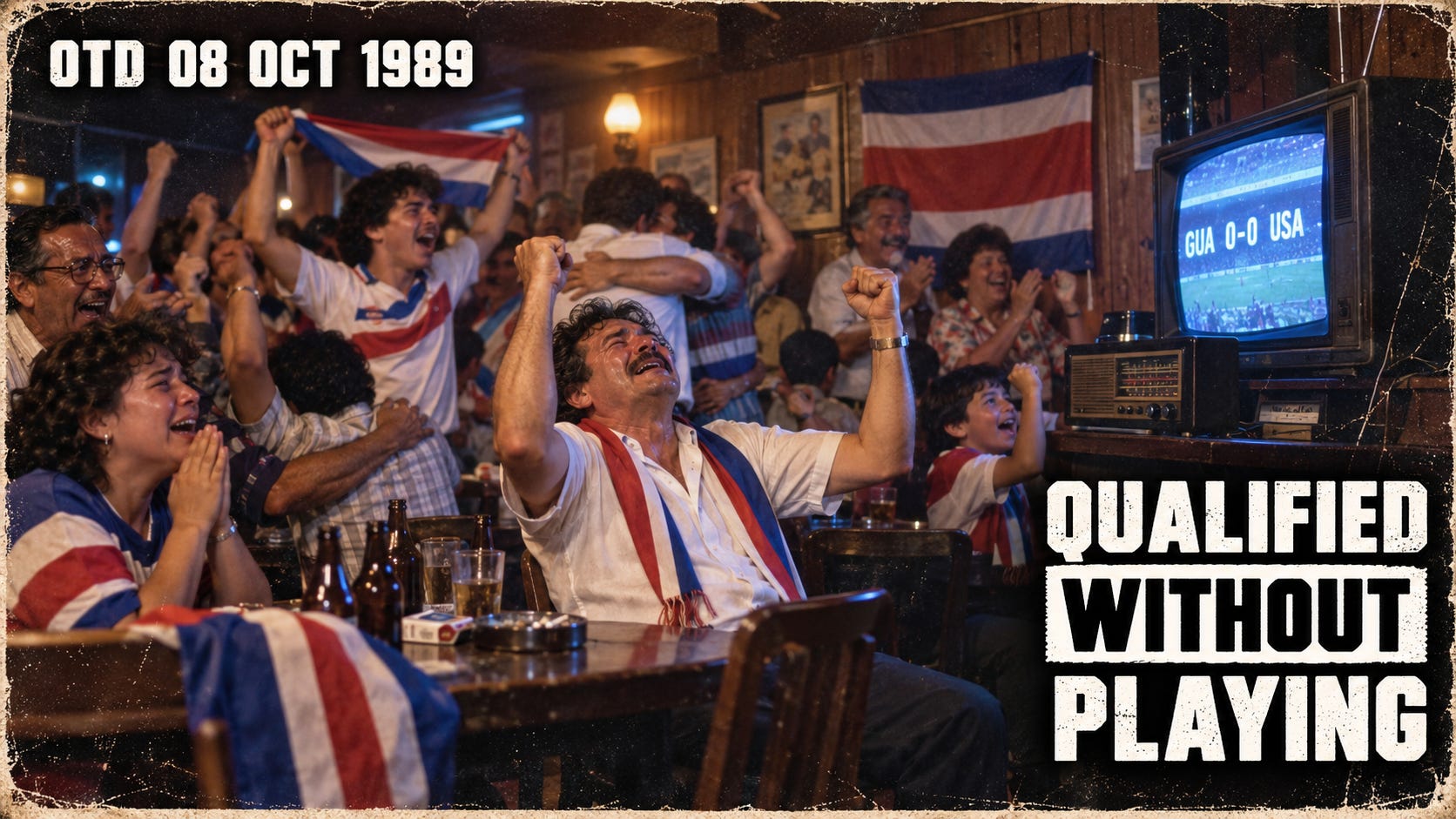
It is 08 October 1989, and Costa Rica are not playing.
Their footballers are scattered around San José and beyond, listening to radios, watching televisions, waiting on a match 850 kilometres away. At the Estadio Mateo Flores in Guatemala City, Guatemala are facing the United States. Costa Rica finished their own qualifying programme in July. They can do nothing now except count points and hope.
The match remains goalless. The minutes disappear. Then the final whistle travels south.
Guatemala 0, United States 0.
The arithmetic is suddenly irreversible. Whatever happens in the remaining fixtures, Costa Rica cannot fall below second place in the final CONCACAF group. For the first time, Los Ticos are going to a World Cup.
There has been no winning goal, no lap of honour, no team gathered beneath the floodlights. A country has reached football’s greatest tournament from its living rooms, bars and radios. Costa Rica have qualified without kicking a ball.
How did we get here?
Football had arrived in Costa Rica near the end of the nineteenth century through British residents, Caribbean railway and port communities, and Costa Ricans returning from Europe. At first it belonged to schools, plazas and improvised clubs. Club Sport La Libertad, founded in 1905, became the first great organizing force. Cartaginés followed in 1906, Alajuelense in 1919 and Herediano in 1921. Saprissa, founded in 1935, would later complete the quartet that came to dominate the national game.
The institutional beginning came on 13 June 1921, when seven clubs formed the Liga Nacional de Fútbol. The first championship started weeks later and Herediano, founded that same year, became the inaugural champion. Costa Rica also assembled its first national side for the Central American Independence Centenary Games in Guatemala.
Even that journey nearly failed. The new organization could not afford to send a full team. Private citizens and football officials supplied the missing money, and Costa Rica travelled with barely enough players. On 14 September 1921 they beat El Salvador 7-0, then defeated Guatemala 6-0 and returned as regional champions. The first national side had required a collection before it could become a champion.
Costa Rica joined FIFA in 1927 and became one of Central America’s strongest football nations. The national side won seven CCCF Championships between 1941 and 1961. The 1940s generation became known as *Los Chaparritos de Oro*, the Little Golden Men, admired for close control and combination play. Clubs toured the region, while exceptional players travelled farther. Alejandro Morera Soto became a star for Barcelona in the 1930s. José Rafael “Fello” Meza played in Mexico and Argentina. These were not isolated curiosities. They were proof that a small country could produce footballers for larger stages.
Yet the World Cup remained beyond reach. Costa Rica entered qualifying for 1958 and fell to Mexico. There were near misses in the 1960s, including the campaign for England 1966, when one defeat by Mexico proved decisive. Regional success did not translate easily into global access. CONCACAF often had only one place, and Mexico usually occupied it.
The domestic game developed unevenly. Professionalism was formally introduced in the late 1940s, but the word overstated the economic reality for many players. Even four decades later, internationals still held ordinary jobs alongside football. Captain Róger Flores worked at Hospital México. Defender Mauricio Montero worked at a petrol station. Training for a World Cup campaign had to coexist with shifts, families and employers.
There were signs of progress before 1989. Costa Rica won the inaugural CONCACAF Championship in 1963 and again in 1969. Saprissa, Alajuelense, Herediano and Cartaginés built fierce domestic rivalries. Alajuelense won the CONCACAF Champions’ Cup in 1986. The national side qualified for the Olympic tournaments of 1980 and 1984, and at Los Angeles 1984 beat Italy 1-0. Italy’s squad included Walter Zenga, Franco Baresi, Pietro Vierchowod and Aldo Serena. Costa Rica were no longer invisible. They were still waiting for the result that would change how the world saw them.
Qualification for Italia ’90 began against Panama in July 1988. A 1-1 home draw made the return leg uncomfortable, but Juan Cayasso scored after one minute in Panama City and Hernán Medford added a second. Costa Rica advanced 3-1 on aggregate.
Mexico should have been next. Instead, FIFA expelled the Mexicans from the qualifying competition after they used four over-age players in a youth tournament. The *Cachirules* scandal removed the region’s habitual giant and gave Costa Rica a passage into the five-country final round. It was an extraordinary opportunity, but not a gift. Two places were available among Costa Rica, the United States, Guatemala, El Salvador and Trinidad and Tobago. Eight matches would decide them.
Costa Rica began disastrously, losing 1-0 in Guatemala on 19 March 1989. Coach Gustavo De Simone was removed. Marvin Rodríguez, a former international who had coached club sides across Central America, took charge with Spaniard Antonio Moyano. The campaign already had the improvised quality of a national emergency.
Two weeks later, Costa Rica recovered. Róger Flores and Evaristo Coronado scored in a 2-1 home win over Guatemala. Gilberto Rhoden then supplied the only goal against the United States in San José. In St Louis, however, Tab Ramos scored as the Americans won 1-0. Costa Rica had two efforts disallowed and Héctor Marchena missed a penalty. Halfway through the group, nothing was secure.
The team’s strength was becoming visible. Luis Gabelo Conejo offered agility and personality in goal. Flores organized the defence beside Montero, Vladimir Quesada and Enrique Díaz. Germán Chavarría brought control in midfield. Cayasso and Coronado carried the scoring threat, with the young Medford’s speed waiting to break a match open. Most came from Saprissa and Alajuelense, so the national side contained rivalries as well as partnerships.
A 1-1 draw in Trinidad kept Costa Rica alive. Cayasso then scored in the opening minutes of the return match, and Conejo protected a 1-0 win. On 25 June came the campaign’s wildest afternoon. Costa Rica won 4-2 in El Salvador through Cayasso, Carlos Hidalgo and two goals from Leonidas Flores. The match was abandoned late after objects were thrown from the crowd following a disallowed Salvadoran goal. FIFA allowed the score to stand.
The final Costa Rican fixture took place on 16 July at the old Estadio Nacional. El Salvador resisted until the second half, when debutant Pastor Fernández headed the only goal. Supporters poured into celebration. Costa Rica had five wins, one draw and two defeats, ten goals scored and six conceded. Under the two-points-for-a-win system, they had eleven points.
But they were not yet mathematically qualified.
The United States had matches in hand. Guatemala could still move through the table. Costa Rica’s footballers returned to their clubs and their jobs, their eight-match campaign complete, while the rest of the group continued. Fernández, the man who scored the apparent qualifying goal, would not make the World Cup squad. Football had given him the decisive moment without guaranteeing him the reward.
Eighty-four days passed.
On 08 October, the United States went to Guatemala City. A victory would strengthen the Americans and preserve more routes by which Costa Rica could be overtaken. Guatemala needed points of their own. Instead, Tony Meola and Ricardo Piccinini kept clean sheets. John Harkes, Tab Ramos, Peter Vermes and Bruce Murray could not find a goal for the visitors. Guatemala could not find one either.
At 0-0, the permutations collapsed. Costa Rica were through.
The United States still had work to do and eventually qualified by beating Trinidad and Tobago on 19 November. Costa Rica finished level with the Americans on eleven points and won the 1989 CONCACAF Championship on goal difference. Their first World Cup place was therefore also a continental title, sealed not by a trophy presentation in San José but by silence in front of goal in Guatemala City.
Costa Rica were not the first country to receive a World Cup ticket without playing on the decisive day, although there are two very different versions of that phrase. In the early tournaments, nations could advance without playing any qualifier at all. Withdrawals sent Brazil, Cuba, Romania and the Dutch East Indies to the 1938 finals without kicking a ball in qualification. India reached the 1950 field after their prospective opponents withdrew, then withdrew themselves and never travelled to Brazil. The disorder became untenable. When Israel advanced through a succession of withdrawals in the 1958 preliminaries, FIFA refused to let a team reach the finals without playing and arranged a special play-off. Wales accepted the invitation, beat Israel home and away, and went to Sweden.
The modern version is less administrative and more dramatic. A team has already accumulated the required results, but the final proof arrives from somebody else’s match. Brazil’s 2018 place became certain only after Peru beat Uruguay on the night Brazil defeated Paraguay. Most recently, Argentina qualified for the 2026 World Cup while idle when Bolivia and Uruguay drew 0-0 on 25 March 2025, hours before the world champions were due to face Brazil. The players still did the work across a campaign; the calendar simply placed the clinching whistle elsewhere.
Costa Rica’s case remains unusually pure. They had not played earlier that day and did not play later. Their schedule had been finished for almost three months. On 08 October 1989, the national side’s only opponent was arithmetic.
So what?
Qualification altered the balance of power inside Costa Rican football immediately. Players who had combined international training with ordinary employment now possessed leverage. There were arguments over preparation, authority and money. Rodríguez, the coach who had taken the side through the final round, was replaced before the World Cup. César Luis Menotti was approached but did not take the job. In March 1990, the federation appointed Bora Milutinović, who had led hosts Mexico to the 1986 quarter-finals.
Bora had roughly three months to learn a squad drawn entirely from Costa Rican clubs. His methods were eccentric, but his central insight was simple: the team should not behave like grateful tourists. He tightened the defence, cultivated belief and used the country’s identity rather than disguising it. The travelling party even brought a gold image of the Virgen de los Ángeles, Costa Rica’s patron saint, to preside over the team hotel.
On 11 June in Genoa, Scotland discovered what that belief meant. Shortly after half-time, Claudio Jara’s backheel released Cayasso, whose low finish produced Costa Rica’s first World Cup goal and first World Cup victory. Conejo made the lead survive. Back home, former president Óscar Arias joined a parade of cars through San José.
Brazil won the second match 1-0 in Turin, but Costa Rica emerged with enhanced credibility. For that game they wore black-and-white stripes, an idea associated with Bora and presented as a tribute to La Libertad, the pioneering club founded in 1905. The shirt resembled Juventus in Juventus’s city, but its roots led home. Costa Rica wore it again against Sweden.
That third group match became the fuller expression of the breakthrough. Johnny Ekström put Sweden ahead. With fifteen minutes remaining, captain Flores headed the equalizer from a rehearsed free kick that Bora later joked had failed more than fifty times in training. Then substitute Medford sprinted clear and scored in the eighty-eighth minute. Costa Rica had beaten Sweden 2-1 and reached the last sixteen at their first attempt.
The reward was tangible. Reports from Italy put the players’ accumulated bonuses at about $11,000 each, roughly half a Costa Rican professional’s annual salary, plus the promise of a Japanese car. European intermediaries arrived at the hotel. Conejo moved to Albacete in Spain. Cayasso joined Stuttgarter Kickers in Germany. Medford began a career that would take him to Europe and Mexico. The World Cup did not invent Costa Rican talent; it changed who was willing to look for it.
There was one final cruelty. Conejo injured his thigh against Sweden and missed the second-round match. Czechoslovakia beat Costa Rica 4-1 in Bari, Tomáš Skuhravý scoring three headers. Rónald González’s equalizer briefly suggested one more miracle, but the run ended. It had already exceeded every reasonable expectation: two wins in four matches, a place among the final sixteen, and a national team that no longer needed explanation.
The breakthrough did not produce a straight ascent. Costa Rica missed the next two World Cups before returning in 2002. Since then, qualification became closer to an expectation: appearances in 2002, 2006, 2014, 2018 and 2022. The peak came in Brazil in 2014. Drawn with former world champions Uruguay, Italy and England, Costa Rica won the group, beat Greece on penalties and reached the quarter-finals unbeaten. Only another shootout, against the Netherlands, stopped them. Keylor Navas, the outstanding goalkeeper of that run, later won three consecutive European Cups with Real Madrid.
The clubs also converted regional strength into international credibility. Saprissa won three CONCACAF titles and finished third at the 2005 Club World Championship. Alajuelense added a second continental championship in 2004 to its 1986 triumph. Cartaginés won in 1994. Costa Rican clubs could not match Mexican money, and later had to contend with the growth of Major League Soccer, but they repeatedly demonstrated that organization and player development could narrow economic gaps.
That is the durable legacy of 1989. Costa Rica became CONCACAF’s most convincing small-country football model: a population smaller than many metropolitan areas, a competitive domestic culture, productive academies, players exported to Mexico, Europe and the United States, and a national side capable of reaching beyond its resources.
It is not a permanent entitlement. Costa Rica left the 2022 World Cup with one victory but also a 7-0 defeat by Spain. The old core aged. In qualifying for the expanded 2026 tournament, with more CONCACAF places available than ever, Los Ticos failed to make it. A 0-0 home draw with Honduras on 18 November 2025 eliminated both countries. As of July 2026, Costa Rica stood fifty-first in FIFA’s ranking, far below its high of thirteenth after the 2014 run.
The symmetry is uncomfortable and useful. In 1989, a goalless draw involving Guatemala and the United States opened the World Cup door. In 2025, another goalless draw closed it. Between those two scorelines lies almost the entire modern history of Costa Rican football: discovery, expectation, a generation of international careers, six World Cups and a quarter-final that made the 1990 surprise look less like an accident than a foundation.
Three things to take away
Costa Rica completed the work long before qualification became official. Their last match was the 1-0 win over El Salvador on 16 July. Guatemala’s 0-0 draw with the United States on 08 October finally made a top-two finish certain.
The first World Cup side reflected the country’s football economy. Every player in the Italia ’90 squad came from a domestic club, and several combined football with ordinary jobs. Their victories over Scotland and Sweden turned local excellence into an international market.
Italia ’90 changed the ceiling, not the difficulty. Costa Rica later reached five more World Cups and the 2014 quarter-finals, while its clubs won regional titles. Missing the expanded 2026 tournament shows that the model must continually renew itself.
On This Day...
On 08 October 1989, Tony Meola and Ricardo Piccinini guarded two goals in Guatemala City while an entire country waited hundreds of kilometres away. The match finished 0-0. No Costa Rican touched the ball, but when the final whistle crossed the radio waves, Costa Rica crossed into the World Cup.
This story was proposed to me by Jorge.
---
Questions, corrections or story ideas: otd@17lawsguy.com
Yesterday: 07 October 2000, The Last Dance Beneath Wembley’s Twin Towers