

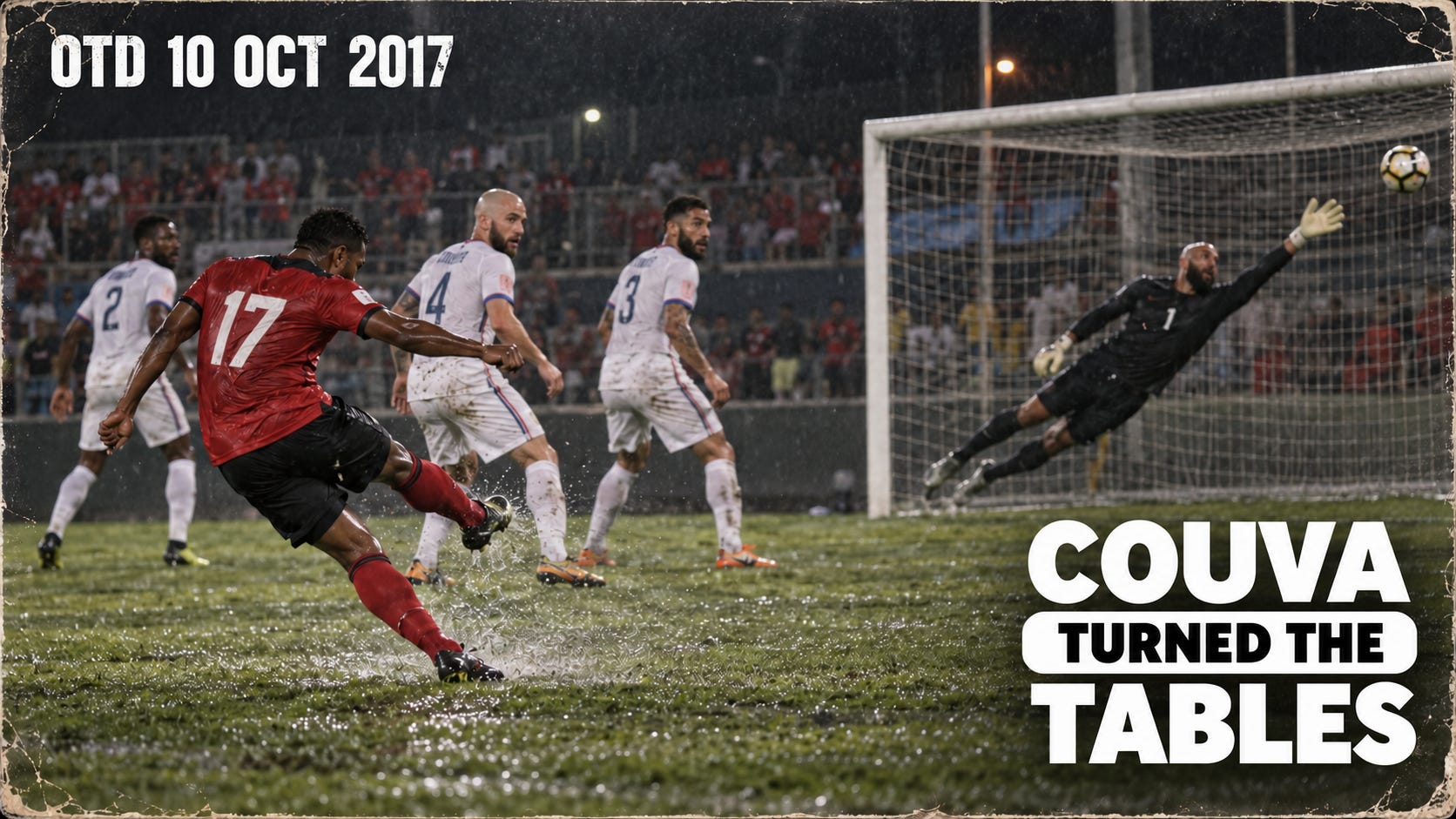
It is 10 October 2017, and Christian Pulisic is crouched on the grass at the Ato Boldon Stadium in Couva. He has scored, run until his legs emptied and spent the last minutes looking for one more opening. Now the whistle has gone. Around him, Trinidad and Tobago players celebrate a victory that cannot take them to the World Cup. It has kept the United States out.
The Americans needed a draw against the team at the bottom of the qualifying group. They have lost 2-1. Panama have beaten Costa Rica. Honduras have beaten Mexico. The only combination of results that could eliminate the United States has happened.
At the center of it stands Alvin Jones, a 23-year-old right-back from W Connection whose long-range shot has beaten Tim Howard. His father, Kelvin, was an unused substitute for Trinidad and Tobago on another decisive night against the United States, in 1989. That time, Paul Caligiuri scored from distance and the Americans went to the World Cup while Trinidad stayed home.
Twenty-eight years later, the son has reversed the pain. One country calls it Couva, a single place-name that means collapse. The other sees an old account finally settled.
How did we get here?
Football on the two islands was organized long before Trinidad and Tobago became an independent country. The Trinidad and Tobago Football Association was formed in 1908, five years before the present United States federation. Colonial clubs, military sides, schools and workplaces made the game part of local life. Independence arrived in 1962, membership of FIFA followed soon afterward, and the national team entered a regional order dominated by Mexico, with the United States still largely absent from serious international football.
Trinidad and Tobago came closest to a first World Cup in 1973. The final CONCACAF tournament was staged in Haiti, and the decisive match against the hosts became one of the region’s enduring scandals. Trinidad and Tobago lost 2-1 after several goals were disallowed; referee José Roberto Henríquez and assistant James Higuet were later banned for life. Haiti went to the 1974 World Cup. Trinidad and Tobago carried another story about a place at the finals being taken away.
The islands nevertheless became the Caribbean’s most successful national side. Trinidad and Tobago won the Caribbean championship eight times between 1989 and 2001. Russell Latapy brought invention, Stern John goals, Shaka Hislop authority and Dwight Yorke the class that would make him a European champion with Manchester United. The domestic game produced players but rarely had the money to keep them. The best moved into leagues in England, Scotland, Portugal and the United States.
The 1989 Strike Squad brought the country within one draw of Italy 1990. A sea of red filled the National Stadium in Port of Spain on 19 November. The United States had not appeared at a World Cup since 1950; Trinidad and Tobago had never qualified. Caligiuri’s dipping left-footed shot in the 30th minute decided it, 1-0. American soccer gained the result it needed just as the country prepared to host the 1994 World Cup. Trinidad and Tobago lost a generation’s great chance. Kelvin Jones watched from the bench.
For the United States, that shot became the beginning of the modern era. The federation had fielded a team at the first World Cup in 1930 and supplied one of the competition’s greatest upsets by beating England in 1950. Then it disappeared from the finals for four decades. Qualification in 1989, the enormous crowds at the 1994 World Cup and the launch of Major League Soccer in 1996 created a new structure. The national team reached the quarterfinals in 2002 and became a dependable World Cup participant, even if it never joined the elite.
Trinidad and Tobago finally reached the tournament in 2006. Leo Beenhakker’s team beat Bahrain in an intercontinental playoff, making the country of roughly 1.3 million people the smallest ever to qualify at the time. In Germany, Hislop excelled in a 0-0 draw with Sweden. England needed two late goals to beat the Soca Warriors, and Paraguay won 2-0, but the team left with its reputation enlarged. Yorke, Latapy, John, Hislop and Dennis Lawrence had taken the long route that the Strike Squad could not complete.
The gap widened afterward. The United States qualified for every World Cup from 1990 through 2014, won regional titles and increasingly selected players employed in Europe’s major leagues. Trinidad and Tobago did not return after 2006. By the 2018 cycle, the United States had Pulisic at Borussia Dortmund, Howard’s World Cup experience, and a squad drawn from MLS, England, Germany and Mexico. Trinidad and Tobago had players scattered through its domestic Pro League and lower-profile competitions abroad.
Yet the American campaign was already unstable. Jürgen Klinsmann’s team lost its first two matches in the final six-nation round, 2-1 at home to Mexico and 4-0 in Costa Rica. Klinsmann was dismissed, and Bruce Arena returned sixteen years after leading the United States to the 2002 World Cup quarterfinals. The repair looked successful. The Americans beat Honduras 6-0, drew in Panama and at the Azteca, defeated Trinidad and Tobago 2-0 behind two Pulisic goals, and won the 2017 Gold Cup.
Then the margins narrowed again. Costa Rica won 2-0 in New Jersey. Bobby Wood’s late goal rescued a 1-1 draw in Honduras. On 6 October, however, the United States demolished Panama 4-0 in Orlando. Pulisic scored, created another goal and left after 57 minutes with qualification apparently under control.
The table supported that confidence. Mexico and Costa Rica had already qualified. The United States were third with twelve points; Panama and Honduras had ten. A win or draw in Couva guaranteed Russia. Even a defeat would still leave the Americans at least in the playoff unless both Panama beat Costa Rica and Honduras beat unbeaten Mexico. ESPN’s model gave the United States a 93 percent chance of qualifying.
Trinidad and Tobago were last, with one win and eight losses. Stephen Hart had been dismissed after the opening Hexagonal defeats. Tom Saintfiet lasted little more than a month. Dennis Lawrence, scorer of the goal that secured the 2006 playoff victory over Bahrain, became the third coach of the campaign. His team had already been eliminated and he used young or inexperienced players.
Alvin Jones embodied the gamble. He had entered the previous qualifier against Honduras for his World Cup qualifying debut and been sent off within ten minutes. At club level he still played for W Connection. He had trialed unsuccessfully with Minnesota United. In Couva, Lawrence started him at right-back.
The venue added another layer. Problems with the floodlights at the larger Hasely Crawford Stadium moved the fixture to the 10,000-capacity Ato Boldon Stadium. Heavy rain left the field and surrounding track soaked. Images of American players being carried across standing water during training irritated some local observers, who felt that the visitors were treating Trinidad and Tobago as an inconvenience. A match that had attracted little local attention acquired an edge.
The announced attendance was small, estimates ranging from 1,500 to about 3,500, and the opening was scrappy. DeAndre Yedlin created the first clear chance in the seventh minute, beating Triston Hodge and finding Jozy Altidore, who shot over.
Trinidad and Tobago attacked the space around the American midfield diamond. Jones advanced from the right and crossed toward Shahdon Winchester. In the 17th minute he tried again. Omar González reached the ball first but sliced it over Howard and into his own net. Trinidad and Tobago led 1-0.
The United States still needed only an equalizer. Instead, in the 37th minute, Jones collected the ball in space more than thirty yards from goal. No American closed him. He looked up and drove a right-footed shot across Howard into the far corner. The goalkeeper stretched but never reached it. Jones raced away, the bench erupted, and the score became 2-0.
Just before halftime, Jones struck a long free kick that Howard spilled. Trinidad and Tobago nearly reached the interval three ahead.
Arena replaced Paul Arriola with Clint Dempsey, and the response came immediately. In the 47th minute, Darlington Nagbe carried the ball through midfield and found Pulisic. The teenager shifted it onto his right foot and shot from outside the area; a deflection off Kevan George took the ball beyond Adrian Foncette. At 2-1, one more American goal would restore the expected order.
Foncette saved from Yedlin. Dempsey struck the outside of a post from distance. Pulisic drove forward, Altidore searched for space and Arena sent on Kellyn Acosta and Benny Feilhaber. The home side defended with the concentration Lawrence had demanded. No second goal came.
All the while, the impossible combination assembled elsewhere. Costa Rica led Panama before Gabriel Torres was credited with an equalizer even though the ball did not appear to cross the line. Román Torres scored Panama’s winner in the 88th minute. Mexico twice led Honduras, but an own goal off Guillermo Ochoa and Romell Quioto’s winner made it 3-2.
When the whistle blew in Couva, the defeat and the two comebacks elsewhere had dropped the United States from third to fifth in the space of one evening.
So what?
Panama qualified for its first World Cup, finishing third on thirteen points. Honduras also reached thirteen, took fourth place on goal difference and entered the intercontinental playoff, where Australia beat them 3-1 on aggregate. The United States finished with twelve. A draw in Couva would have placed them third and sent them directly to Russia.
There was no disciplinary rescue. The Americans filed no protest capable of changing the result, and the controversial Panama goal was not reviewable under technology then used in qualifying. The consequences were sporting and professional rather than punitive. Arena resigned three days later and accepted responsibility. Sunil Gulati did not seek another term as federation president; Carlos Cordeiro succeeded him in February 2018 after an eight-candidate election.
The public reaction in the United States ranged from disbelief to fury. Television analyst Taylor Twellman repeatedly asked what the country was doing and attacked complacency throughout the system. Debate moved quickly from Arena’s lineup and the players’ urgency to youth soccer’s pay-to-play model, coaching education, MLS, the absence of promotion and relegation, and whether a wealthy country with millions of players should ever fail in CONCACAF.
The players did not hide. Michael Bradley said they had let themselves and their supporters down. González called the own goal one that would haunt him forever. Arena said the game had been perfectly positioned and offered no excuse. Pulisic, nineteen years old and already carrying much of the team’s attack, became the image of the ending.
Trinidad and Tobago’s response was different. The victory did not disguise a failed campaign, but it restored pride to one of Caribbean football’s great national teams. Lawrence praised ninety minutes of concentration. Jones connected the result explicitly to the Strike Squad and said his father’s generation could finally put 1989 to bed. Local coverage called it justice and redemption. The detail that made the story feel written was true: Kelvin Jones had watched Caligiuri’s shot from the bench; his son answered with another long-range goal.
The night did change the United States, although not as completely as the first outrage suggested. Dave Sarachan led a young interim team. U.S. Soccer created a men’s general manager position and appointed Earnie Stewart, who selected Gregg Berhalter as coach in December 2018. Howard, Dempsey, Bradley and Altidore gradually left the center of the team. Tyler Adams, Weston McKennie, Sergiño Dest, Antonee Robinson and other young players formed a new core around Pulisic.
The United States qualified for the 2022 World Cup with the tournament’s youngest squad by average age, then reached the round of sixteen. That recovery reflected changes already underway as much as reforms caused by Couva. MLS academies were producing more professionals, more teenagers were moving to Europe, and a larger player pool carried dual national backgrounds. Pay-to-play, fragmented youth governance and unequal access did not disappear because of one defeat. Couva accelerated a reckoning; it did not solve it.
Nor did the famous victory cure Trinidad and Tobago’s weaknesses. Jones earned a move to Oklahoma City Energy in the United States, but the national program continued to struggle. Financial and governance problems deepened. In 2020, FIFA installed a normalization committee after finding the association at serious risk of insolvency, then briefly suspended it during the resulting legal dispute. Trinidad and Tobago missed the 2022 World Cup and remained far from the level of the 2006 generation.
That is one of Couva’s harder lessons. A giant-killing can reveal talent and restore memory without repairing the institution behind the team. Trinidad and Tobago won the night and deserved every part of it. The United States absorbed the larger competitive consequence. Neither federation could treat the score as a substitute for structural work.
The rivalry supplied a final echo in November 2023. The United States won the first leg of a Nations League quarterfinal 3-0, then returned to Trinidad and Tobago. The Soca Warriors won the second leg 2-1, and Alvin Jones again scored from long range. This time the Americans advanced 4-2 on aggregate. Couva had become a warning they could survive, but Jones remained the man capable of reopening it.
Three things to take away
The result reversed 1989 with extraordinary precision. Paul Caligiuri’s long-range goal in Port of Spain took the United States to the 1990 World Cup and eliminated Trinidad and Tobago. In 2017, Alvin Jones, son of 1989 squad member Kelvin Jones, scored from distance as Trinidad and Tobago ended the Americans’ run of seven consecutive appearances.
The United States were eliminated by the only combination that could do it. They lost to the group’s last-place team while Panama came from behind to beat Costa Rica and Honduras came from behind to beat Mexico. Panama qualified directly, Honduras reached the playoff and the United States fell from third to fifth.
Couva forced a reset, not a revolution. Arena resigned, federation leadership changed, a general manager was appointed and a younger generation took over. The United States returned in 2022, but the deeper arguments about access, youth development and governance survived. Trinidad and Tobago gained a national memory while its institutional troubles continued.
On This Day...
On 10 October 2017, Alvin Jones found the space the United States had left him and struck from more than thirty yards. Tim Howard flew to his right. The ball did not bend away from history; it flew straight into it. In 1989, Kelvin Jones had sat on a Trinidad and Tobago bench while an American shot ended his World Cup dream. Twenty-eight years later, his son watched another long-range shot cross the line and turn the same story around.
---
Questions, corrections or story ideas: otd@17lawsguy.com
Yesterday: 09 October 1996, One Team in Tallinn.