

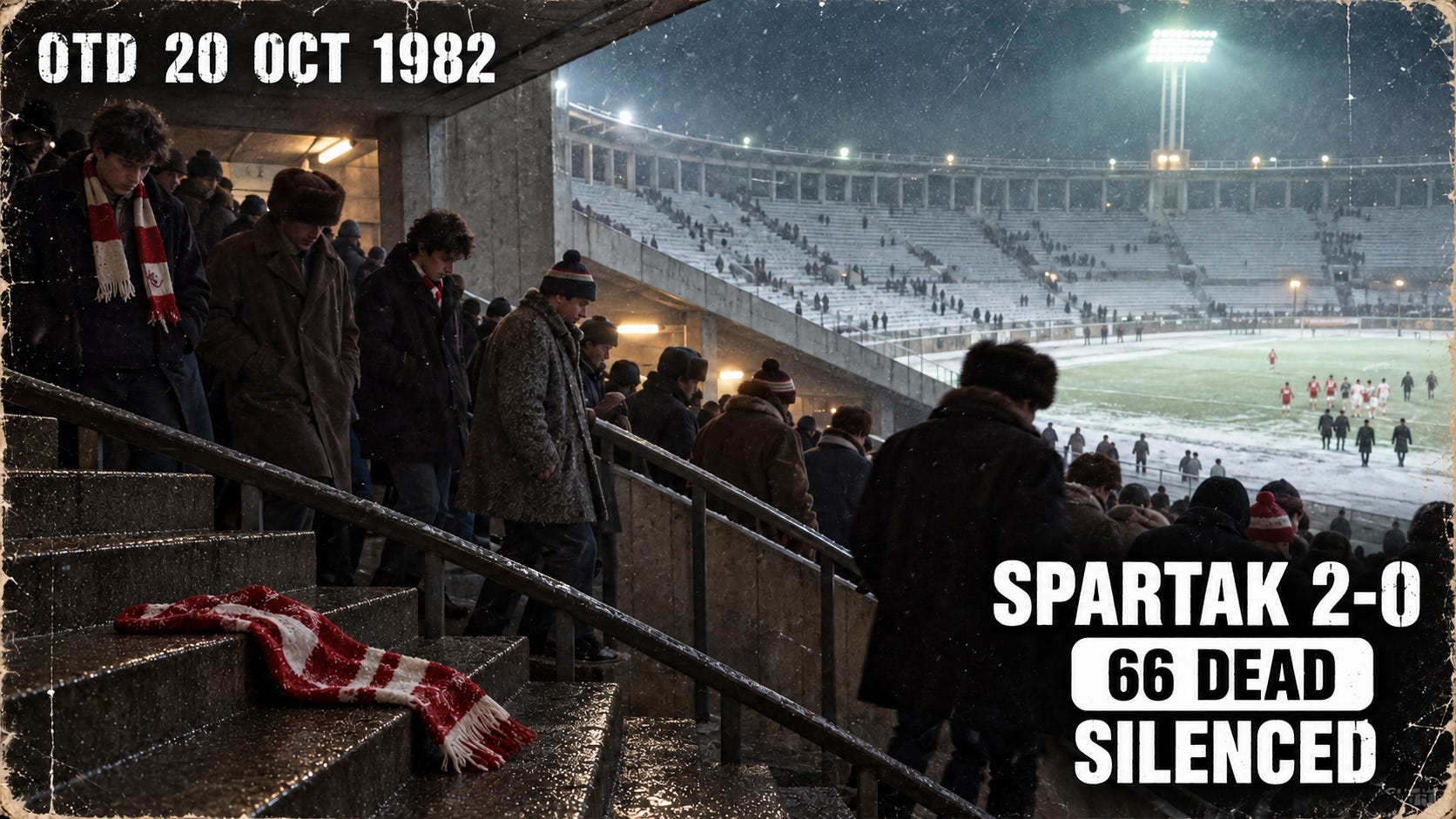
On the night of 20 October 1982, Spartak Moscow beat Haarlem 2-0 in the UEFA Cup.
That is the result in the record books. Edgar Gess scored the first goal. Sergei Shvetsov scored the second, very late. Spartak would win the return match in the Netherlands 3-1 and progress 5-1 on aggregate.
But the lasting fact of that Moscow night lies not in the scoreline, or even in the tie. It lies in a stairway at the Grand Arena of the Central Lenin Stadium, today’s Luzhniki. Sixty-six people, most of them young Spartak supporters, died in a crowd crush. Another 61 were injured.
For years, the Soviet state treated those deaths as if they were an administrative inconvenience: a thing to be reduced to a few evasive words, then removed from public life. The dead had families. Their friends had seen ambulances and bodies. The visiting Dutch team had heard the sirens. Yet a country that could fill an Olympic stadium, send a team into Europe and stage its modernity before foreign visitors could not bring itself to tell its own people what had happened.
That is why Spartak v Haarlem is more than a stadium-disaster story. It is a story about football crossing the Cold War frontier, and about what a closed state did when the game produced a truth it could not safely celebrate.
How Did We Get Here?
European club football in the early 1980s created a peculiar kind of passage between two systems. The UEFA Cup drew teams across borders that were otherwise hard, watched and politically charged. A Dutch club travelling to Moscow did not simply arrange flights, find a hotel and send a reporter to the ground. It entered a managed world.
Visitors required visas and formal invitations. Their movements were channelled through official hospitality and approved hotels. Translators and guides did more than help with menus. In the Soviet imagination, foreign visitors brought opportunity and danger together: foreign currency, prestige and a chance to display a successful socialist society, but also espionage, unsanctioned contact, embarrassing questions and the possibility that someone might decide not to go home.
The KGB’s remit joined intelligence, counter-intelligence, border control and political policing. Scholars of late Soviet travel have shown that diplomats and journalists attracted particularly close attention, but the larger point matters more than any spy-thriller cliché: the state treated contact itself as something to organise, observe and document. A foreign team, match officials and accredited press did not enter an empty political space. They entered an apparatus.
That did not mean every footballer was followed by a trench-coated operative, or every translator was an agent. It does mean that the normal liberal assumptions around a European away trip did not apply. The itinerary was part of the visit. The hotel was part of the visit. The access to local people was part of the visit. So was the exit.
Football had already shown why that mattered. In 1956, Budapest Honvéd travelled abroad for a European Cup tie just as the Hungarian uprising and Soviet intervention ruptured their country. The club’s great players were suddenly not merely athletes on an away trip. Ferenc Puskás, Zoltán Czibor and Sándor Kocsis were among those who did not return to the communist system. The European Cup had become an escape route, a family crisis and an international political problem.
That earlier OTD story matters here because it explains the texture of the world Haarlem entered. International football could not be sealed off from the Cold War. It created brief openings in a frontier designed to control openings. Clubs, players, referees and journalists carried news in both directions. To a state obsessed with loyalty, defection and foreign influence, that made a football tie something much larger than 90 minutes.
Spartak, meanwhile, carried a special cultural weight in Moscow. In a sporting system where clubs were closely associated with institutions, Spartak cultivated an identity as the people’s club rather than a representative of the army or security organs. Its European matches mattered. They offered Soviet supporters a direct comparison with the outside game, and they offered the authorities another carefully staged encounter with it.
Haarlem’s arrival was modest by the standards of the grand European names. The Dutch club had eliminated Gent in the first round. For Haarlem, the tie was an adventure and an achievement. The delegation travelled with players, staff, officials, a cook and an interpreter. Moscow greeted them with an abrupt early winter: deep snow, severe cold and a city whose scale could make a visitor feel very small.
On 20 October, the setting was the vast Central Lenin Stadium. It had been the great arena of the 1980 Olympics. It was built for enormous occasions and enormous crowds. This was not one. The temperature was close to minus 10°C, extraordinarily cold for October. Only a fraction of the available seats were sold, roughly 16,500 by the official account. Large areas of the stadium stood empty, snow-covered and dark.
That mismatch between building and occasion mattered. A huge stadium does not automatically make a crowd safe. Safety depends on how people are admitted, separated, directed and allowed to leave. Sparse attendance can create false confidence. It can also encourage an administration to concentrate spectators, reduce staffing or treat an exit as a simple flow problem.
The match itself was tight for most of the night. Haarlem resisted. Gess put Spartak ahead, but 1-0 was still a manageable deficit in a two-legged European tie. As the end approached, cold spectators began to leave. The conventional account is that a dense stream moved down Stairway No. 1 from the east stand toward the metro and warmth.
What followed has too often been reduced to a single neat explanation: Shvetsov scored; people turned back to celebrate; two human currents collided; people died. It is a powerful story, and Shvetsov himself later said he wished he had never scored. But it is not a complete investigation.
The late goal was an accelerant, not a verdict on causation. The available records and later testimony describe several conditions: bitter cold; people leaving before the final whistle; a constricted stairway; a dense movement of bodies; falls that created a blockage; and failures in crowd management. Later official material also complicates two durable claims: that the disaster occurred on a staircase glazed with ice, and that only one exit was open. Snow and ice were present in the stadium, but the covered stairway itself was reported dry; the later case materials said exits on the two operating stands had been opened, even though most people from the relevant sector still converged on one route.
Those distinctions matter because they restore human responsibility. “Panic” is often a word institutions use when they want a crowd, rather than a system, to carry the blame. The people on the stairway did not create the architecture, decide the routes, train the stewards or control the response.
With only seconds remaining, Shvetsov made it 2-0. The noise from the stadium travelled outward. Some supporters who had begun to leave appear to have turned, or at least the moving crowd became still more unstable. Somewhere in the compressed flow, people fell. Once bodies were down, the mass behind them could not see, could not stop and could not understand the scale of the catastrophe forming beneath its own pressure.
On the pitch, the game ended. In the dressing rooms, the players did not yet know. Gess later recalled that Spartak only understood something was wrong when they saw ambulances moving in the opposite direction on the way back to their training base. Haarlem’s captain, Martin Haar, recalled being hurried out of the stadium and then noticing the sirens from the team bus. The Dutch side had been beaten. It did not know that, nearby, a disaster was still being counted.
The next day, *Vechernyaya Moskva* printed a short notice. It said that, after the match, an accident had occurred because of disturbances in the movement of people; there had been casualties; an investigation was under way.
That was the public version. No number. No names. No account of the dead. The national sports press could report the football and omit the catastrophe beside it. Families were left to navigate hospitals, morgues, funerals and official discretion. In a state built on records, the record most people could see was almost blank.
The foreign world caught fragments. The small Moscow notice was picked up beyond the USSR. Dutch journalists at the match and the Dutch news agency ANP circulated an early report of three deaths and around 60 injured. Italian and Spanish papers carried it. Within days, Western reporting was describing a far more serious event; the *New York Times* reported that more than 20 people had died. Estimates then floated upward, because the Soviet authorities would neither confirm nor properly deny them.
This was the pre-mobile-phone, pre-internet reality of a closed story. There was no spectator video circulating overnight. No photographs from the stairway appearing on every screen. There was telephone, wire copy, diplomatic conversations, travellers’ observations, foreign broadcasts and rumour. Information left Moscow in scraps. Inside the Soviet Union, people heard more through foreign shortwave broadcasters, including Voice of America, than through the institutions that owed them an answer.
The concealment had a practical as well as political purpose. A mass death at the country’s showpiece stadium contradicted the image of order, competence and care. It risked scrutiny of police, stadium management and the local authorities. It also collided with a late-Brezhnev habit of governance: bad news was not always denied in a grand speech; it was often made administratively invisible.
There were consequences, but they were narrow and quiet. Criminal proceedings reached the stadium leadership. Director Viktor Kokryshev and stadium manager Yuri Panchikhin were convicted of negligence and received three-year prison sentences, the maximum available for that offence; Kokryshev was released early under an anniversary amnesty. Other responsible officials were investigated or charged. None of that was allowed to become a public national reckoning. The system could punish a few men without admitting what the wider system had done.
Then came glasnost.
In 1989, as Mikhail Gorbachev’s policy of openness loosened the old controls, *Sovetsky Sport* returned to Luzhniki. Its sensational investigation, published in the shadow of Hillsborough, alleged a far higher toll, including the figure of 340, and claimed that the scale had been concealed through practices such as multiple burials. That report performed an important service by breaking the public silence. But its most dramatic claims could not be substantiated.
The more durable revelation came from the reopened official investigation. Detective Aleksandr Shpeyer, who had led the 1982 case, stated in *Izvestia* that 66 people had died and 61 had been injured. The Moscow prosecutor’s office confirmed that total in 1989. *Sovetsky Sport* later acknowledged that its own larger figure rested on conjecture and that emotion had outrun fact.
That does not make 66 a small number, or the cover-up a minor one. It makes precision an obligation. The political crime was not merely that the state may have hidden an enormous number. It was that it hid the deaths it knew about: 66 people whose existence should never have been contestable.
So What?
The Luzhniki disaster belongs to a wider Eastern Bloc history in which football’s international fixtures exposed the limits of official narrative. Matches carried people across borders; they also carried stories across borders. When those stories were flattering, states welcomed them. When they were dangerous, states tried to control the frame.
Defection was the clearest example. Honvéd’s 1956 European Cup journey became inseparable from revolution, exile and the fragmentation of Hungary’s great team. In later decades, players from the Soviet bloc remained subject to restrictions that made a foreign trip emotionally and politically charged. A missed return flight could be a private choice, a public embarrassment and an intelligence concern at once.
But Luzhniki was different. Nobody defected. Nobody needed to cross a border to know the truth. The state tried to seal the story inside its own capital.
That is why the Haarlem connection matters. The Dutch visitors did not possess a full account on the night, and for years the club did not know what had occurred. Yet their presence meant the event could not disappear entirely. A foreign team had seen the abrupt departure, heard the ambulances and carried unease home. Foreign reporters caught the official euphemism. A small transnational network of people and publications kept the question alive until Soviet newspapers were permitted to ask it properly.
The event also teaches a broader lesson about crowd disasters. Football’s most memorable tragedies are regularly flattened into a fateful trigger: a goal, a gate, a flare, a charge, a mistake by someone in the crowd. The trigger is usually visible. The system is harder to see. At Luzhniki, Shvetsov’s goal became the unforgettable final moment because it was audible, dramatic and attached to one name. The real story is less tidy: infrastructure, routing, supervision, cold, compressed movement, falls and the inability of people in danger to communicate with those controlling the space.
And then there was the second failure: the refusal to let the public learn from the first.
Luzhniki now has a memorial. Spartak and Haarlem veterans met there in 2007 to commemorate the dead. Those gestures matter. They give the victims back a place in football history. But commemoration cannot turn uncertainty into licence for myth. The figure of 340 continues to circulate because silence created a vacuum, and vacuums invite numbers that feel morally satisfying. The historical task is more demanding: hold the state accountable for the suppression, identify the evidence that survives, and refuse to use the victims as props for a larger but unproven story.
On 20 October 1982, a UEFA Cup match brought a small Dutch club to Moscow and gave Spartak a 2-0 lead. By the next morning, the result was printed. The disaster was almost not.
That is what makes the night endure. Football was supposed to be the public event: floodlights, crowd, scoreline, foreign visitors, a European tie. Instead, the most important thing that happened was forced into private grief and coded language. For seven years, Soviet football’s worst disaster was not remembered as history. It was managed as a secret.
The score survived. The people did not disappear, although the state tried to make their deaths disappear from the story. That is why Spartak 2-0 Haarlem remains an argument about more than a late goal and a UEFA Cup tie. It is a reminder that football can bring a closed system into contact with the wider world, but it cannot by itself make that system tell the truth.
Three Things to Take Away
1. The disaster at Luzhniki killed 66 people and injured 61. The later figure of 340 was widely repeated after a 1989 investigation, but it could not be substantiated and should not be treated as fact.
2. The Soviet authorities did not wholly erase the disaster: there was a brief Moscow notice and quiet criminal proceedings. They did, however, suppress the names, scale and public reckoning that the victims’ families deserved.
3. The European Cup and UEFA Cup made Cold War borders briefly porous. Teams, referees and journalists could cross them, carrying football, rumours and sometimes truths that states struggled to contain.
On This Day...
On 20 October 1982, Spartak Moscow beat Haarlem 2-0 in a UEFA Cup tie at the Central Lenin Stadium. Edgar Gess scored first. Sergei Shvetsov added the late goal. On a stadium stairway, 66 people died in a crowd crush and 61 were injured. The score was published. The disaster was scarcely named. Seven years later, glasnost began to expose a tragedy the Soviet state had tried to keep out of public memory.
Questions, corrections or story ideas: otd@17lawsguy.com
Yesterday: 19 October 1908, When Nations First Played at the Olympics.